
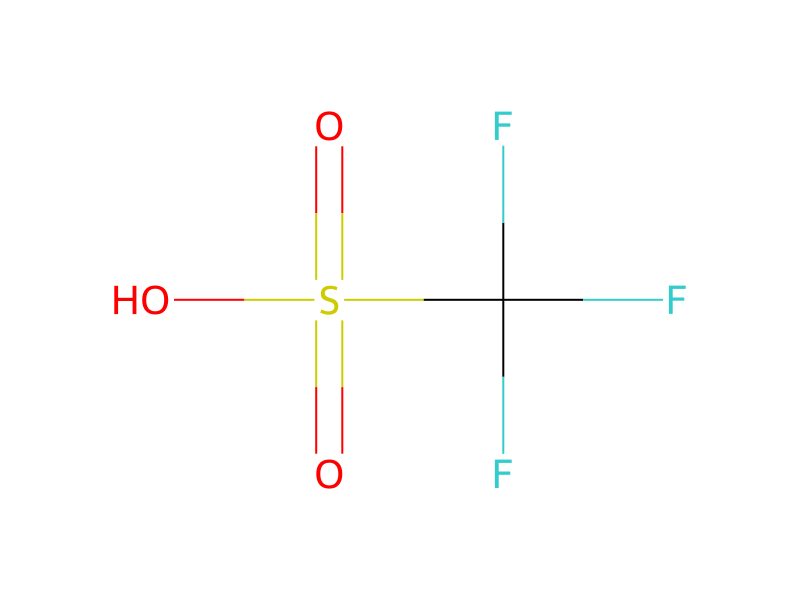
基本情報
- 標準SMILES
O=S(=O)(O)C(F)(F)F- InChIKey
ITMCEJHCFYSIIV-UHFFFAOYSA-N- 分子式
- CHF3O3S
- 平均分子量
- 150.08 g/mol
概要
Triflic acid is a one-carbon compound that is methanesulfonic acid in which the hydrogens attached to the methyl carbon have been replaced by fluorines. It is a perfluoroalkanesulfonic acid and a one-carbon compound. It is a conjugate acid of a triflate.
名称と識別子
- 優先名称
- Trifluoromethanesulfonic acid
- IUPAC
- trifluoromethanesulfonic acid
- 現地名
- トリフルオロメタンスルホン酸
- 英語名
- Trifluoromethanesulfonic acid
- 分子式
- CHF3O3S
- 分子量
- 150.08
名称と別名
Trifluoromethanesulfonic acid1493-13-6Triflic acidPerfluoromethanesulfonic acidTrifluoromethanesulphonic acidtfmsaTrifluoromethane sulfonic acidTfOHDTXSID2044397HOTfJE2SY203E8Trifluormethansulfonsaeure
名称をさらに表示
トリフルオロメタンスルホン酸フルオラードFC-24三フッ化メタンスルホン酸ペルフルオロメタンスルホン酸トリフラートトリフル酸トリメシラートトリフルオロメタンスルホン酸, 99+%Triflatetrifluorormethanesulfonic acidTFMStrifluoromethanesulfonictriflic
DTXCID0024397CHEBI:485111,1,1-trifluoromethanesulfonic acidAgOTf cpdCu(OTf)2Eu(OTf)3TFMSA cpdRefChem:191595
データベース識別子
- CAS
1493-13-6- PubChem CID
- 62406
- DTXSID
DTXSID2044397- ChEMBL
CHEMBL1236265- ChEBI
CHEBI:48511- UNII
- JE2SY203E8
- EC Number
- 216-087-5
- Nikkaji
- J12.301C
物性
構造計算による物性
- XLogP
- 0.3
- 極性表面積
- 62.8 Ų
- 水素結合供与体数
- 1
- 水素結合受容体数
- 6
- 回転可能結合数
- 0
- 重原子数
- 8
- 形式電荷
- 0
- 複雑度
- 158
実験および物理化学的性質
Chemical Classes
Other Classes -> Organic Acids
Ionic Liquids -> Fluorinated Ionic Liquids
Ionic Liquids
PFAS
PFAS -> Perfluorosulfonic acids
PFAS -> Ultra Short Chain PFsulfonic acids
PFAS -> PFAS identified in REACH Regulation EC No. 1272/2008
PFAS -> Suspected persistent, mobile, toxic (PMT) PFAS or PFAS-like compounds
PFAS -> PFAS with analytical method available
SpringerMaterials PropertiesSchoenflies notation
Food AdditivesUse unspecified -> FDA Substance added to food
Density1.696 @25 °C
Boiling Point162 °C @760 [mm Hg]
Melting Point-40 °C
Physical Description
Liquid
Colorless hygroscopic liquid; [Merck Index]
Collision Cross Section110.8 Ų [M-H]- [CCS Type: DT; Buffer gas: N2; Ionization: ESI-; Dataset: TOXCAST; Source Identifier: DTXSID2044397]
物理化学的性質
- 融点
- -40 °C · -40 °C
- 沸点
- 162 °C · 162 °C (lit.)
- 比重(密度)
- 1.696 g/mL · 1.696 g/mL at 25 °C (lit.)
- 蒸気密度
- 5.2 · 5.2 (vs air)
- 蒸気圧
- 8 mm · 8 mm Hg ( 25 °C)
- 屈折率
- 20 · n20/D 1.327(lit.)
- 闪点
- None
- 貯蔵温度
- 30 °C · Store below +30°C.
- 溶解性
- 2 Oに混和性 · H 2 Oに混和性
- 酸解離定数(Pka)
- -14 · -14(at 25℃)
- 外見
- 発煙液
- 比重
- 1.696 · 1.696
- 色
- やや茶色
- PH
- 1 · <1 (H2O)
- 水溶解度
- 溶ける
- Merck
- 14 · 14,9676
- BRN
- 1812100 · 1812100
- 安定性
- 安定。酸、アルカリ、金属と相容れない。
- InChI
- 1S/CHF3O3S/c2-1(3,4)8(5,6)7/h(H,5,6,7)
- InChIKey
- ITMCEJHCFYSIIV-UHFFFAOYSA-N
- SMILES
- OS(=O)(=O)C(F)(F)F
- LogP
- 0.3 at · 0.3 at 25℃
- CAS データベース
- 1493 · 1493-13-6(CAS DataBase Reference)
- NISTの化学物質情報
- 3 SO3H · CF3SO3H(1493-13-6)
- EPAの化学物質情報
- Methanesulfonic acid, trifluoro- (1493-13-6)
化学的性質
化学性质強酸(pK 約~14)
安全と法規制
GHS分類
GHS Classification
Danger
H290 (92.8%): May be corrosive to metals [Warning Corrosive to Metals]
P234, P260, P261, P264, P270, P271, P280, P301+P317, P301+P330+P331, P302+P361+P354, P304+P340, P305+P354+P338, P316, P319, P321, P330, P363, P390, P403+P233, P405, P406, and P501 (click each P-code to see the statement)
Aggregated GHS information provided per 2365 reports by companies from 34 notifications to the ECHA C&L Inventory. Each notification may be associated with multiple companies.
Warning
H319: Causes serious eye irritation [Warning Serious eye damage/eye irritation]
危険有害性情報
Regulatory Information
Chemical: Methanesulfonic acid, trifluoro-
Methanesulfonic acid, 1,1,1-trifluoro- is listed on the EPA's Chemical Data Reporting (CDR) system. Manufacturers and importers of Methanesulfonic acid, 1,1,1-trifluoro- are required to report information about their production and use of this chemical to the EPA under the Toxic Substances Control Act (TSCA). (40 eCFR Part 711)
Status: Active Update: 03-11-2021 https://echa.europa.eu/registration-dossier/-/registered-dossier/5311
Trifluoromethanesulphonic acid: Does not have an individual approval but may be used under an appropriate group standard
Hazards Summary
Highly corrosive to skin; [Quick CPC] One of the strongest acids known. May cause burns; [Merck Index] Oral LD50 (rat) is between 500 and 2,000 mg/kg; An acute dermal toxicity study of rats at 2,000 mg/kg produced extensive and severe local skin effects considered to be life threatening; 50 mg/kg doses were tolerated and showed no significant adverse effects at necropsy; No evidence of skin sensitization in guinea pigs; No evidence of mutagenicity; [EPA TSCA] Causes burns; Inhalation of high concentration can cause chemical pneumonitis; [Alfa Aesar MSDS]
Hazard Classes and Categories
Met. Corr. 1 (92.8%)
Serious eye damage/eye irritation - Category 2A-2B
安全と保護具
Protective Action Criteria (PAC)
4.8 [mg/m3]
53 [mg/m3]
320 [mg/m3]
毒性情報
Health Effects
Silver itself is not toxic to humans, but most silver salts are. In large doses, silver and compounds containing it can be absorbed into the circulatory system and become deposited in various body tissues, leading to argyria, which results in a blue-grayish pigmentation of the skin, eyes, and mucous membranes. Argyria is rare, and although, so far as known, this condition does not otherwise harm a person's health, it is disfiguring and usually permanent. Mild forms of argyria are sometimes mistaken for cyanosis. (L809)
Adverse EffectsDermatotoxin - Skin burns.
Exposure RoutesOral (L808) ; inhalation (L808) ; dermal (L808)
Toxicity Summary
Metallic silver is oxidized and may deposit in the tissues, causing arygria. The silver ion is known to inhibit glutathione peroxidase and NA+,K+-ATPase activity, disrupting selenium-catalyzed sulfhydryl oxidation-reduction reactions and intracellular ion concentrations, respectively. Silver nanoparticles are believed to disrupt the mitochondrial respiratory chain, causing oxidative stress, reduced ATP synthesis, and DNA damage. (L808, A243, A244, A245, A246)
Signs and Symptoms
Exposure to high levels of silver for a long period of time may result in a condition called arygria, a blue-gray discoloration of the skin and other body tissues. Argyria is a permanent effect but does not appear to be harmful to health. Exposure to high levels of silver in the air has resulted in breathing problems, lung and throat irritation, and stomach pains. Skin contact with silver can cause mild allergic reactions such as rash, swelling, and inflammation in some people. (L808)
Carcinogen ClassificationNo indication of carcinogenicity to humans (not listed by IARC).
安全データ
- F
- 3-10
- wgk
- 2
- tsca
- TSCA listed
- ridadr
- UN 3265 8/PG 2
- 毒性
- LD50 orally in Rabbit: 1605 mg/kg LD50 dermal Rat > 2000 mg/kg
- hs_code
- 29049020
- risk_code
- 21/22-35-10
- 化審法
- (2)-2809
- hazard_code
- C
- hazard_note
- Corrosive/Hygroscopic
- safety_code
- 26-36/37/39-45
- hazard_class
- 8
- packing_group
- II
- 毒劇物取締法
- 劇物
- Hazard Classifications
- Acute Tox. 4 OralMet. Corr. 1Skin Corr. 1BSTOT SE 3
- ストレージクラス
- 8A - Combustible corrosive hazardous materials
化学と産業
薬理情報
Metabolism/Metabolites
Silver and its compounds can be absorbed via inhalation, while silver compounds can also be absorbed orally and dermally. It distributes throughout the body in the blood, particularily to the liver. Insoluble silver salts are transformed into soluble silver sulfide albuminates, bind to amino or carboxyl groups in RNA, DNA, and proteins, or are reduced to metallic silver by ascorbic acid or catecholamines. Metallic silver is oxidized and may deposit in the tissues, causing arygria. Silver is eliminated primarily in the faeces. (L808)
用途と製造
Uses
Used as a catalyst, solvent for ESR, acid titrant, and with trifluoroacetic acid in peptide synthesis; [Merck Index]
Silver trifluoromethanesulfonate is used in inorganic and organometallic chemistry to replace halide anions or ligands. (L833)
U.S. Production2023: 26,136 lb
Industry UsesNot Known or Reasonably Ascertainable
Use ClassificationPFAS -> Ultra Short Chain PFsulfonic acids
General Manufacturing Information
Not Known or Reasonably Ascertainable
Methanesulfonic acid, 1,1,1-trifluoro-: ACTIVE
応用分野
解説トリフルオロメタンスルホン酸,トリフルオロメタンスルホンサン,CHF3O3S(150.07).CF3SO3H.略称TFSA.メタンスルホニルクロリドの電解フッ素化によって得られるトリフルオロメタンスルホニルフルオリドの加水分解で合成される.無色の液体.融点-34 ℃,沸点162 ℃.d251.698.空気中で白煙を生じ,一水和物結晶になる.水,有機溶媒に可溶.硫酸より強い超強酸の一種で,有機合成反応触媒として用いられる.皮膚や眼をはげしく刺激する.
用途有機合成原料(重合触媒、スルホン化剤、脱水剤)、溶媒(たん白質、ポリマー)。
用途試薬,触媒,医薬,農薬原料
使用A cost-effective process for synthesizing daidzein was developed by Hai Cao and colleagues[1]. A two-step synthesis of daidzein (Friedel–Crafts acylation and [5+1] cyclization) was developed via the employment of trifluoromethanesulfonic acid (TfOH) as an effective promoting reagent. Due to the facilitating effect of TfOH, the Friedel–Crafts acylation was completed within 10 min at 90 °C and the [5+1] cyclization was completed within 180 min at 25 °C.
一般的な説明Trifluoromethanesulfonic acid is a strong organic acid. It can be prepared by reacting bis(trifluoromethylthio)mercury with H2O2. On mixing with HNO3, it affords a nitrating reagent (a nitronium salt). This reagent is useful for the nitration of aromatic compounds. Its dissociation in various organic solvents has been studied.
上流・下流製品情報
上流原料
下流製品
サプライヤー50 社
国药集团化学试剂有限公司86-21-63210123 · [email protected]
梯希爱(上海)化成工业发展有限公司021-67121386 · [email protected]
上海阿拉丁生化科技股份有限公司400-6206333 13167063860 · [email protected]
中船(邯郸)派瑞特种气体股份有限公司021-53930372 13917175395
INTATRADE GmbH+49 3493/605464 · [email protected]
T&W GROUP021-61551611 13296011611 · [email protected]
爱斯特(成都)生物制药股份有限公司+86-28-85122536 85324413 · [email protected]
科瑞迪化学400-821-5857 021-64326257 · [email protected]
Syntechem Co.,Ltd[email protected]
上海迈瑞尔生化科技有限公司4006356688 18621169109 · [email protected]
宇瑞(上海)化学有限公司02150456736 18602143071 · [email protected]
Wuhan EnTai Technology Development Co,.Ltd86-27-82330560 · [email protected]
天津中信凯泰化工有限公司022-66880623 · [email protected]
阿法埃莎(中国)化学有限公司400-6106006 · [email protected]
安耐吉化学&3A(安徽泽升科技股份有限公司)400-0056266 · [email protected]
石家庄斯迪亚诺精细化工有限公司0311-89250318 13582355795 · [email protected]
武汉凯威斯科技有限公司86-027-67849912 · [email protected]
上海瀚鸿科技股份有限公司021-54306202 13764082696 · [email protected]
上海相辉医药科技有限公司13761987713 · [email protected]
上海景颜化工科技有限公司13817811078 · [email protected]
嘉兴市艾森化工有限公司0573-85285100 18627885956 · [email protected]
池州捷峰生物科技有限公司0566-8928158 · [email protected]
南京哈柏医药科技有限公司13376080562 13376090521 · [email protected]
雅帝興業有限公司+86-561-5269788, 5209788
上海长根化学科技有限公司021-69106814 13917161715
上海忆嵘生物科技有限公司18049974220 · [email protected]
孝感深远化工有限公司15527621225; 15527621225 · [email protected]
江西国化医药科技有限公司0794-7183888 13155888520
山东西亚化学有限公司13355009207 13355009207 · [email protected]
玛雅试剂+86 (573) 82222445 (0)18006601000 452520369 · [email protected]
四川库利南科技有限公司400-1166-196 18981987031 · [email protected]
天津希恩思生化科技有限公司400 638 7771 · [email protected]
武汉科美沃化工有限公司027-85736489 · [email protected]
湖南汇百侍生物科技有限公司0731-85526065 13308475853 · [email protected]
南京维奥化工有限公司Please Send Email 18652950785 · [email protected]
武汉华邦化学新材料有限公司027-83229541 13971313286 · [email protected]
河南多贝化工有限公司0370-2785118 17550508557 · [email protected]
斯百全化学(上海)有限公司021-021-021-67601398-809-809-809 15221380277 · [email protected]
北京泰亚杰科技有限公司021-33690831-8001 13552411790;18616022633 · [email protected]
武汉海正工贸发展有限公司027-8866 0053/88660577/88660578
艾科试剂4008-755-333 18080918076 · [email protected]
上海思域化工科技有限公司86-21-34053660 · [email protected]
苏州思变化学技术有限公司0512-65617459 18915409046 · [email protected]
赛默飞世尔科技(中国)有限公司800-810-5118 · [email protected]
北京伊诺凯科技有限公司400-810-7969 010-59572699 · [email protected]
上海特伯化学科技有限公司+86-21-60341587 · [email protected]
上海健超生物科技有限公司150-2103-5486 18017383231 · [email protected]
TOKYO CHEMICAL INDUSTRY CO., LTD.03-36680489 · [email protected]
上海贤鼎生物科技有限公司4009209199 · [email protected]
上海柏懿化工有限公司+86-21-54380268
補足説明
定義ChEBI: Trifluoromethanesulfonic acid is a one-carbon compound that is methanesulfonic acid in which the hydrogens attached to the methyl carbon have been replaced by fluorines. It is a one-carbon compound and a perfluoroalkanesulfonic acid. It is a conjugate acid of a triflate.
関連反応
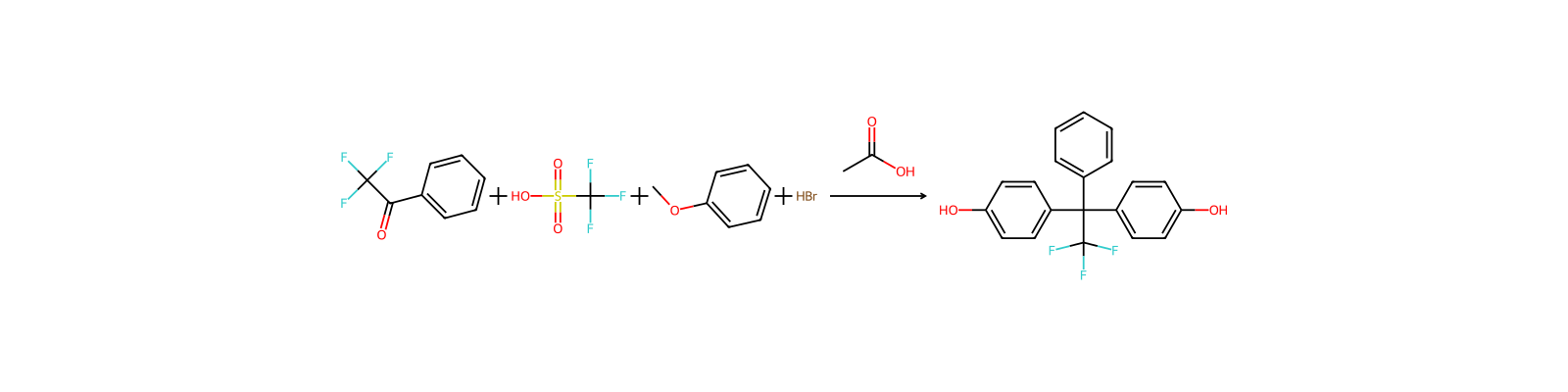
1,687 件




関連ノート
読み込み中…