
HRID 36865反応物として
Potassium Chlorate
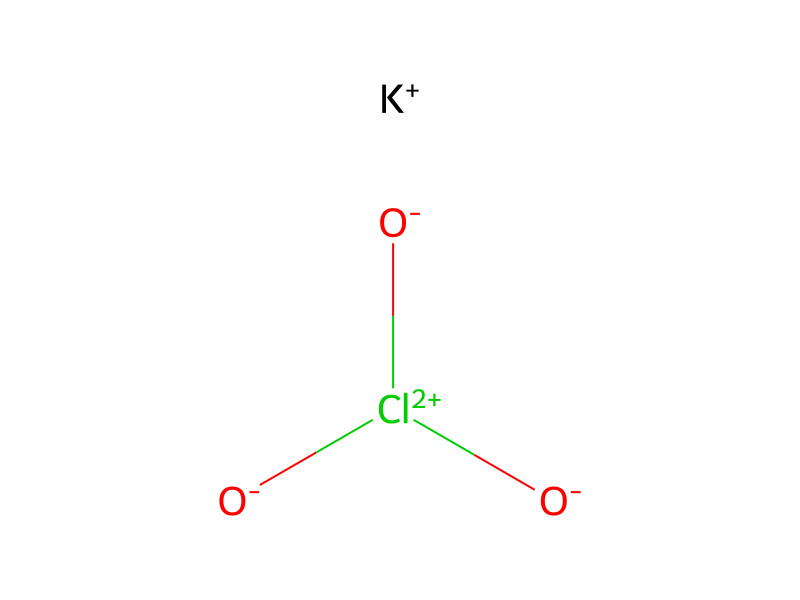
3811-04-9[K+].[O-][Cl+2]([O-])[O-]VKJKEPKFPUWCAS-UHFFFAOYSA-MPotassium chlorate appears as a white crystalline solid. Forms a very flammable mixture with combustible materials. Mixture may be explosive if combustible material is very finely divided. Mixture may be ignited by friction. Contact with strong sulfuric acid may cause fires or explosions. May spontaneously decompose and ignite when mixed with ammonium salts. May explode under prolonged exposure to heat or fire. Used to make matches, paper, explosives, and many other uses.
3811-04-9DTXSID6047448CHEMBL3188561Other Classes -> Inorganic Oxidizing Agents
Reactive agents - 1st degree
Cosmetic ingredients (Potassium Chlorate) -> CIR (Cosmetic Ingredient Review)
Oxidising
2.34 at 68 °F (USCG, 1999) - Denser than water; will sink
2.32 g/cu cm
2.3 g/cm³
2.29 @25 °C
Colorless, lustrous crystals or white granules or powder
White monoclinic crystals
8.61 g/100 g water at 25 °C
1 g dissolves slowly in 16.5 ml water, 1.8 ml boiling water, about 50 ml glycerol; almost insol in alcohol
SLIGHTLY SOL IN LIQUID AMMONIA; INSOL IN ACETONE; SOL IN ALKALIES
In water, 70,000 mg/L at 25 °C
Solubility in water, g/100ml: 7.3
Decomposes on heating above 400 °C, on contact with strong acids producing toxic fumes including chlorine dioxide, chlorine fumes and producing oxygen.
Above the melting point it decomposes into perchlorate and oxygen. Emits toxic fumes of chlorine and potassium oxide when heated to decomposition.
When heated to decomposition it emits very toxic fumes of /hydrogen chloride/ and K2O.
When mixed with ammonium salts, spontaneous decomposition and ignition may result.
400 °C
680 °F (USCG, 1999)
368 °C
Decomposes into perchlorate and oxygen above melting point; explodes with sulfuric acid; inflames with explosion if tritruated with any organic substance, sulfur, phosphorus, sulfite, hypophosphite, and other oxidizable substances
368 °C
357 °C
Potassium chlorate appears as a white crystalline solid. Forms a very flammable mixture with combustible materials. Mixture may be explosive if combustible material is very finely divided. Mixture may be ignited by friction. Contact with strong sulfuric acid may cause fires or explosions. May spontaneously decompose and ignite when mixed with ammonium salts. May explode under prolonged exposure to heat or fire. Used to make matches, paper, explosives, and many other uses.
Potassium chlorate, aqueous solution appears as a colorless liquid. Denser than water. Contact may irritate skin, eyes and mucous membranes. May be toxic by ingestion. Used to make other chemicals. Ignites organic materials upon contact.
Clear liquid; [CAMEO]
COLOURLESS CRYSTALS OR WHITE POWDER.
化学的特性Potassium chlorate, KCI03, is transparent, colorless crystals or a white powder that is soluble in water,alcohol, and alkalies,and has a melting point of 356 °C.Used as an oxidizing agent,for explosives and matches, and in textile printing and paper manufacture.
安全情報は参考情報です。供給元の安全データシート(SDS)、適用法令、専門家による評価に代わるものではありません。
Danger
H271: May cause fire or explosion; strong Oxidizer [Danger Oxidizing liquids; Oxidizing solids]
P210, P220, P264, P270, P280, P283, P301+P316, P306+P360, P321, P330, P370+P378, P371+P380+P375, P405, P420, and P501 (click each P-code to see the statement)
Danger
H271 (99.2%): May cause fire or explosion; strong Oxidizer [Danger Oxidizing liquids; Oxidizing solids]
P210, P220, P261, P264, P270, P271, P273, P280, P283, P301+P316, P301+P317, P304+P340, P306+P360, P317, P321, P330, P370+P378, P371+P380+P375, P391, P405, P420, and P501 (click each P-code to see the statement)
Chemical: Chloric acid, potassium salt
REACH registered substance: Potassium chlorate (EC: 223-289-7)
Chloric acid, potassium salt: HSNO Approval: HSR001337 Approved with controls
The New Jersey Worker and Community Right to Know Act requires public and private employers to provide information about hazardous substances at their workplaces. (N.J.S.A. 34:5A-1 et. seq.)
Oxidizer
Oxidizer
Special Hazards of Combustion Products: Toxic fumes are formed in fires.
Excerpt from ERG Guide 140 [Oxidizers]:
CAUTION: Ammonium nitrate products may explode if involved in fire or contaminated with hydrocarbons (fuels), organic matter, other contaminants or when hot molten and contained. Treat as an explosive (GUIDE 112).
CAUTION: Ammonium nitrate products may explode if involved in fire or contaminated with hydrocarbons (fuels), organic matter, other contaminants or when hot molten and contained. Treat as an explosive (GUIDE 112).
Not combustible but enhances combustion of other substances. Gives off irritating or toxic fumes (or gases) in a fire. Risk of fire and explosion on contact with organic materials, powdered metals, ammonium salts, combustible substances or reducing agents.
Not flammable, but may cause fire upon contact with ordinary combustibles.
THEY ARE NOT THEMSELVES EXPLOSIVE BUT THEY FORM FLAMMABLE OR EXPLOSIVE MIXTURES WITH ORG MATTER, SULFUR, SULFIDES, POWDERED METALS & AMMONIUM COMPD. CLOTH, LEATHER, WOOD & PAPER ARE EXTREMELY FLAMMABLE WHEN IMPREGNATED BY...CHLORATES. /CHLORATES/
Potassium chlorate is flammable and forms explosive mixtures with combustible materials (sulfur, sugar, etc) ... .
Inhalation of dust can irritate nose and throat. Contact with eyes or skin causes irritation. Ingestion causes abdominal pain, nausea, vomiting, cyanosis, collapse. (USCG, 1999)
Excerpt from ERG Guide 140 [Oxidizers]:
· Inhalation, ingestion or contact (skin, eyes) with vapors or substance may cause severe injury, burns or death.
· Inhalation, ingestion or contact (skin, eyes) with vapors or substance may cause severe injury, burns or death.
A skin and eye irritant; toxic by ingestion; [CAMEO] Irritating to the G.I. tract and can cause blood hemolysis and methemoglobinemia; [Merck Index] A respiratory tract irritant; [ICSC] Very toxic after ingestion with a lethal dose of about 50-500 mg/kg; Methemoglobinemia, hemolysis, and kidney injury have been reported after ingestion; [HSDB]
1485 140
2427 140
Oxidizing Agents, Strong
Oxidizing Agents, Strong
Cosmetic Ingredient Review Panel; Final Report on the Safety Assessment of Potassium Chlorate. J Am Coll Toxicol 14(3): 221-30 (1995).
European Chemicals Bureau; IUCLID Dataset, Potassium chlorate (3811-04-9) (2000 CD-ROM edition) contains information on use, toxicology, and environmental effects of this chemical as supplied to the European Union by industry.
Cosmetic Ingredient Review Panel; Final Report on the Safety Assessment of Potassium Chlorate. J Am Coll Toxicol 14(3): 221-30 (1995). This report is supported by an industry association to evaluate the safety of chemicals used in cosmetics.
Excerpt from ERG Guide 140 [Oxidizers]:
Excerpt from ERG Guide 140 [Oxidizers]:
In case of fire in the surroundings, use appropriate extinguishing media. In case of fire: keep drums, etc., cool by spraying with water. Combat fire from a sheltered position.
Fresh air, rest. Refer for medical attention.
First rinse with plenty of water for at least 15 minutes, then remove contaminated clothes and rinse again. Refer for medical attention .
First rinse with plenty of water for several minutes (remove contact lenses if easily possible), then refer for medical attention.
Rinse mouth. Refer immediately for medical attention.
· CALL 911. Then call emergency response telephone number on shipping paper. If shipping paper not available or no answer, refer to appropriate telephone number listed on the inside back cover.
· Keep combustibles (wood, paper, oil, etc.) away from spilled material.
· CALL 911. Then call emergency response telephone number on shipping paper. If shipping paper not available or no answer, refer to appropriate telephone number listed on the inside back cover.
· Keep combustibles (wood, paper, oil, etc.) away from spilled material.
EYES: flush with water for at least 15 min.
Excerpt from ERG Guide 140 [Oxidizers]:
General First Aid:
General First Aid:
· Wear positive pressure self-contained breathing apparatus (SCBA).
· Wear positive pressure self-contained breathing apparatus (SCBA).
Not combustible, but substance is a strong oxidizer and its heat of reaction with reducing agents or combustibles may cause ignition. When heated, it releases oxygen which increases combustion. Use any means suitable for extinguishing surrounding fire. Water spray may be used to keep fire exposed containers cool. In the event of a fire, wear full protective clothing and NIOSH-approved self-contained breathing apparatus with full facepiece operated in the pressure demand or other positive pressure mode.
If material on fire or involved in fire: Flood with water. Cool all affected containers with flooding quantities of water. Apply water from as far a distance as possible. /Potassium chlorate; Potassium chlorate, aqueous solution/
Evacuation: If fire becomes uncontrollable-consider evacuation of one-half (1/2) mile radius. /Potassium chlorate; Potassium chlorate, aqueous solution/
... Containers of potassium chlorate should be protected from physical damage and sudden shocks.
Keep in a tightly closed container, stored in a cool, dry, ventilated area. Protect against physical damage and moisture. Isolate from any source of heat or ignition. Avoid storage on wood floors. Separate from incompatibles, combustibles, organic or other readily oxidizable materials. Containers of this material may be hazardous when empty since they retain product residues (dust, solids); observe all warnings and precautions listed for the product.
Accidental Release Measures. Remove all sources of ignition. Ventilate area of leak or spill. Wear appropriate personal protective equipment as specified in Section 8. Spills: Clean up spills in a manner that does not disperse dust into the air. Use non-sparking tools and equipment. Reduce airborne dust and prevent scattering by moistening with water. Pick up spill for recovery or disposal and place in a closed container.
Excerpt from ERG Guide 140 [Oxidizers]:
Excerpt from ERG Guide 140 [Oxidizers]:
SRP: The most favorable course of action is to use an alternative chemical product with less inherent propensity for occupational exposure or environmental contamination. Recycle any unused portion of the material for its approved use or return it to the manufacturer or supplier. Ultimate disposal of the chemical must consider: the material's impact on air quality; potential migration in soil or water; effects on animal, aquatic, and plant life; and conformance with environmental and public health regulations.
Whatever cannot be saved for recovery or recycling should be handled as hazardous waste and sent to a RCRA approved waste facility. Processing, use or contamination of this product may change the waste management options. State and local disposal regulations may differ from federal disposal regulations. Dispose of container and unused contents in accordance with federal, state and local requirements.
Sodium chlorate (NaClO3) and potassium chlorate (KClO3) ... were tested for potential promoting effect in two-stage rat renal carcinogenesis. Three groups of 15 male F344 rats each were given N-ethyl-N-hydroxyethylnitrosamine (EHEN) at the level of 0.05% for the first 2 weeks during the initiation phase. Thereafter, the rats were treated orally for 25 weeks with NaClO3 (1%), KClO3 (1%), or distilled water (DW). Three other groups (controls) were treated similarly, except that DW was given in the initiation phase. All animals survived for the duration of the experiment. Renal neoplastic lesions were classified histologically as dysplastic foci (DF) and renal cell tumors (RCT). The number of these lesions per unit area, in six sections from each kidney, was determined microscopically. There were no statistically significant differences in the incidences and in the mean number of DF and RCT of the kidney between compound- and DW-treated rats initiated with EHEN. It is concluded that NaClO3 and KClO3 show no promoting effect in rat renal carcinogenesis under the conditions of this study.
Sodium chlorate (NaClO3) and potassium chlorate (KClO3) ... were tested for potential promoting effect in two-stage rat renal carcinogenesis. Three groups of 15 male F344 rats each were given N-ethyl-N-hydroxyethylnitrosamine (EHEN) at the level of 0.05% for the first 2 weeks during the initiation phase. Thereafter, the rats were treated orally for 25 weeks with NaClO3 (1%), KClO3 (1%), or distilled water (DW). Three other groups (controls) were treated similarly, except that DW was given in the initiation phase. All animals survived for the duration of the experiment. Renal neoplastic lesions were classified histologically as dysplastic foci (DF) and renal cell tumors (RCT). The number of these lesions per unit area, in six sections from each kidney, was determined microscopically. There were no statistically significant differences in the incidences and in the mean number of DF and RCT of the kidney between compound- and DW-treated rats initiated with EHEN. It is concluded that NaClO3 and KClO3 show no promoting effect in rat renal carcinogenesis under the conditions of this study.
EC50; Species: Chlorococcales (Green algae); Conditions: freshwater, static; Concentration: 210 mg/L for 24 hr; Effect: physiology, assimilation efficiency /formulated product/
LC50; Species: Daphnia magna (Water flea, age < or =24 hr); Conditions: freshwater, static, 20-22 °C, pH 7.6-7.7; Concentration: 880 mg/L for 24 hr
LC50 Eisenia foetida and Lombricus lombricus (Earthworm) >750 mg/kg soil dry weight for 14 days; artificial soil (test substrate consisted of 83.5% fine quartz sand, 5 bentonite, 10% finely ground dried sphagnum peat, 1% calcium carbonate, and 0.5% cattle manure)
The safety of this ingredient has not been documented and substantiated. The CIR Expert Panel cannot conclude whether Potassium Chlorate is safe for use in cosmetic products until the appropriate safety data have been obtained and evaluated.
Ingredients for which the data are insufficient and their use in cosmetics is not supported
Cough. Sore throat.
Redness.
Redness. Pain.
Abdominal pain. Blue lips, fingernails and skin. Confusion. Convulsions. Diarrhoea. Dizziness. Headache. Nausea. Shortness of breath. Sore throat. Unconsciousness. Vomiting. Symptoms may be delayed.
/SIGNS AND SYMPTOMS/ Inhalation: Causes irritation to the respiratory tract. Symptoms may include coughing, shortness of breath. Ingestion: Causes irritation to the gastrointestinal tract. Symptoms may include nausea, vomiting and diarrhea. May cause abdominal pain, hemolysis, methemoglobinemia, cyanosis, anuria, coma, and convulsions. May cause liver and kidney damage. Death may occur from renal failure, generally in 4 days. Estimated lethal dose from 15 to 30 grams. Skin Contact: Causes irritation to skin. Symptoms include redness, itching, and pain. Eye Contact: Causes irritation, redness, and pain.
/SIGNS AND SYMPTOMS/ From.../cases of accidental or suicidal ingestion/, the lethal dose in adults is estimated to be... 5 to 30 g for potassium chlorate.
/SIGNS AND SYMPTOMS/ Ingestion of more than a few grams of sodium or potassium chlorate results in acute intravascular hemolysis and anuric renal failure. Before 1960 the renal complication of chlorate poisoning was almost invariably fatal though since then successful treatment of the renal failure by peritoneal dialysis or hemodialysis has been recorded on a number of occasions
/SIGNS AND SYMPTOMS/ There are clinical descriptions of poisoning from accidental or suicidal ingestion of...overdose of potassium chlorate... Common poisonous effects are the rapid oxidative destruction of red blood cells, possibly followed or preceded by increased methemoglobin, and eventual cyanosis and progressive kidney failure.
For more Human Toxicity Excerpts (Complete) data for POTASSIUM CHLORATE (13 total), please visit the HSDB record page.
/LABORATORY ANIMALS: Acute Exposure/ Potassium chlorate is a relatively powerful inhibitor of catalase ... . The inhibition is irreversible.
/LABORATORY ANIMALS: Acute Exposure/ ... The oral lowest lethal dose (LDLO) of potassium chlorate was 7,000 mg/kg for rats, 2,000 mg/kg for rabbits ... and 1,200 mg/kg for dogs ... . The average oral lethal dose, that is, the dose that would produce acute poisoning and death within 1 hr, of potassium chlorate in an M/1 solution was 7.0 and 7.5 g/kg for 29 albino rats and 32 guinea pigs, respectively ... The ip LDLO of potassium chlorate for rats was 1,500 mg/kg ... . The average ip lethal dose of potassium chlorate in an M/2 solution was 1.5 and 1.8 g/kg for 29 albino rats and 32 guinea pits, respectively ... .
/LABORATORY ANIMALS: Acute Exposure/ ... Potassium chlorate has produced renal tubular necrosis in animals ... . /Oral acute toxicity/
/LABORATORY ANIMALS: Subchronic or Prechronic Exposure/ ...Seven cats /were given/ IM injections of potassium...chlorate in 5% or 10% solution. Daily doses of 0.05 to 0.25 g/kg were administered for 25 to 32 days. None of...cats had demonstrable methemoglobin. But, upon histological exam, all cats receiving greater than 0.05 g/kg showed fibrosis and atrophy of distal renal tubules.
For more Non-Human Toxicity Excerpts (Complete) data for POTASSIUM CHLORATE (7 total), please visit the HSDB record page.
Immediate first aid: Ensure that adequate decontamination has been carried out. If patient is not breathing, start artificial respiration, preferably with a demand-valve resuscitator, bag-valve-mask device, or pocket mask, as trained. Perform CPR as necessary. Immediately flush contaminated eyes with gently flowing water. Do not induce vomiting. If vomiting occurs, lean patient forward or place on left side (head-down position, if possible) to maintain an open airway and prevent aspiration. Keep patient quiet and maintain normal body temperature. Obtain medical attention. /Chlorates and Related Compounds/
Basic treatment: Establish a patent airway (oropharyngeal or nasopharyngeal airway, if needed). Suction if necessary. Watch for signs of respiratory insufficiency and assist ventilations if necessary. Administer oxygen by nonrebreather mask at 10 to 15 L/min. Anticipate seizures and treat if necessary ... . For eye contamination, flush eyes immediately with water. Irrigate each eye continuously with 0.9% saline (NS) during transport ... . Do not use emetics. For ingestion, rinse mouth and administer 5 ml/kg up to 200 ml of water for dilution if the patient can swallow, has a strong gag reflex, and does not drool ... . /Chlorates and Related Compounds/
Advanced treatment: Consider orotracheal or nasotracheal intubation for airway control in the patient who is unconscious or is in severe respiratory distress. Start IV administration of D5W /SRP: "To keep open", minimal flow rate/. Use 0.9% saline (NS) or lactated Ringer's (LR) if signs of hypovolemia are present. For hypotension with signs of hypovolemia, administer fluid cautiously. Watch for signs of fluid overload ... . Treat seizures with diazepam or lorazepam ... . Use proparacaine hydrochloride to assist eye irrigation ... . /Chlorates and Related Compounds/
Emergency and supportive treatment: Maintain on open airway and assist ventilation if necessary. Treat coma, hemolysis, hyperkalemia, and renal or hepatic failure if they occur. Massive hemolysis may require blood transfusions. To prevent renal failure resulting from deposition of free hemoglobin in the kidney tubules, administer intravenous fluids and sodium bicarbonate. /Chlorates/
Specific drugs and antidotes: Treat methemoglobinemia with methylene blue, ... . Methylene blue is reportedly most effective when used early in mild cases but has poor effectiveness in severe cases in which hemolysis has already occurred. Intravenous sodium thiosulfate may inactivate the chlorate ion and has been reported to be successful in anecdotal reports. However, this treatment has not been clinically tested. Administration as a lavage fluid may potentially produce some hydrogen sulfide, and so it is contraindicated. /Chlorates/
LD50 Rat oral 1870 mg/kg bw
LD50 Mouse oral 8350 mg/kg bw
LD50 Rabbit oral 7200 mg/kg bw
Potassium chlorate
A Commercial Grade
400
Explosive/Improvised Explosive Device Precursor material that, if stolen or diverted, can be converted into weapons using simple chemistry, equipment, or techniques.
(CA) CALIFORNIA 800 ug/L /Chlorate ion/
(ME) MAINE 7 ug/L /Chlorate ion/
KALI CHLORICUM
Osmotic Laxative [EPC]; Inhibition Large Intestine Fluid/Electrolyte Absorption [PE]; Potassium Salt [EPC]; Potassium Compounds [CS]; Increased Large Intestinal Motility [PE]; Osmotic Activity [MoA]
POTASSIUM CHLORATE
Osmotic Activity [MoA]; Increased Large Intestinal Motility [PE]; Potassium Compounds [CS]; Potassium Salt [EPC]; Inhibition Large Intestine Fluid/Electrolyte Absorption [PE]; Osmotic Laxative [EPC]
Two groups of Sprague-Dawley rats, four males per group, were dosed orally with 5 mg/L K(36)ClO3 (0.85 uCi) ... . For one group, blood samples were obtained by retro-orbital bleeding at various times for up to 48 hr after dosing. The animals were killed after 72 hr, with blood samples taken and various tissues collected. The (36)Cl content of the tissues was determined by liquid scintillation spectrometry. The second group of animals was placed in metabolism cages following dosing, with expired air and fecal and urine samples measured for up to 72 hr after dosing. The radioactivity of Cl-, ClO2-, and ClO3 was measured. For the first group of animals, a peak (36)Cl plasma concentration was reached after 30 min. Chlorate elimination from the plasma was two-phase; the rapid phase of elimination, the a-phase, had a half-life (t1/2) of 6 hr, and the slower phase of elimination, the beta-phase, had a t1/2 of 36.7 hr. Following ClO3- administration, measured radioactivity was greatest in the plasma, followed by the whole blood, stomach, testes, lungs, kidneys, skin, duodenum, spleen, brain, packed cells, ileum, carcass, liver, and bone marrow. The amount of (36)Cl in the plasma was approximately 2.0 ng/g, and in the bone marrow, less than 0.5 ng/g. For the second group of animals, about 43% of the chlorate was excreted in 72 hr; 39% of the (36)Cl was recovered in the urine and feces after 24 hr. No radioactivity was recovered in expired air. The administered ClO3- was eliminated as approximately 20% chloride, 4.0% chlorite, and 13.0% chlorate.
Oral administration of 3 mL (5 mg/L) to rats have shown: absorption T1/2: 1.74 hr, elimination T1/2: 26.7 hr. Distribution mainly in blood, excretion in feces and urine: 43% of initial dose in 72 hr. Increased formation of chloroform in the liver.
CIR ingredient: Potassium Chlorate
Used in the production of explosives, fireworks, matches, and dyes; used in textile dyeing; Dilute solutions have been used as antiseptics and mouthwash (vet); [Merck Index] Used in pulp and paper manufacturing; [HSDB] Used in photography (platinum printing); [www.ci.tucson.az.us/arthazards/medium.html]
Pulp and Paper Processing [Category: Industry]
Intalagio printing [Category: Hobbies]
Oxidizing agent, explosives, matches, source of oxygen, textile printing, pyrotechnics, percussion caps, disinfectant, bleaching.
Explosives; fireworks; matches; printing and dyeing cotton and wool black; manuf aniline black and other dyes; source of oxygen; in chemical analyses.
(1972) No Data
(1975) No Data
(1972) 2.05X10+8 GRAMS
(1975) 2.02X10+8 GRAMS
(1) By electrolyzing a hot concentrated alkaline solution of potassium chloride. Preferably (2) by interaction of solutions of potassium chloride and sodium chlorate or calcium chlorate.
Potassium chlorate is generally made from potassium chloride and sodium chlorate. ... Solid KCl is added to the sodium chlorate cell liquor in stoichiometric amounts. The mixture is then transferred to a crystallizer and the potassium chlorate slurry is removed ... The mother liquor is recycled to the cells, where the salt is converted to chlorate and the process is repeated. Quality requirements for solid KCl are high, because no purification is possible after it is added to the solution.
Food Additives -> BLEACHING_AGENT; FLOUR_TREATMENT_AGENT -> JECFA Functional Classes
Cosmetics -> Oxidising
Chloric acid, potassium salt (1:1): ACTIVE
"STRIKE-ANYWHERE" OR KITCHEN MATCH...IS MADE OF...24% POTASSIUM CHLORATE... "SAFETY" OR STRIKE-ON-BOX MATCH...IN HEAD, CHIEF INGREDIENT IS POTASSIUM CHLORATE.
Incompatible with iodides, tartaric acid. ... explodes with sulfuric acid; inflames with explosion if titrated with any organic substances, sulfur, phosphorus, sulfite, hyposulfite, and other oxidizable substances.
解説塩素酸カリウム,光沢のある無色の単斜晶系板状結晶.融点356 ℃.密度2.32 g cm-3.加熱すれば400 ℃ 以上で塩化カリウムと過塩素酸カリウムに分解し,さらに加熱すると酸素と塩化カリウムに分解する.二酸化マンガンの存在下では200 ℃ で分解され,実験室で酸素を得るために利用される.水100 g に対する溶解度は3.3 g(0 ℃),57 g(100 ℃).エタノールに微溶,アセトンに不溶.強い酸化剤で,有機物,炭素,硫化物,硫黄,赤リンなどとまぜたものは加熱や衝撃によって爆発する.濃硫酸,濃塩酸に触れても爆発しやすい.酸性水溶液も強い酸化剤であるが,中性,アルカリ性水溶液には酸化作用がない.森北出版「化学辞典(第2版)
用途酸化剤。分析試料調製前処理剤。酸素発生用。殺虫剤。除草剤。
説明Potassium chlorate, is a transparent, colorless crystal or white powder. It is soluble in boiling water and decomposes at approximately 750°F (398°C), giving off oxygen gas. Potassium chlorate is a strong oxidizer and forms explosive mixtures with combustible materials, such as sugar, sulfur, and others. Potassium chlorate is incompatible with sulfuric acid, other acids, and organic material. The four-digit UN identification number is 1485. Its primary uses are as an oxidizing agent in the manufacture of explosives and matches; in pyrotechnics; and as a source of oxygen. Sodium and potassium chlorates have similar properties. Chlorites are powerful oxidizing agents. They have one less oxygen than the base-state oxysalts. They form explosive mixtures with combustible materials, and in contact with strong acids, they can release explosive chlorine dioxide gas.
使用Potassium Chlorate is used in micro-smoke cold fireworks containing bright bead.
一般的な説明A colorless liquid. Denser than water. Contact may irritate skin, eyes and mucous membranes. May be toxic by ingestion. Used to make other chemicals. Ignites organic materials upon contact .
使用用途塩素酸カリウムの主な使用用途は、 爆薬、マッチ (頭薬部分) 、分析用試薬、印刷インキ、漂白剤、染料、防腐剤、除草剤、医薬品、花火です。塩素酸カリウムと硫黄との混合物は、摩擦によって発火する性質を持ちます。 また、塩素酸カリウムは強力な酸化剤としての性質がある物質です。これらの性質故に、塩素酸カリウムは、花火や爆薬といった主に発火や燃焼に関連する製品の原料に使われています。 医療・医薬分野では、塩素酸カリウム水溶液をうがい薬として使用する場合もあります。
純化方法It has been recrystallised from water (1.8mL/g) between 100o and 0o, and the crystals were filtered onto sintered glass. Keep away from organic material as it oxidises them readily.
定義potassium chlorate: A colourlesscrystalline compound, KClO3, whichis soluble in water and moderatelysoluble in ethanol; monoclinic; r.d.2.32; m.p. 356°C; decomposes above400°C giving off oxygen. The industrialroute to potassium chlorate involvesthe fractional crystallization ofa solution of potassium chloride andsodium chlorate but it may also beprepared by electrolysis of hot concentratedsolutions of potassiumchloride. It is a powerful oxidizingagent finding applications in weedkillersand disinfectants and, becauseof its ability to produce oxygen, it isused in explosives, pyrotechnics, andmatches.


