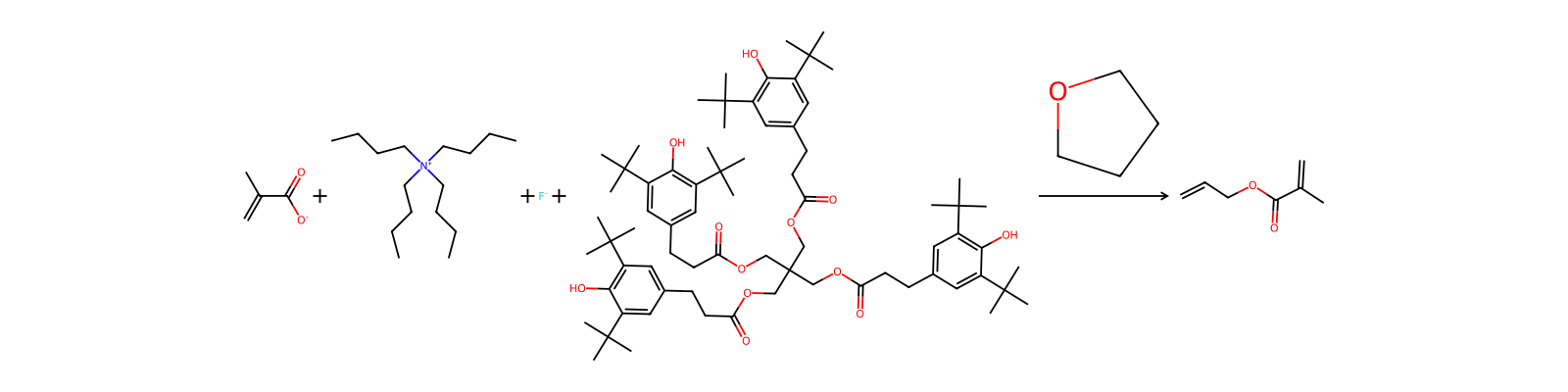
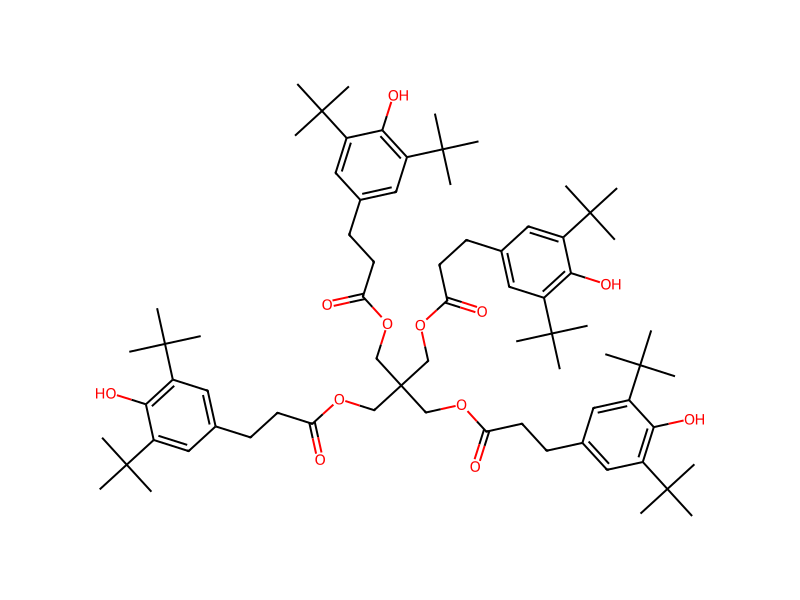
ペンタエリトリトールテトラキス[3-(3,5-ジ-tert-ブチル-4-ヒドロキシフェニル)プロピオナート]
Antioxidant 1010
データを補完しています。しばらくしてからページを更新すると最新の内容を表示できます
基本情報
- CAS
6683-19-8- 標準SMILES
CC(C)(C)c1cc(CCC(=O)OCC(COC(=O)CCc2cc(C(C)(C)C)c(O)c(C(C)(C)C)c2)(COC(=O)CCc2cc(C(C)(C)C)c(O)c(C(C)(C)C)c2)COC(=O)CCc2cc(C(C)(C)C)c(O)c(C(C)(C)C)c2)cc(C(C)(C)C)c1O- InChIKey
BGYHLZZASRKEJE-UHFFFAOYSA-N- 分子式
- C73H108O12
- 平均分子量
- 1,177.6 g/mol
- 単同位体質量
- 1,176.7840789
概要
has antioxidant activity
名称と識別子
- 優先名称
- Antioxidant 1010
- IUPAC
- [3-[3-(3,5-ditert-butyl-4-hydroxyphenyl)propanoyloxy]-2,2-bis[3-(3,5-ditert-butyl-4-hydroxyphenyl)propanoyloxymethyl]propyl] 3-(3,5-ditert-butyl-4-hydroxyphenyl)propanoate
- 現地名
- ペンタエリトリトールテトラキス[3-(3,5-ジ-tert-ブチル-4-ヒドロキシフェニル)プロピオナート]
- 英語名
- Antioxidant 1010
- 分子式
- C73H108O12
- 分子量
- 1177.66
名称と別名
6683-19-8Irganox 1010Pentaerythritol tetrakis(3-(3,5-di-tert-butyl-4-hydroxyphenyl)propionate)Antioxidant 1010Tetraalkofen BPEPhenosane 23Dovernox 10Fenozan 22Fenozan 23Naugard 10Sumilizer BP 101Irganox 1010FF
名称をさらに表示
ペンタエリトリトールテトラキス[3-(3,5-ジ-tert-ブチル-4-ヒドロキシフェニル)プロピオナート]テトラキス[3-(4-ヒドロキシ-3,5-ジ-tert-ブチルフェニル)プロパン酸](メタンテトライルテトラキスメチレン)1,3-ビス[3-(3,5-ジ-tert-ブチル-4-ヒドロキシフェニル)プロピオニルオキシ]-2,2-ビス[[3-(3,5-ジ-tert-ブチル-4-ヒドロキシフェニル)プロピオニルオキシ]メチル]プロパンビス[3-[4-ヒドロキシ-3,5-ビス(1,1-ジメチルエチル)フェニル]プロパン酸]2,2-ビス[[[3-[4-ヒドロキシ-3,5-ビス(1,1-ジメチルエチル)フェニル]プロパノイル]オキシ]メチル]プロパン-1,3-ジイルテトラキス[3-(3,5-ジ-tert-ブチル-4-ヒドロキシフェニル)プロパン酸]メタンテトライルテトラキスメチレン2,2-ビス[[[3-(3,5-ジ-tert-ブチル-4-ヒドロキシフェニル)プロピオニル]オキシ]メチル]プロパン-1,3-ジオール1,3-ビス[3-(3,5-ジ-tert-ブチル-4-ヒドロキシフェニル)プロピオナート]2,2-ビス(ヒドロキシメチル)-1,3-プロパンジオールテトラキス[3,5-ジ(tert-ブチル)-4-ヒドロキシベンゼンプロパノアート]テトラキス[3-(4-ヒドロキシ-3,5-ジ-tert-ブチルフェニル)プロピオン酸]メタンテトライルテトラキスメチレン
物性
構造計算による物性補完中
- XLogP
- 19.4
- 極性表面積
- 186 Ų
- 水素結合供与体数
- 4
- 水素結合受容体数
- 12
- 回転可能結合数
- 32
- 重原子数
- 85
- 形式電荷
- 0
- 複雑度
- 1,730
実験および物理化学的性質
Chemical ClassesOther Classes -> Other Organic Compounds
Polymers
Plastics -> Polyolefin-I; PUR; Polyolefin-II; PVC (soft); PVC (rigid); PET; PA; PC; (E)PS
Plastics -> Antioxidants
CosmeticsCosmetic ingredients (Pentaerythrityl Tetra-di-t-butyl Hydroxyhydrocinnamate) -> CIR (Cosmetic Ingredient Review)
FragrancesFragrance Ingredient (Benzenepropanoic acid, 3,5-bis(1,1-dimethylethyl)-4-hydroxy-, 2,2-bis[[3-[3,5-bis(1,1-dimethylethyl)-4-hydroxyphenyl]-1-oxopropoxy]methyl]- -1,3-propanediyl ester) -> IFRA transparency List
LogP23
Density1.15 g/cm³
SolubilitySolubility in water: none
Flash Point
297 °C o.c.
566.6 °F (open cup)
Animal DrugsPharmaceuticals -> UK Veterinary Medicines Directorate List
Endocrine DisruptorsPotential endocrine disrupting compound
安全と法規制
安全情報は参考情報です。供給元の安全データシート(SDS)、適用法令、専門家による評価に代わるものではありません。
GHS分類
GHS Classification
This chemical does not meet GHS hazard criteria for 91.6% (2698 of 2945) of all reports.
Not Classified
Aggregated GHS information provided per 2945 reports by companies from 12 notifications to the ECHA C&L Inventory.
Warning
H302 (100%): Harmful if swallowed [Warning Acute toxicity, oral]
P264, P270, P273, P280, P301+P317, P302+P352, P321, P330, P332+P317, P362+P364, and P501 (click each P-code to see the statement)
危険有害性情報
Regulatory Information
Chemical: Benzenepropanoic acid, 3,5-bis(1,1-dimethylethyl)-4-hydroxy-, 2,2-bis[[3-[3,5-bis(1,1-dimethylethyl)-4-hydroxyphenyl]-1-oxopropoxy]methyl]-1,3-propanediyl ester
Benzenepropanoic acid, 3,5-bis(1,1-dimethylethyl)-4-hydroxy-, 1,1'-[2,2-bis[[3-[3,5-bis(1,1-dimethylethyl)-4-hydroxyphenyl]-1-oxopropoxy]methyl]-1,3-propanediyl] ester is listed on the EPA's Chemical Data Reporting (CDR) system. Manufacturers and importers of Benzenepropanoic acid, 3,5-bis(1,1-dimethylethyl)-4-hydroxy-, 1,1'-[2,2-bis[[3-[3,5-bis(1,1-dimethylethyl)-4-hydroxyphenyl]-1-oxopropoxy]methyl]-1,3-propanediyl] ester are required to report information about their production and use of this chemical to the EPA under the Toxic Substances Control Act (TSCA). (40 eCFR Part 711)
Status: Active Update: 26-10-2022 https://echa.europa.eu/registration-dossier/-/registered-dossier/15308
Benzenepropanoic acid, 3,5-bis(1,1-dimethylethyl)-4-hydroxy-, 2,2-bis[[3-[3,5-bis(1,1-dimethylethyl)-4-hydroxyphenyl]-1-oxopropoxy]methyl]-1,3-propanediyl ester: Does not have an individual approval but may be used under an appropriate group standard
Other Safety InformationIMAP assessments - Benzenepropanoic acid, 3,5-bis(1,1-dimethylethyl)-4-hydroxy-, 2,2-bis[[3-[3,5-bis(1,1-dimethylethyl)-4-hydroxyphenyl]-1-oxopropoxy]methyl]-1,3-propanediyl ester: Human health tier I assessment
Fire HazardsCombustible. Finely dispersed particles form explosive mixtures in air.
化学と産業
用途と製造
Uses
CIR ingredient: Pentaerythrityl Tetra-di-t-butyl Hydroxyhydrocinnamate
Used in the polymers industry as a stabilizer and antioxidant; [IUCLID] Used as a stabilizer for various polymers, as a radical scavenger in polyolefins, to make construction foam, Raffia film (PP film) and fibers, adhesives and sealants, thermoplastics, plastic and rubber products, wire and cable, wood plastic composites, and textiles-leather-fur; [ExPub: ECHA REACH Registrations] Permitted for use as an inert ingredient in non-food pesticide products; [EPA] Used as an antioxidant; [Addivant MSDS]
Textiles (Fiber & Fabric Manufacturing) [Category: Industry]
Plastics -> Typical concentration range in plastic materials -> 0.002 - 0.5%
U.S. Production2023: 40,000,000 - <55,000,000 lb
Consumer UsesAnti-static agent
Industry UsesOxidizing agent
Household ProductsInformation on 33 consumer products that contain Pentaerythrityl Tetra-Di-T-Butyl Hydroxyhydrocinnamate in the following categories is provided:
Use Classification
EPA Safer Chemical Functional Use Classes -> Preservatives and Antioxidants
Safer Chemical Classes -> Green circle - The chemical has been verified to be of low concern
Fragrance Ingredients
Plastics -> Polymer Type -> Polyolefin-I; PUR; Polyolefin-II; PVC (soft); PVC (rigid); PET; PA; PC; (E)PS
Plastics -> Antioxidants
General Manufacturing Information
Transportation Equipment Manufacturing
Benzenepropanoic acid, 3,5-bis(1,1-dimethylethyl)-4-hydroxy-, 1,1'-[2,2-bis[[3-[3,5-bis(1,1-dimethylethyl)-4-hydroxyphenyl]-1-oxopropoxy]methyl]-1,3-propanediyl] ester: ACTIVE
応用分野
関連反応
8 件





化合物ノート
読み込み中…