ホームMCPワークベンチSkills
ホームワークベンチ通知マイページ
llms.txt · MCPガイドプライバシーポリシー · 利用規約 · サポートv1.8.0
  1. ホーム
  2. /化合物

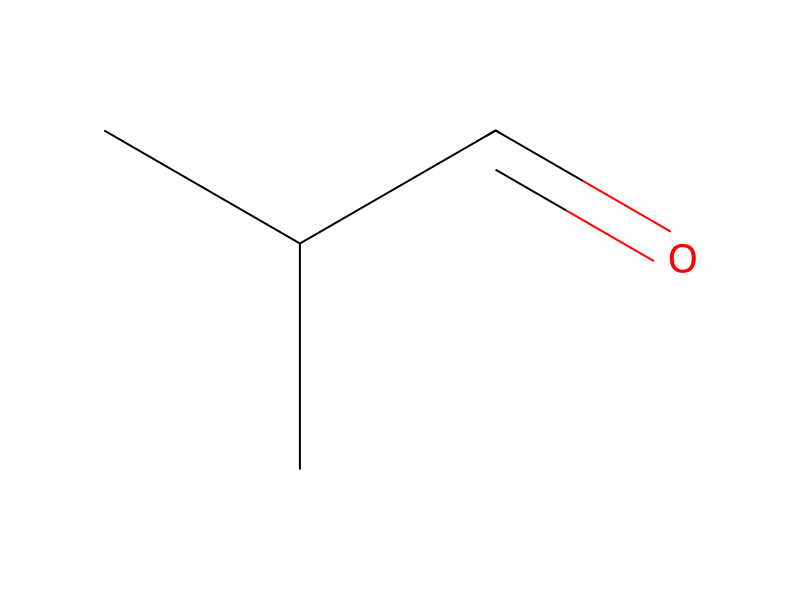
Isobutyraldehyde

HCID 6561
ノートを作成反応を作成見積依頼を出す
印刷プレビュー
基本情報概要名称と識別子物性安全と法規制化学と産業関連反応化合物ノート
部分構造検索類似構造を探す

基本情報

CAS
78-84-2
標準SMILES
CC(C)C=O
InChIKey
AMIMRNSIRUDHCM-UHFFFAOYSA-N
分子式
C4H8O
平均分子量
72.11 g/mol
単同位体質量
72.05751488

概要

Isobutyl aldehyde appears as a clear colorless liquid with a pungent odor. Flash point of -40 °F. Less dense than water and insoluble in water. Hence floats on water. Vapors are heavier than air. Used to make other chemicals.

名称と識別子

優先名称
Isobutyraldehyde
IUPAC
2-methylpropanal
英語名
2-Methylpropanal
分子式
C4H8O
分子量
72.10572

名称と別名

ISOBUTYRALDEHYDE2-Methylpropanal78-84-2IsobutanalIsobutylaldehyde2-MethylpropionaldehydePropanal, 2-methyl-Isobutyric aldehydeMethylpropanalValine aldehyde2-Methyl-1-propanalIsopropylaldehyde
名称をさらに表示
IsopropylformaldehydeIsobutaldehydeIsobutyraldehydIsobutyralMethyl propanalIsobutyryl aldehydeIsopropyl aldehydealpha-Methylpropionaldehyde

データベース識別子

CAS
78-84-2
PubChem CID
6561
DTXSID
DTXSID9021635
ChEMBL
CHEMBL1404017
ChEBI
CHEBI:48943
UNII
C42E28168L
EC Number
201-149-6
Nikkaji
J1.483D

物性

構造計算による物性

XLogP
0.8
極性表面積
17.1 Ų
水素結合供与体数
0
水素結合受容体数
1
回転可能結合数
1
重原子数
5
形式電荷
0
複雑度
30.6

実験および物理化学的性質

Chemical Classes · 2 件

Other Classes -> Aldehydes

Flammable agents - 3rd degree

SpringerMaterials PropertiesCoriolis coupling
FragrancesFragrance Ingredient (Isobutyraldehyde) -> IFRA transparency List
LogP · 3 件

0.740

1.2

0.4

Odor · 2 件

EXTREMELY SHARP

Pungent odor

TasteFRUITY TASTE
Food AdditivesFLAVORING AGENT OR ADJUVANT -> FDA Substance added to food
Density · 6 件

0.791 at 68 °F (USCG, 1999) - Less dense than water; will float

0.7938 @ 20 °C/4 °C

0.8 g/cm³

Relative density of the vapour/air-mixture at 20 °C (air = 1): 1.2

0.783-0.788

0.7938 @ 20°C

Flavoring AgentsEU Flavoring substances
Viscosity · 2 件

0.5382 cP @ 28.2 °C

0.7 mm²/s at 28 °C

安全と法規制

安全情報は参考情報です。供給元の安全データシート(SDS)、適用法令、専門家による評価に代わるものではありません。

GHS分類

GHS Classification · 6 件

Danger

H225 (100%): Highly Flammable liquid and vapor [Danger Flammable liquids]

P210, P233, P240, P241, P242, P243, P264+P265, P280, P303+P361+P353, P305+P351+P338, P337+P317, P370+P378, P403+P235, and P501 (click each P-code to see the statement)

Aggregated GHS information provided per 4104 reports by companies from 15 notifications to the ECHA C&L Inventory. Each notification may be associated with multiple companies.

Danger

H225: Highly Flammable liquid and vapor [Danger Flammable liquids]

危険有害性情報

Regulatory Information · 6 件

Chemical: Propanal, 2-methyl-

Regulation (EC) No 1831/2003 (amended)

Propanal, 2-methyl- is listed on the EPA's Chemical Data Reporting (CDR) system. Manufacturers and importers of Propanal, 2-methyl- are required to report information about their production and use of this chemical to the EPA under the Toxic Substances Control Act (TSCA). (40 eCFR Part 711)

Status: Active Update: 17-10-2022 https://echa.europa.eu/registration-dossier/-/registered-dossier/14300

Propanal, 2-methyl-: HSNO Approval: HSR001256 Approved with controls

The New Jersey Worker and Community Right to Know Act requires public and private employers to provide information about hazardous substances at their workplaces. (N.J.S.A. 34:5A-1 et. seq.)

DOT LabelFlammable Liquid
Fire Hazards · 4 件

Behavior in Fire: Vapors are heavier than air and may travel considerable distance to a source of ignition and flash back. Fires are difficult to control due to ease of reignition. (USCG, 1999)

· HIGHLY FLAMMABLE: Will be easily ignited by heat, sparks or flames.

· HIGHLY FLAMMABLE: Will be easily ignited by heat, sparks or flames.

Highly flammable. Gives off irritating or toxic fumes (or gases) in a fire. Vapour/air mixtures are explosive.

Fire Potential

化学と産業

薬理情報

Cellular LocationsCytoplasm

用途と製造

Uses · 5 件

Used in organic synthesis (pantothenic acid, valine, leucine, cellulose esters, perfumes, flavors, plasticizers, resins, and gasoline additives); [Merck Index] Used as a chemical intermediate; [Hawley] An FDA-approved flavoring agent and it occurs naturally in foods; [AIHA]

Synthesis of pantothenic acid, cellulose esters, perfumes, flavors, and gasoline additives.

ITS DERIVATIVES ARE USED IN MEDICINES & IN MOLD INHIBITORS & REPELLENTS

CHEM INT FOR ISOBUTYL ALCOHOL FOR RESINS & PLASTICIZERS & FOR ISOBUTYRIC ACID & ITS ESTERS, FOR AMINO ACIDS (VALINE, LEUCINE) & FOR PANTOTHENIC ACID IN CHICKEN FEED, FOR ISOBUTYRALDEHYDE OXIME & FOR 2,2,4-TRIMETHYL-1,3-PENTANEDIOL & DERIVATIVES, FOR NEOPENTYL GLYCOL & DERIVATIVES & FOR TRIMETHYL PENTANOL & DERIVATIVES

Intermediate for rubber antioxidants and accelerators for neopentyl glycol; synthesis of amino acids.

U.S. Production · 4 件

2023: 500,000,000 - <1,000,000,000 lb

(1974) 1.73X10+11 G

(1975) GREATER THAN 4.54X10+5 G

(1991) 4.47X10+8 lbs

Consumption Patterns5.37X10+10 G AS A CHEM INT FOR ISOBUTYL ALCOHOL (1974 EST)
Consumer UsesNot Known or Reasonably Ascertainable
Industry UsesNot Known or Reasonably Ascertainable
Methods of Manufacturing · 4 件

REACTION OF PROPYLENE, CARBON MONOXIDE, AND HYDROGEN IN THE PRESENCE OF A COBALT CATALYST (OXO PROCESS), FOLLOWED BY SEPARATION OF ISOMERS BY DISTILLATION

Mfr by oxo process from propylene, carbon monoxide, and hydrogen @ 130-160 °C and 1500-3000 psi in presence of cobalt catalyst: Roelen, US patent 2,327,066 (1943); also prepd by air oxidn of isobutyl alcohol: Fossek, Monatsh 2, 614 (1881); Lipp, Ann 205, 2 (1880).

関連反応

725 件
反応記録を作成
HRID 2992 の反応式
HRID 2992反応物としてuspto-grants-1998_03
HRID 9651 の反応式
HRID 9651反応物としてuspto-grants-2006_08
HRID 10962 の反応式
HRID 10962反応物としてuspto-grants-2006_08
HRID 10964 の反応式
HRID 10964反応物としてuspto-grants-2006_08
HRID 16161 の反応式
HRID 16161反応物としてuspto-grants-2010_06
HRID 24866 の反応式
HRID 24866反応物としてuspto-grants-2005_02
HRID 24867 の反応式
HRID 24867反応物としてuspto-grants-2005_02
HRID 25230 の反応式
HRID 25230反応物としてuspto-grants-2005_02
1 / 91 ページ

化合物ノート

読み込み中…

このページの内容基本情報概要名称と識別子物性安全と法規制化学と産業関連反応化合物ノート
その他の操作
ノートを作成反応を作成見積依頼を出す
Color/FormTransparent, colorless liquid
Solubility · 6 件

less than 1 mg/mL at 66 °F (NTP, 1992)

Miscible in ethanol, ether, carbon disulfide, acetone, benzene, toluene, and chloroform.

Slightly soluble in carbon tetrachloride

In water, 89,000 mg/l @ 25 °C.

89 mg/mL at 25 °C

Solubility in water, g/100ml at 20 °C: 6.7 (moderate)

物理化学的性質

融点
-65.9 °C · -65.9 °C
沸点
64 °C · 64 °C
比重(密度)
0.7938 g/cm3 · 0.7938 g/cm3
A very dangerous fire hazard when exposed to heat, flame, or oxidizers.
Health Hazards · 3 件

Vapor is irritating to the eyes and mucous membranes. (USCG, 1999)

· May cause toxic effects if inhaled or absorbed through skin.

· May cause toxic effects if inhaled or absorbed through skin.

Hazards Summary · 1 件

A corrosive substance that can cause pulmonary edema; Can cause skin burns; Can cause severe burns to eyes; [ICSC] Inhalation of high concentrations can cause CNS depression; [HSDB] An irritant; [MSDSonline] No irritation in 15 volunteers exposed to 210 ppm, but two became nauseated; [AIHA]

DOT ID and Guide · 2 件

2045 130

2045 130

FDA Requirements · 1 件

Isobutyraldehyde is a food additive permitted for direct addition to food for human consumption as a synthetic flavoring substance and adjuvant in accordance with the following conditions: a) they are used in the minimum quantity required to produce their intended effect, and otherwise in accordance with all the principles of good manufacturing practice, and 2) they consist of one or more of the following, used alone or in combination with flavoring substances and adjuvants generally recognized as safe in food, prior-sanctioned for such use, or regulated by an appropriate section in this part.

Reactive GroupAldehydes
UN ClassificationUN Hazard Class: 3; UN Pack Group: II
Special Reports · 1 件

Toxicology & Carcinogenesis Studies of Isobutyraldehyde in F344/N Rats and B6C3F1 Mice. Technical Report Series No. 472 (1999) NIH Publication No. 99-3962 U.S. Department of Health and Human Services, National Toxicology Program, National Institute of Environmental Health Sciences, Research Triangle Park, NC 27709

TSCA Requirements · 2 件

Section 8(a) of TSCA requires manufacturers of this chemical substance to report preliminary assessment information concerned with production, use, and exposure to EPA as cited in the preamble in 51 FR 41329.

Pursuant to section 8(d) of TSCA, EPA promulgated a model Health and Safety Data Reporting Rule. The section 8(d) model rule requires manufacturers, importers, and processors of listed chemical substances and mixtures to submit to EPA copies and lists of unpublished health and safety studies. 2-Methylpropanal is included on this list.

安全と保護具

Fire Fighting · 2 件

Excerpt from ERG Guide 130 [Flammable Liquids (Water-Immiscible / Noxious)]:

Use powder, foam, carbon dioxide. In case of fire: keep drums, etc., cool by spraying with water.

First Aid Measures · 4 件

Fresh air, rest. Refer for medical attention.

Rinse skin with plenty of water or shower. Remove contaminated clothes. Refer for medical attention .

First rinse with plenty of water for several minutes (remove contact lenses if easily possible), then refer for medical attention.

Rinse mouth. Do NOT induce vomiting. Give one or two glasses of water to drink. Refer for medical attention .

Accidental Release Measures · 4 件

· CALL 911. Then call emergency response telephone number on shipping paper. If shipping paper not available or no answer, refer to appropriate telephone number listed on the inside back cover.

· ELIMINATE all ignition sources (no smoking, flares, sparks or flames) from immediate area.

· CALL 911. Then call emergency response telephone number on shipping paper. If shipping paper not available or no answer, refer to appropriate telephone number listed on the inside back cover.

· ELIMINATE all ignition sources (no smoking, flares, sparks or flames) from immediate area.

First Aid · 3 件

EYES: First check the victim for contact lenses and remove if present. Flush victim's eyes with water or normal saline solution for 20 to 30 minutes while simultaneously calling a hospital or poison control center. Do not put any ointments, oils, or medication in the victim's eyes without specific instructions from a physician. IMMEDIATELY transport the victim after flushing eyes to a hospital even if no symptoms (such as redness or irritation) develop.

General First Aid:

General First Aid:

Safe StorageFireproof. Separated from strong oxidants, strong bases, strong acids and strong reducing agents. Well closed. Store in an area without drain or sewer access.
Firefighting HazardsVAPORS ARE HEAVIER THAN AIR & MAY TRAVEL CONSIDERABLE DISTANCE TO SOURCE OF IGNITION & FLASH BACK. FIRES ARE DIFFICULT TO CONTROL DUE TO EASE OF REIGNITION.
Exposure Control and Personal Protection · 2 件

· Wear positive pressure self-contained breathing apparatus (SCBA).

· Wear positive pressure self-contained breathing apparatus (SCBA).

Fire Fighting Procedures · 2 件

Foam, dry chemical or carbon dioxide.

WEAR GOGGLES & SELF-CONTAINED BREATHING APPARATUS. ... COOL EXPOSED CONTAINERS WITH WATER.

Storage Conditions · 1 件

MATERIALS WHICH ARE TOXIC AS STORED OR WHICH CAN DECOMPOSE INTO TOXIC COMPONENTS ... SHOULD BE STORED IN A COOL WELL VENTILATED PLACE, OUT OF THE DIRECT RAYS OF THE SUN, AWAY FROM AREAS OF HIGH FIRE HAZARD, AND SHOULD BE PERIODICALLY INSPECTED. INCOMPATIBLE MATERIALS SHOULD BE ISOLATED ... .

Nonfire Spill ResponseExcerpt from ERG Guide 130 [Flammable Liquids (Water-Immiscible / Noxious)]:
Disposal Methods · 2 件

SRP: At the time of review, criteria for land treatment or burial (sanitary landfill) disposal practices are subject to significant revision. Prior to implementing land disposal of waste residue (including waste sludge), consult with environmental regulatory agencies for guidance on acceptable disposal practices.

(1) Absorb on vermiculite and burn in open incinerator. (2) Dissolve in flammable solvent and spray in incinerator with after burner.

Spillage Disposal · 1 件

Evacuate danger area! Consult an expert! Remove all ignition sources. Personal protection: protective clothing, protective gloves, safety goggles and filter respirator for organic vapours of low boiling point adapted to the airborne concentration of the substance. Do NOT let this chemical enter the environment. Do NOT wash away into sewer. Collect leaking liquid in sealable containers. Cover the spilled material with inert absorbent. Then store and dispose of according to local regulations.

毒性情報

Body BurdenIsobutyraldehyde has been detected in human urine and feces(1).
Environmental Fate · 3 件

TERRESTRIAL FATE: Based on a classification scheme(1), an estimated Koc value of 8(SRC), determined from a water solubility of 8.9X10+4(2) and a regression-derived equation(3), indicates that isobutyraldehyde is expected to have very high mobility in soil(SRC). Volatilization of isobutyraldehyde from moist soil surfaces is expected to be an important fate process(SRC) given an estimated Henry's Law constant of 1.8X10⁻⁴ atm-cu m/mole(SRC), derived from its vapor pressure, 173 mm Hg(4), and its water solubility(2). The potential for volatilization of isobutyraldehyde from dry soil surfaces may exist(SRC) based upon a its vapor pressure(4). Biodegradation is expected to be the major environmental fate process for isobutyraldehyde in soil since it was found to readily biodegrade in water(5).

AQUATIC FATE: Based on a classification scheme(1), an estimated Koc value of 8(SRC), determined from a water solubility of 8.9X10+4(2) and a regression-derived equation(3), indicates that isobutyraldehyde is not expected to adsorb to suspended solids and sediment(SRC). Volatilization from water surfaces is expected(3) based upon an estimated Henry's Law constant of 1.8X10⁻⁴ atm-cu m/mole(SRC), derived from its vapor pressure, 173 mm Hg(4), and its water solubility(2). Using this Henry's Law constant and an estimation method(3), volatilization half-lives for a model river and model lake are 3.6 hrs and 4.6 days, respectively(SRC). According to a classification scheme(5), an estimated BCF of 1(SRC), from its water solubility(2) and a regression-derived equation(3), suggests the potential for bioconcentration in aquatic organisms is low(SRC). Isobutyraldehyde, present at 100 mg/l, reached 81% of its theoretical BOD in 2 weeks using an activated sludge inoculum at 30 mg/l and the Japanese MITI test(6).

ATMOSPHERIC FATE: According to a model of gas/particle partitioning of semivolatile organic compounds in the atmosphere(1), isobutyraldehyde, which has a vapor pressure of 173 mm Hg at 25 °C(2), is expected to exist solely as a vapor in the ambient atmosphere(SRC). Vapor-phase isobutyraldehyde is degraded in the atmosphere by reaction with photochemically-produced hydroxyl radicals(SRC); the half-life for this reaction in air is estimated to be 14.6 hours(SRC), calculated from its rate constant of 2.6X10⁻¹¹ cu cm/molecule-sec at 25 °C(3). Based upon direct photolysis measurements, the direct photolysis rate constants of isobutyraldehyde at solar zenith angles of 30 and 58 deg were determined to be 7.6X10⁻⁵ and 5.9X10⁻⁵ /sec(4), respectively, which correspond to respective half-lives of 2.5 and 3.3 hr(SRC).

Food Survey Values · 1 件

Isobutyraldehyde has been qualitatively detected as a volatile constituent of coffee(1), fried bacon(2), roasted filbert nuts(3), cooked meats(4), and chickpeas(5). Isobutyraldehyde concns of 27-140 ppb were detected in dried samples of lima beans, common beans, mung beans, soybeans, split peas, and lentils(6). Isobutyraldehyde has been qualitatively detected in peanut butter(7), cheddar cheese(8), and bread(9). Isobutyraldehyde was qualitatively detected in whole and ground grain samples(10).

Adverse EffectsDermatotoxin - Skin burns.
Exposure RoutesThe substance can be absorbed into the body by inhalation, through the skin and by ingestion.
Plant ConcentrationsIsobutyraldehyde was qualitatively detected in kiwi fruit flowers(1). Isobutyraldehyde has been detected in volatile emissions from Northern white cedar trees(2), alfalfa(3), tea leaves(4) and marine macroalgae(5).
Signs and Symptoms · 4 件

Sore throat. Cough. Burning sensation. Headache. Dizziness. Nausea. Vomiting.

Redness.

Pain. Redness.

Abdominal cramps. Aspiration hazard! Further see Inhalation.

Ongoing Test Status · 1 件

The following link will take the user to the National Toxicology Program (NTP) Test Agent Search Results page, which tabulates all of the "Standard Toxicology & Carcinogenesis Studies", "Developmental Studies", and "Genetic Toxicity Studies" performed with this chemical. Clicking on the "Testing Status" link will take the user to the status (i.e., in review, in progress, in preparation, on test, completed, etc.) and results of all the studies that the NTP has done on this chemical. [http://ntp-apps.niehs.nih.gov/ntp_tox/index.cfm?fuseaction=ntpsearch.searchresults&searchterm=78-84-2]

Effluent Concentrations · 2 件

Isobutyraldehyde emission factors ranging from 2.6 to 79.5 mg/kg were detected in the flue gas of cookstoves(1). Isobutyraldehyde's emission rate from hamburger meat charbroiling over a natural gas fired grill was measured and found to be 373,000 ug/kg(2).

An isobutyraldehyde concn of 0.13 ppm was detected in an automobile exhaust sample(1); isobutyraldehyde was qualitatively detected in wood smoke emissions(1). Isobutyraldehyde has been detected in volatile emissions from Northern white cedar trees(2). Monitoring of automobile exhaust from four vehicles equipped in low nitrogen oxide catalytic converters, detected mean isobutyraldehyde emission rates of 0.14-1.57 mg/km(3).

ICSC Environmental DataThe substance is harmful to aquatic organisms.
Soil Adsorption/Mobility · 1 件

The Koc of isobutyraldehyde is estimated as 8(SRC), using a water solubility of 8.9X10+4(1) and a regression-derived equation(2). According to a classification scheme(3), this estimated Koc value suggests that isobutyraldehyde is expected to have very high mobility in soil(SRC).

Natural Pollution Sources · 2 件

REPORTED FOUND IN APPLE & CURRANT AROMAS & IN ESSENTIAL OILS FROM TOBACCO LEAVES & TEA LEAVES; ALSO IN THE ESSENTIAL OILS OF: PINUS JEFFREYI MURR LEAVES, CITRUS AURANTIUM LEAVES, & DATURA STRAMONIUM.

Similar to other saturated aldehydes, isobutyraldehyde occurs naturally in foods(1); it is also emitted into the atmosphere by plants(1).

法規制情報

FDA Requirements · 1 件

Isobutyraldehyde is a food additive permitted for direct addition to food for human consumption as a synthetic flavoring substance and adjuvant in accordance with the following conditions: a) they are used in the minimum quantity required to produce their intended effect, and otherwise in accordance with all the principles of good manufacturing practice, and 2) they consist of one or more of the following, used alone or in combination with flavoring substances and adjuvants generally recognized as safe in food, prior-sanctioned for such use, or regulated by an appropriate section in this part.

TSCA Requirements · 2 件

Section 8(a) of TSCA requires manufacturers of this chemical substance to report preliminary assessment information concerned with production, use, and exposure to EPA as cited in the preamble in 51 FR 41329.

Pursuant to section 8(d) of TSCA, EPA promulgated a model Health and Safety Data Reporting Rule. The section 8(d) model rule requires manufacturers, importers, and processors of listed chemical substances and mixtures to submit to EPA copies and lists of unpublished health and safety studies. 2-Methylpropanal is included on this list.

Atmospheric Standards · 1 件

This action promulgates standards of performance for equipment leaks of Volatile Organic Compounds (VOC) in the Synthetic Organic Chemical Manufacturing Industry (SOCMI). The intended effect of these standards is to require all newly constructed, modified, and reconstructed SOCMI process units to use the best demonstrated system of continuous emission reduction for equipment leaks of VOC, considering costs, non air quality health and environmental impact and energy requirements. Isobutyraldehyde is produced, as an intermediate or a final product, by process units covered under this subpart.

安全データ

ridadr
UN 2045
hazard_class
3
packing_group
II

BY OXIDATION OF ISOBUTYL ALCOHOL WITH POTASSIUM DICHROMATE & CONCENTRATED SULFURIC ACID. COTTET ET AL, BULL SOC CHIM FR, 12, 4499, 1967.

Propylene + synthesis gas (hydroformylation; coproduced with n-butyraldehyde)

Formulations/PreparationsGRADES OR PURITY: DRY GRADE: 98.0%; WET GRADE: 96.0%; COMMERCIAL 97%.
Household ProductsInformation on 3 consumer products that contain Isobutyraldehyde in the following categories is provided:
Use Classification · 3 件

Fragrance Ingredients

Flavouring Agent -> FLAVOURING_AGENT -> JECFA Functional Classes

Flavoring Agents -> JECFA Flavorings Index

General Manufacturing Information · 4 件

Plastics Material and Resin Manufacturing

Propanal, 2-methyl-: ACTIVE

FEMA NUMBER 2220

ISOBUTYRALDEHYDE & ITS COGENERS OCCUR IN A WIDE VARIETY OF FEEDSTUFFS, WHERE THEY MAY SERVE AS INDICATORS FOR THE AVAILABILITY OF THE INDISPENSABLE AMINO ACIDS VALINE, LEUCINE, & ISOLEUCINE.