
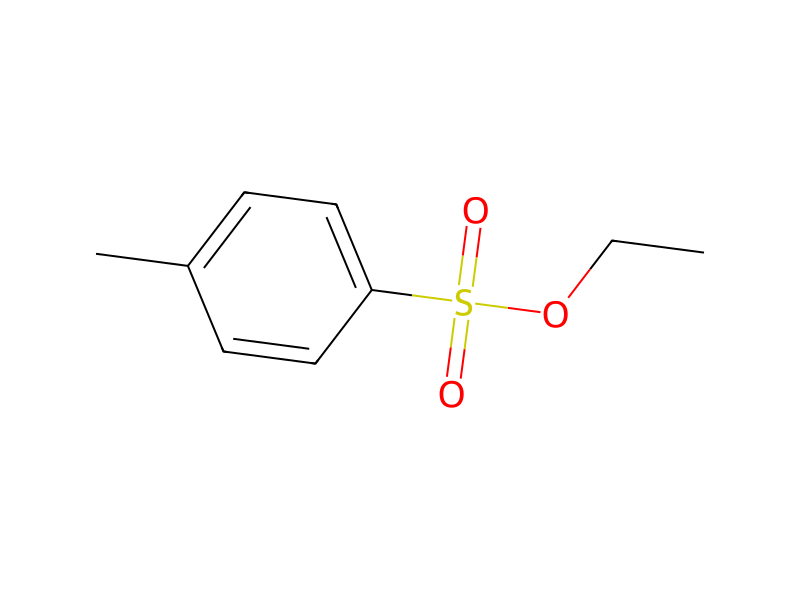
基本情報
- 標準SMILES
CCOS(=O)(=O)c1ccc(C)cc1- InChIKey
VRZVPALEJCLXPR-UHFFFAOYSA-N- 分子式
- C9H12O3S
- 平均分子量
- 200.26 g/mol
- 単同位体質量
- 200.05071524
名称と識別子
- 優先名称
- Ethyl p-methylbenzenesulfonate
- IUPAC
- ethyl 4-methylbenzenesulfonate
- 現地名
- p-トルエンスルホン酸エチル
- 英語名
- Ethyl p-toluenesulfonate
- 分子式
- C9H12O3S
- 分子量
- 200.25
名称と別名
Ethyl p-toluenesulfonate80-40-0Ethyl 4-methylbenzenesulfonateEthyl tosylateEthyl p-tosylateETHYL P-METHYLBENZENESULFONATEBenzenesulfonic acid, 4-methyl-, ethyl esterEthyl p-TSp-Toluenesulfonic acid, ethyl esterEthyl-p-toluenesulfonateEthyl PTSEthyl 4-toluenesulfonate
名称をさらに表示
p-トルエンスルホン酸エチル4-メチルベンゼンスルホン酸エチルp-メチルベンゼンスルホン酸エチルエチルp-トルエンスルホナートpトルエンスルホン酸エチルエステルパラトルエンスルホン酸エチルエチルトシラートP‐トルエンスルホン酸エチル4-トルエンスルホン酸エチルトシル酸エチルEthyl para-toluenesulfonateMittel AEP4-METHYLBENZENESULFONIC ACID, ETHYL ESTERethylpts
p-Toluolsulfonsaeure aethyl esterNSC 8887toluene-4-sulfonic acid ethyl esterEthyl p-methyl benzenesulfonateCCRIS 10284-Methylbenzenesulfonic acid ethyl esterHSDB 5235EINECS 201-276-7
データベース識別子
- CAS
80-40-0- PubChem CID
- 6638
- DTXSID
DTXSID2058833- UNII
- 2160N0YURF
- EC Number
- 201-276-7
- Nikkaji
- J3.853I
物性
構造計算による物性
- XLogP
- 1.8
- 極性表面積
- 51.8 Ų
- 水素結合供与体数
- 0
- 水素結合受容体数
- 3
- 回転可能結合数
- 3
- 重原子数
- 13
- 形式電荷
- 0
- 複雑度
- 232
実験および物理化学的性質
Chemical ClassesOther Classes -> Benzenesulfonic Acid Derivatives
SpringerMaterials PropertiesDiamagnetic susceptibility
LogPLog kow = 1.81
Density1.17
Color/Form
MONOCLINIC CRYSTALS
MONOCLINIC PRISMS FROM ACETIC ACID, ETHYL ACETATE
Solubility
INSOL IN WATER; SOL IN ALC, ETHER, HOT ACETIC ACID
SOL IN HOT ETHYL ACETATE
Flash Point316 °F
Boiling Point173 °C @ 15 MM HG
Melting Point33 °C
Vapor Pressure0.000241 [mmHg]
Physical DescriptionUnstable solid; mp = 33 deg C; [Hawley] White solid; mp = 32-34 deg C; [MSDSonline]
Stability/Shelf LifeUNSTABLE SOLID
物理化学的性質
- 融点
- 29 · 29-33 °C(lit.)
- 沸点
- 158 · 158-162 °C10 mm Hg(lit.)
- 比重(密度)
- 1.174 g/mL · 1.174 g/mL at 25 °C(lit.)
- 蒸気圧
- 0.6 hPa · 0.6 hPa (14 °C)
- 屈折率
- 20 · n20/D 1.511(lit.)
- 闪点
- 316 °F · 316 °F
- 貯蔵温度
- 2 · 2-8°C
- 溶解性
- 1.24 g/リットル · 1.24g/リットル
- 外見
- 融解後の液体
- 色
- 無色透明~淡褐色
- 水溶解度
- 不溶性
- Merck
- 14 · 14,3858
- BRN
- 611213 · 611213
- InChI
- 1S/C9H12O3S/c1-3-12-13(10,11)9-6-4-8(2)5-7-9/h4-7H,3H2,1-2H3
- InChIKey
- VRZVPALEJCLXPR-UHFFFAOYSA-N
- SMILES
- CCOS(=O)(=O)c1ccc(C)cc1
- CAS データベース
- 80 · 80-40-0(CAS DataBase Reference)
- NISTの化学物質情報
- 4 · Benzenesulfonic acid, 4-methyl-, ethyl ester(80-40-0)
- EPAの化学物質情報
- 4 · Benzenesulfonic acid, 4-methyl-, ethyl ester (80-40-0)
化学的性質
化学的特性Clear colorless to brownish liquid after melting
安全と法規制
GHS分類
GHS Classification
This chemical does not meet GHS hazard criteria for 0.6% (1 of 169) of reports.
Danger
H301 (65.1%): Toxic if swallowed [Danger Acute toxicity, oral]
P261, P264, P264+P265, P270, P271, P280, P301+P316, P302+P352, P304+P340, P305+P351+P338, P319, P321, P330, P332+P317, P337+P317, P362+P364, P403+P233, P405, and P501 (click each P-code to see the statement)
Aggregated GHS information provided per 169 reports by companies from 15 notifications to the ECHA C&L Inventory. Each notification may be associated with multiple companies.
危険有害性情報
Regulatory Information
Chemical: Benzenesulfonic acid, 4-methyl-, ethyl ester
Benzenesulfonic acid, 4-methyl-, ethyl ester: Does not have an individual approval but may be used as a component in a product covered by a group standard. It is not approved for use as a chemical in its own right.
Hazards SummaryAn irritant; [MSDSonline]
Hazard Classes and CategoriesAcute Tox. 3 (65.1%)
安全と保護具
Disposal Methods
SRP: At the time of review, criteria for land treatment or burial (sanitary landfill) disposal practices are subject to significant revision. Prior to implementing land disposal of waste residue (including waste sludge), consult with environmental regulatory agencies for guidance on acceptable disposal practices.
毒性情報
Non-Human Toxicity Excerpts
MUTAGENICITY: MUTATION RESEARCH 87: 211 (1981). DNA REPAIR-DEFICIENT BACTERIAL TESTS: POSITIVE.
65 MG/KG ADMIN SC TO BD RATS WEEKLY FOR 50 WK; 3/11 DEVELOPED LOCAL SARCOMAS AFTER 600 DAYS. /FROM TABLE/
Several direct acting mutagens were tested for mutagenic activity in adult Drosophila melanogaster when administered in feeding or as an injected dose. An inhibitor or cytochrome p450, 1-phenylimidazole, administered at concentrations of 2.5, 4 and 10 mmol, was not mutagenic in Drosophila. Methyl-p-toluenesulfonate applied orally was a weak mutagen. When administered simultaneously with 1-phenylimidazole, a concentration dependent increase was noted in mutagenic activity of methyl-p-toluenesulfonate. Following injection, mutagenesis by methyl-p-toluenesulfonate was considerable. Ethyl-p-toluenesulfonate demonstrated marginal mutagenesis in Drosophila when orally applied but was decidedly mutagenic on injection. Simultaneous treatment with 4 mmol 1-phenylimidazole and 1 mmole of ethyl-p-toluenesulfonate did not alter mutagenesis nor did treatment with diethylmaleate (glutathione depletion). Combined treatment with 2 mmol ethyl-p-toluenesulfonate and 2 mmol 1-phenylimidazole produced a statistically significant increase in mutagenesis. /It was concluded/ that weak mutagenesis by p-toluenesulfonates after feeding experiments compared to considerable effects after injection suggests metabolic deactivation in the gut.
The cancerogenic activity of 12 direct alkylating substances was tested in 535 BD rats. Local sarcomas were produced by the subcutaneous injections once a week of p-toluene sulfonic acid methylester. Only a jew tumors were observed following treatment with p-toluene sulfonic acid ethylester and p-toluenesulfonic acid butylester were not cancerogenic.
安全データ
- F
- 21
- wgk
- 3
- tsca
- TSCA listed
- rtecs
- XT6825000
- ridadr
- UN2811
- hs_code
- 29041000
- risk_code
- 36/37/38-40-22
- 化審法
- (3)-1896
- 消防法
- 危-4-3-III
- hazard_code
- Xi,Xn
- safety_code
- 26-45-36/37/39
- hazard_class
- 6.1
- packing_group
- III
- 自然発火温度
- 500 °C
- Hazard Classifications
- Eye Irrit. 2Skin Irrit. 2STOT SE 3
- ストレージクラス
- 11 - Combustible Solids
- 有毒物質データの
- 80-40-0(Hazardous Substances Data)
化学と産業
用途と製造
Uses
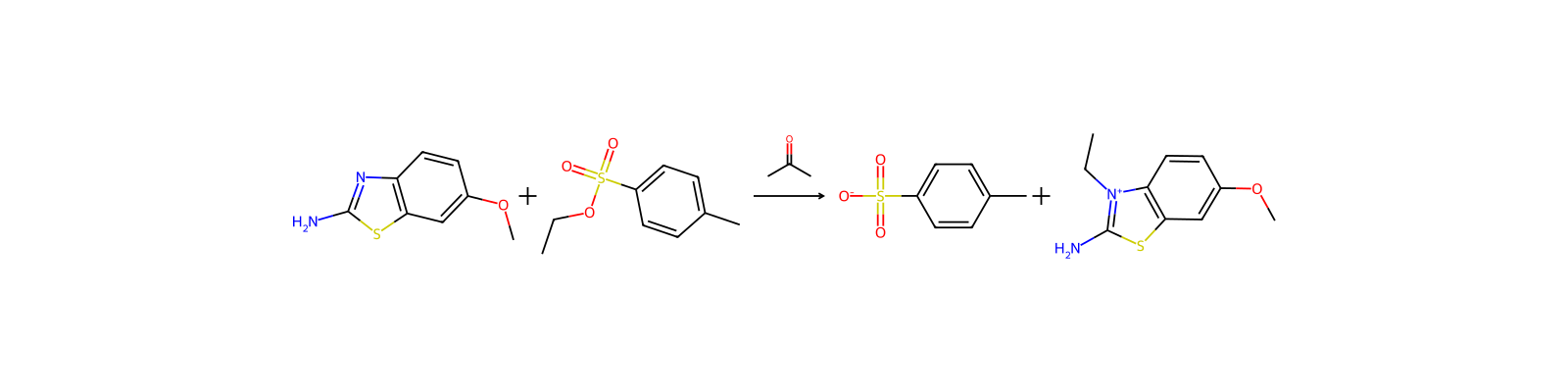
Used as plasticizer for cellulose acetate and as an ethylating agent; [Hawley]
PLASTICIZER FOR CELLULOSE ACETATE; ETHYLATING AGENT
General Manufacturing InformationBenzenesulfonic acid, 4-methyl-, ethyl ester: ACTIVE
応用分野
使用Ethyl p-toluenesulfonate can be used in the manufacture of organic synthesis, and also can be used as intermediate of methylation reagent and sensitive material. It also is flexibilizer of cellulose acetate.
一般的な説明Ethyl p-toluenesulfonate (EPTS), used as a potent alkylating agent in the modern pharmaceutical industry, is classified as a potential genotoxic impurity. It is an alkyl sulfonate formed by the reaction of ethanol with p-toluenesulfonic acid during the production of active pharmaceutical ingredients. Because EPTS has the ability to alkylate DNA, it may pose risks such as carcinogenicity and teratogenicity; therefore, its content must be strictly controlled[1].
上流・下流製品情報
上流原料
下流製品
サプライヤー50 社
国药集团化学试剂有限公司86-21-63210123 · [email protected]
梯希爱(上海)化成工业发展有限公司021-67121386 · [email protected]
衢州润东化工有限公司0570-8789886 18892685668 · [email protected]
上海阿拉丁生化科技股份有限公司400-6206333 13167063860 · [email protected]
上海如吉生物科技发展有限公司+86-21-65211385-8001 36031160 · [email protected]
南京兰亚化工贸易有限公司+86-25-8331-5620 · [email protected]
韶远科技(上海)有限公司021-50795510 4000665055 · [email protected]
上海将来实业股份有限公司400-0066400 13621662912 · [email protected]
Syntechem Co.,Ltd[email protected]
上海迈瑞尔生化科技有限公司4006356688 18621169109 · [email protected]
阿法埃莎(中国)化学有限公司400-6106006 · [email protected]
安耐吉化学&3A(安徽泽升科技股份有限公司)400-0056266 · [email protected]
上海瀚鸿科技股份有限公司021-54306202 13764082696 · [email protected]
上海柯维化学技术有限公司021-64609169 18901607656 · [email protected]
孝感深远化工有限公司15527621225; 15527621225 · [email protected]
山东西亚化学有限公司13355009207 13355009207 · [email protected]
玛雅试剂+86 (573) 82222445 (0)18006601000 452520369 · [email protected]
四川库利南科技有限公司400-1166-196 18981987031 · [email protected]
天津希恩思生化科技有限公司400 638 7771 · [email protected]
嘉兴信思得进出口有限公司+86 (573) 8203-0555 · [email protected]
寿光诺盟化工有限公司0536-5399456 13869682027 · [email protected]
艾科试剂4008-755-333 18080918076 · [email protected]
上海思域化工科技有限公司86-21-34053660 · [email protected]
赛默飞世尔科技(中国)有限公司800-810-5118 · [email protected]
北京伊诺凯科技有限公司400-810-7969 010-59572699 · [email protected]
上海遐瑞医药科技有限公司+86 21 61551611
TOKYO CHEMICAL INDUSTRY CO., LTD.03-36680489 · [email protected]
深圳振强药物研发有限公司0755-66853366 13670046396 · [email protected]
上海将来实业股份有限公司400-0066400 13621662912 · [email protected]
上海将来实业股份有限公司021-61552785 · [email protected]
HBCChem, Inc.+1-510-219-6317 · [email protected]
日照力德士化工有限公司010-51268198 · [email protected]
郑州鸿晟医药科技有限公司0371-0371-13526885213 15637198702 · [email protected]
美岚实业(上海)有限公司021-58958189 · [email protected]
上海爱蝶实业有限公司021-58957966 18930537195 · [email protected]
成都零六生物科技有限公司400-1166-196 13458535857 · [email protected]
广拓化学(上海)有限公司021-60899189-8001 18918189673 · [email protected]
雷丁试剂0510-85629785 18013409632 · [email protected]
湖南华腾制药有限公司400-8592883 · [email protected]
上海麦克林生化科技股份有限公司15221275939 15221275939 · [email protected]
杭州杰恒化工有限公司0571-87396432 · [email protected]
上海嵩爰化工科技有限公司010-1234567 18521000990 · [email protected]
上海有朋化工有限公司021-69005955 13701776567 · [email protected]
北京海力扬化学科技有限公司13718199399 · [email protected]
北京欣赛维化学科技有限公司010-56218822 13717722232 · [email protected]
四川海诺威科技有限公司13708085536 13708085536 · [email protected]
江苏艾康生物医药研发有限公司025-66028182 17714375163 · [email protected]
苏州麦凯尔生物医药科技有限公司15952441622 · [email protected]
菏泽市金沃泰化工有限公司+86-15157335533 13505737768 · [email protected]
上海凯赛化工有限公司021-33516722 13701817765 · [email protected]
関連反応
39 件


関連ノート
読み込み中…