
p-トルエンスルホン酸メチル
Methyl p-toluenesulfonate
データを補完しています。しばらくしてからページを更新すると最新の内容を表示できます
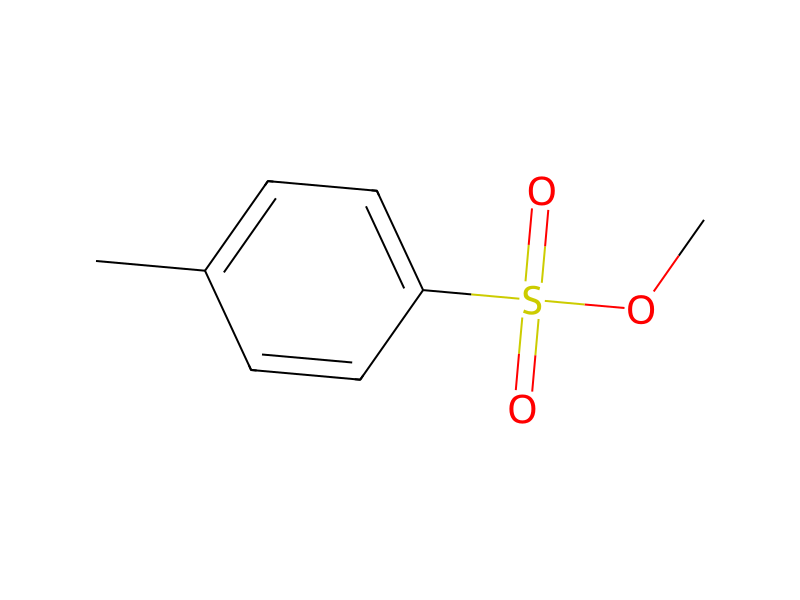
基本情報
- CAS
80-48-8- 標準SMILES
COS(=O)(=O)c1ccc(C)cc1- InChIKey
VUQUOGPMUUJORT-UHFFFAOYSA-N- 分子式
- C8H10O3S
- 平均分子量
- 186.23 g/mol
- 単同位体質量
- 186.03506535
名称と識別子
- 優先名称
- Methyl p-toluenesulfonate
- IUPAC
- methyl 4-methylbenzenesulfonate
- 現地名
- p-トルエンスルホン酸メチル
- 英語名
- Methyl p-toluenesulfonate
- 分子式
- C8H10O3S
- 分子量
- 186.23
名称と別名
Methyl p-toluenesulfonate80-48-8Methyl 4-methylbenzenesulfonateMethyl tosylateMethyl toluene-4-sulfonateMethyl-p-toluenesulfonateMethyl p-tosylateMethyl toluenesulfonateMethyl toluene-4-sulphonateBenzenesulfonic acid, 4-methyl-, methyl esterp-Toluenesulfonic acid, methyl esterMethyl toluene sulfonate
名称をさらに表示
p-トルエンスルホン酸メチルメチルトシラート4-メチルベンゼンスルホン酸メチルメタノールトシラートメチルp-トルエンスルホナートp-トルエンスルホン酸メチルエステルpトルエンスルホン酸メチルエステルパラ-トルエンスルホン酸メチルP‐トルエンスルホン酸メチルMPTSPTSMEMETHYL 4-TOLUENESULFONATEMETHYL P-TOLUENESULPHONATEMethyl para-toluenesulfonate4-TOLUENESULFONIC ACID METHYL ESTER
p-Methylbenzenesulfonate methyl esterMETHYL P-METHYLBENZENESULFONATEp-Toluolsulfonsaeure methyl esterMethyl 4-toluene sulfonate4-Toluenesulfonic acid, methyl esterMethylester kyseliny p-toluensulfonoveDTXSID40525504SU69KI68L
データベース識別子
- CAS
80-48-8- PubChem CID
- 6645
- DTXSID
DTXSID4052550- ChEMBL
CHEMBL5189891- UNII
- 4SU69KI68L
- EC Number
- 201-283-5
- Nikkaji
- J54.424H
物性
構造計算による物性補完中
- XLogP
- 2.2
- 極性表面積
- 51.8 Ų
- 水素結合供与体数
- 0
- 水素結合受容体数
- 3
- 回転可能結合数
- 2
- 重原子数
- 12
- 形式電荷
- 0
- 複雑度
- 219
実験および物理化学的性質
Density
1.230 @ 25 DEG/25 °C
1.230-1.238 @25 °C
Color/Form
MONOCLINIC LEAFLETS OR PRISMS FROM ETHER-PETROLEUM ETHER
LIGHT BROWN CRYSTALS
WHITE DAMP CRYSTALS
SolubilityINSOL IN WATER; SLIGHTLY SOL IN PETROLEUM ETHER; SOL IN ETHER; VERY SOL IN ALCOHOL, BENZENE, CHLOROFORM
Flash Point306 °F (152 °C) (open cup)
Boiling Point292 °C @ 760 MM HG
Melting Point28-29 °C
Vapor Density6.45 (AIR= 1)
Physical Description
Liquid
White vesicant solid; Solidifies at 24 deg C; [Hawley] White or light brown solid; mp = 28-29 deg C; [HSDB] Off-white low melting solid or clear liquid; mp = 27-28 deg C; [MSDSonline]
Other Experimental Properties
LOW-MELTING SOLID OR LIQUID
DECOMP @ 262 °C
安全と法規制
安全情報は参考情報です。供給元の安全データシート(SDS)、適用法令、専門家による評価に代わるものではありません。
GHS分類
GHS Classification
Danger
H302 (100%): Harmful if swallowed [Warning Acute toxicity, oral];H311 (29.9%): Toxic in contact with skin [Danger Acute toxicity, dermal];H314 (22.8%): Causes severe skin burns and eye damage [Danger Skin corrosion/irritation];H315 (76.9%): Causes skin irritation [Warning Skin corrosion/irritation];H317 (97.2%): May cause an allergic skin reaction [Warning Sensitization, Skin];H319 (35%): Causes serious eye irritation [Warning Serious eye damage/eye irritation];H335 (26.2%): May cause respiratory irritation [Warning Specific target organ toxicity, single exposure; Respiratory tract irritation];H411 (29.6%): Toxic to aquatic life with long lasting effects [Hazardous to the aquatic environment, long-term hazard]
P260, P261, P262, P264, P264+P265, P270, P271, P272, P273, P280, P301+P317, P301+P330+P331, P302+P352, P302+P361+P354, P304+P340, P305+P351+P338, P305+P354+P338, P316, P319, P321, P330, P332+P317, P333+P317, P337+P317, P361+P364, P362+P364, P363, P391, P403+P233, P405, and P501 (click each P-code to see the statement)
Aggregated GHS information provided per 351 reports by companies from 26 notifications to the ECHA C&L Inventory. Each notification may be associated with multiple companies.;Information may vary between notifications depending on impurities, additives, and other factors. The percentage value in parenthesis indicates the notified classification ratio from companies that provide hazard codes. Only hazard codes with percentage values above 10% are shown. For more detailed information, please visit ECHA C&L website.
危険有害性情報
Regulatory Information
Chemical: Benzenesulfonic acid, 4-methyl-, methyl ester
Benzenesulfonic acid, 4-methyl-, methyl ester is listed on the EPA's Chemical Data Reporting (CDR) system. Manufacturers and importers of Benzenesulfonic acid, 4-methyl-, methyl ester are required to report information about their production and use of this chemical to the EPA under the Toxic Substances Control Act (TSCA). (40 eCFR Part 711)
Status: Active Update: 22-02-2022 https://echa.europa.eu/registration-dossier/-/registered-dossier/21794;Status: Active Update: 11-12-2019 https://echa.europa.eu/registration-dossier/-/registered-dossier/18934
化学と産業
用途と製造
Uses
Used as methylating agent in organic synthesis and as a catalyst for alkyd resins; [HSDB]
METHYLATING AGENT IN ORGANIC SYNTHESIS
ACCELERATOR; CATALYST FOR ALKYD RESINS
CHEM INT FOR BASIC DYE C.I. 46000
U.S. Imports
(1977) 1.35X10+7 GRAMS (PRINCPL CUSTMS DISTS)
(1979) 7.99X10+6 GRAMS (PRINCPL CUSTMS DISTS)
U.S. Production
2022: 119,181 lb;2021: 54,718 lb;2020: 31,482 lb
(1977) NOT PRODUCED COMMERCIALLY IN US
(1979) NOT PRODUCED COMMERCIALLY IN US
Industry UsesCorrosion inhibitor
Methods of ManufacturingPROBABLY BY REACTION OF P-TOLUENESULFONYL CHLORIDE WITH METHYL ALCOHOL
Formulations/PreparationsGRADE: 97% MIN
General Manufacturing Information
Fabricated Metal Product Manufacturing
Benzenesulfonic acid, 4-methyl-, methyl ester: ACTIVE
応用分野
用途メチル化剤
使用Methyl p-Toluenesulfonate can be used in the manufacture of dyes and organic synthesis, and also is the raw materials of methylation.
一般的な説明Methyl p-toluenesulfonate is a solid or liquid with a low melting point. Its melting point is 25–28°C, and it undergoes a phase transition between liquid and solid at room temperature depending on the season. Caking occurs when temperatures are low, which is a normal physical phenomenon. It is hygroscopic, so care must be taken to protect it from moisture during storage.
Methyl p-toluenesulfonate is sulfonate ester present as potentially genotoxic impurity in drug substances. Kinetics of reactions of methyl p-toluenesulfonate with N,N-dimethylaniline has been investigated. It participates in selective 1-substitution reaction of tetrazole.
関連反応
446 件



化合物ノート
読み込み中…