ホームMCPワークベンチSkills
ホームワークベンチ通知マイページ
llms.txt · MCPガイドプライバシーポリシー · 利用規約 · サポートv1.8.0
  1. ホーム
  2. /化合物

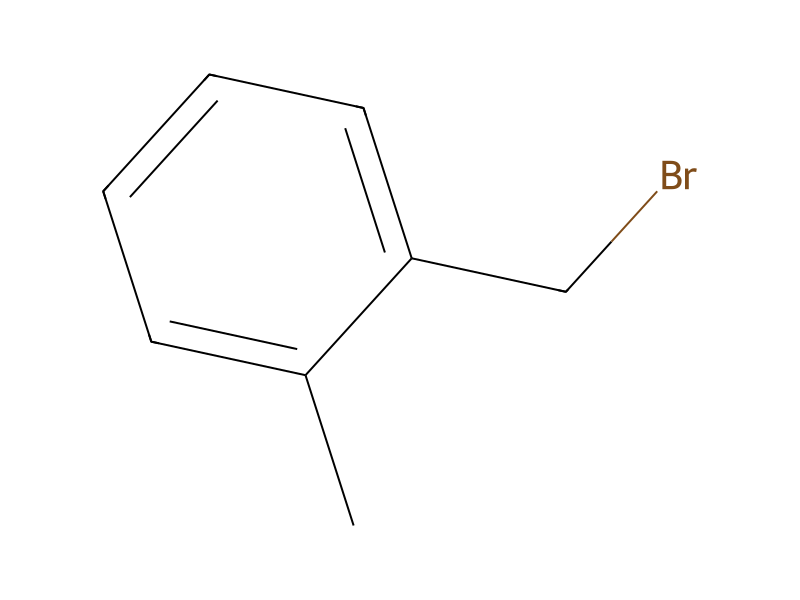
α-ブロモ-o-キシレン

o-Xylyl bromide

HCID 6992
ノートを作成反応を作成見積依頼を出す
印刷プレビュー

データを補完しています。しばらくしてからページを更新すると最新の内容を表示できます
基本情報概要名称と識別子物性安全と法規制化学と産業関連反応化合物ノート
部分構造検索類似構造を探す

基本情報

CAS
28777-60-8
標準SMILES
Cc1ccccc1CBr
InChIKey
WGVYCXYGPNNUQA-UHFFFAOYSA-N
分子式
C8H9Br
平均分子量
185.06 g/mol
単同位体質量
183.98876239

概要

o-Xylyl bromide, also known as methylbenzyl bromide or T-stoff, is a poisonous organic chemical compound, formerly used as a tear gas. Physically it is a colourless liquid (melting point 21 °C) with a pleasant aromatic odour. o-Xylyl bromide is highly toxic, irritant and lachrymatory, and has been incorporated in chemical weapons since the early months of World War I. The first extensive use of xylyl bromide was the firing by German forces of 18,000 "T-shells" at Russian positions in the Battle of Bolimów in January 1915. In the absence of clarification, the name "xylyl bromide" may refer to any one of 3 xylyl isomers (o-Xylyl, p-Xylyl, m-Xylyl) or a mixture of all three.

名称と識別子

優先名称
o-Xylyl bromide
IUPAC
1-(bromomethyl)-2-methylbenzene
現地名
α-ブロモ-o-キシレン
英語名
2-Methylbenzyl bromide
分子式
C8H9Br
分子量
185.06

名称と別名

2-Methylbenzyl bromide89-92-91-(Bromomethyl)-2-methylbenzenealpha-Bromo-o-xyleneO-XYLYL BROMIDEo-Methylbenzyl bromide2-Xylyl bromide2-(Bromomethyl)tolueneBenzene, 1-(bromomethyl)-2-methyl-A-BROMO-O-XYLENEo-(Bromomethyl)toluene.alpha.-Bromo-o-xylene
名称をさらに表示
α-ブロモ-o-キシレン(o-トリルメチル)ブロミドo-キシリルブロミド2-(ブロモメチル)トルエン1-メチル-2-(ブロモメチル)ベンゼン2-メチルベンジルブロミドo-メチルベンジルブロミド1-ブロモメチル-2-メチルベンゼン1-(ブロモメチル)-2-メチルベンゼン臭化2-メチルベンジル 臭化物臭化2-メチルベンジル1-(bromomethyl)-2-methyl-benzenuorobenzyL2-xylylbromideà-bromo-o-xylene2-BROMO-O-XYLENEα-Bromo-o-xylene
o-Xylene, alpha-bromo-alpha-Bromo-ortho-xyleneNSC 60145HSDB 2192.alpha.-Bromo-ortho-xyleneEINECS 201-951-63NDQ4L309UNSC-60145

物性

構造計算による物性補完中

XLogP
3
極性表面積
0 Ų
水素結合供与体数
0
水素結合受容体数
0
回転可能結合数
1
重原子数
9
形式電荷
0
複雑度
80.6

実験および物理化学的性質

Chemical ClassesOther Classes -> Halogenated Monoaromatics
SpringerMaterials PropertiesNuclear quadrupole resonance spectroscopy
Density1.381 g/cu cm at 23 °C
Color/FormPrisms
Solubility · 3 件

Insoluble in water

Practically insol in water; sol in alcohol, ether

Soluble in acetone, benzene, organic solvents

Flash Point82 °C (180 °F) - closed cup
Boiling Point · 2 件

217 °C

BP: 223-234 °C; 216-217 °C at 742 mm Hg; 102 °C at 15 mm Hg

DecompositionHazardous decomposition products formed under fire conditions. - Carbon oxides, Hydrogen bromide gas
Melting Point21 °C
Vapor Pressure0.15 [mmHg]
Refractive IndexIndex of refraction: 1.5730 at 27 °C/D

安全と法規制

安全情報は参考情報です。供給元の安全データシート(SDS)、適用法令、専門家による評価に代わるものではありません。

GHS分類

GHS Classification · 4 件

Danger

H314 (100%): Causes severe skin burns and eye damage [Danger Skin corrosion/irritation]

P260, P264, P271, P280, P284, P301+P330+P331, P302+P361+P354, P304+P340, P305+P354+P338, P316, P320, P321, P363, P403+P233, P405, and P501 (click each P-code to see the statement)

Aggregated GHS information provided per 46 reports by companies from 5 notifications to the ECHA C&L Inventory. Each notification may be associated with multiple companies.

危険有害性情報

Regulatory InformationBenzene, 1-(bromomethyl)-2-methyl-: Does not have an individual approval but may be used under an appropriate group standard
Fire PotentialSlight, when exposed to heat or flame.
Hazards SummaryPowerful lachrymator; [Merck Index] Toxic by inhalation and ingestion; A strong irritant; [Hawley] Toxic by inhalation; Causes burns; May cause pneumonitis and pulmonary edema after inhalation of high concentrations; [MSDSonline]
Hazard Classes and CategoriesSkin Corr. 1B (100%)
Shipment Methods and Regulations · 3 件

No person may /transport,/ offer or accept a hazardous material for transportation in commerce unless that person is registered in conformance ... and the hazardous material is properly classed, described, packaged, marked, labeled, and in condition for shipment as required or authorized by ... /the hazardous materials regulations (49 CFR 171-177)./

The International Air Transport Association (IATA) Dangerous Goods Regulations are published by the IATA Dangerous Goods Board pursuant to IATA Resolutions 618 and 619 and constitute a manual of industry carrier regulations to be followed by all IATA Member airlines when transporting hazardous materials.

The International Maritime Dangerous Goods Code lays down basic principles for transporting hazardous chemicals. Detailed recommendations for individual substances and a number of recommendations for good practice are included in the classes dealing with such substances. A general index of technical names has also been compiled. This index should always be consulted when attempting to locate the appropriate procedures to be used when shipping any substance or article.

化学と産業

薬理情報

Metabolism/Metabolites · 1 件

Bromine is mainly absorbed via inhalation, but may also enter the body through dermal contact. Bromine salts can be ingested. Due to its reactivity, bromine quickly forms bromide and may be deposited in the tissues, displacing other halogens. (L626)

用途と製造

Uses · 5 件

Used in organic synthesis and as a military tear gas; [Merck Index]

In war-gas formulations

Organic synthesis, tear gas. /Mixture of ortho-, meta-, and para-isomers/

A poison. /Xylyl Bromide/

Occupational exposure to xylyl bromide may occur through inhalation and dermal contact with this compound at workplaces where xylyl bromide is produced or used.

Methods of ManufacturingBromination of xylene. /Mixture of ortho-, meta-, and para-isomers/
Formulations/PreparationsGrade: technical. /Mixture of ortho-, meta-, and para-isomers/

上流・下流製品情報

下流製品

(2-メチルフェニル)メタンスルホニルクロリド2-メチルベンジルアミン1,4-ビス(2-メチルスチリル)ベンゼンα-ブロモ-p-キシレンo-キシリレンジシアニド

関連反応

145 件
反応記録を作成
HRID 4911 の反応式
HRID 4911反応物としてuspto-grants-1993_09
HRID 44536 の反応式
HRID 44536反応物としてuspto-grants-2013_09
HRID 51399 の反応式
HRID 51399反応物としてuspto-grants-2004_03
HRID 102887 の反応式
HRID 102887反応物としてTraining data from https://doi.org/10.1039/C8SC04228D (2/10)
HRID 108928 の反応式
HRID 108928反応物としてTraining data from https://doi.org/10.1039/C8SC04228D (2/10)
HRID 111856 の反応式
HRID 111856反応物としてTraining data from https://doi.org/10.1039/C8SC04228D (2/10)
HRID 139942 の反応式
HRID 139942反応物としてTraining data from https://doi.org/10.1039/C8SC04228D (9/10)
HRID 144267 の反応式
HRID 144267反応物としてTraining data from https://doi.org/10.1039/C8SC04228D (9/10)
1 / 19 ページ

化合物ノート

読み込み中…

このページの内容基本情報概要名称と識別子物性安全と法規制化学と産業関連反応化合物ノート
その他の操作
ノートを作成反応を作成見積依頼を出す

データベース識別子

CAS
28777-60-8、89-92-9
PubChem CID
6992
DTXSID
DTXSID00870422
UNII
3NDQ4L309U
EC Number
201-951-6
Nikkaji
J4.311G
Physical DescriptionPrisms; [Merck Index] Colorless liquid with melting point of 18-20 deg C; [MSDSonline]

物理化学的性質

融点
16 · 16-20 °C(lit.)
沸点
216 · 216-217 °C742 mm Hg(lit.)
比重(密度)
1.381 g/mL · 1.381 g/mL at 25 °C(lit.)
屈折率
20 · n20/D 1.575(lit.)
闪点
180 °F · 180 °F
貯蔵温度
2 · 2-8°C
外見
clear liquid
色
Colorless to Light yellow
水溶解度
実質的に不溶
Merck
14 · 14,10090
BRN
636333 · 636333
Henry's Law Constant
1.3 · 1.3×10-2 mol/(m3Pa) at 25℃, HSDB (2015)
InChI
1S/C8H9Br/c1-7-4-2-3-5-8(7)6-9/h2-5H,6H2,1H3
InChIKey
WGVYCXYGPNNUQA-UHFFFAOYSA-N
SMILES
Cc1ccccc1CBr
CAS データベース
89 · 89-92-9(CAS DataBase Reference)
NISTの化学物質情報
1 · Benzene, 1-(bromomethyl)-2-methyl-(89-92-9)

化学的性質

化学的特性clear yellow liquid

Shipping Name/ Number DOT/UN/NA/IMO · 3 件

UN 1701; Xylyl bromide, liquid

UN 3417; Xylyl bromide, solid

IMO 6.1; Xylyl bromide, liquid; Xylyl bromide, solid

Hazardous Reactivities and IncompatibilitiesAlcohols, Bases, Amines, Oxidizing agents

安全と保護具

Fire Fighting Procedures · 5 件

For small (incipient) fires, use media such as "alcohol" foam, dry chemical, or carbon dioxide. For large fires, apply water from as far as possible. Use very large quantities (flooding) of water applied as a mist or spray; solid streams of water may be ineffective. Cool all affected containers with flooding quantities of water.

Use water spray to cool unopened containers.

Wear self contained breathing apparatus for fire fighting if necessary.

If material on fire or involved in fire: Use water in flooding quantities as fog. Use "alcohol" foam, dry chemical or carbon dioxide. Cool all affected containers with flooding quantities of water. Use water spray to knock-down vapors. /Xylyl bromide, liquid; Xylyl bromide, solid/

Personnel protection: ... Wear positive pressure self-contained breathing apparatus when fighting fires involving this material. /Xylyl bromide, liquid; Xylyl bromide, solid/

Storage ConditionsKeep container tightly closed in a dry and well-ventilated place. Containers which are opened must be carefully resealed and kept upright to prevent leakage.
Cleanup Methods · 3 件

Use personal protective equipment. Avoid breathing vapors, mist or gas. Ensure adequate ventilation. Remove all sources of ignition. Evacuate personnel to safe areas. Beware of vapors accumulating to form explosive concentrations. Vapors can accumulate in low areas.

Contain spillage, and then collect with an electrically protected vacuum cleaner or by wet-brushing and place in container for disposal according to local regulations. Keep in suitable, closed containers for disposal.

Prevent further leakage or spillage if safe to do so. Do not let product enter drains.

Disposal Methods · 3 件

SRP: The most favorable course of action is to use an alternative chemical product with less inherent propensity for occupational harm/injury/toxicity or environmental contamination. Recycle any unused portion of the material for its approved use or return it to the manufacturer or supplier. Ultimate disposal of the chemical must consider: the material's impact on air quality; potential migration in soil or water; effects on animal and plant life; and conformance with environmental and public health regulations.

Contaminated packaging: Dispose of as unused product.

This combustible material may be burned in a chemical incinerator equipped with an afterburner and scrubber. Offer surplus and non-recyclable solutions to a licensed disposal company.

Preventive Measures · 5 件

Handle in accordance with good industrial hygiene and safety practice. Wash hands before breaks and at the end of workday.

Avoid inhalation of vapor or mist. Keep away from sources of ignition - No smoking. Take measures to prevent the buildup of electrostatic charge.

In case of skin contact: Take off contaminated clothing and shoes immediately. Wash off with soap and plenty of water.

If material not on fire and not involved in fire: Keep sparks, flames, and other sources of ignition away. Keep material out of water sources and sewers. Use water spray to knock-down vapors. /Xylyl bromide, liquid; Xylyl bromide, solid/

Personnel protection: Avoid breathing vapors. Keep upwind. ... Avoid bodily contact with the material. ... Do not handle broken packages unless wearing appropriate personal protective equipment. Wash away any material which may have contacted the body with copious amounts of water or soap and water. ... If contact with the material anticipated, wear appropriate chemical protective clothing. /Xylyl bromide, liquid; Xylyl bromide, solid/

Personal Protective Equipment (PPE) · 5 件

Wear protective gloves/ protective clothing/ eye protection/ face protection.

Complete suit protecting against chemicals.

Tightly fitting safety goggles. Faceshield (8-inch minimum). Use equipment for eye protection tested and approved under appropriate government standards such as NIOSH (US) or EN 166(EU).

Handle with gloves. Gloves must be inspected prior to use. Use proper glove removal technique (without touching glove's outer surface) to avoid skin contact with this product. Dispose of contaminated gloves after use in accordance with applicable laws and good laboratory practices. Wash and dry hands.

For more Personal Protective Equipment (PPE) (Complete) data for O-XYLYL BROMIDE (6 total), please visit the HSDB record page.

毒性情報

Treatment · 1 件

EYES: irrigate opened eyes for several minutes under running water. INGESTION: do not induce vomiting. Rinse mouth with water (never give anything by mouth to an unconscious person). Seek immediate medical advice. SKIN: should be treated immediately by rinsing the affected parts in cold running water for at least 15 minutes, followed by thorough washing with soap and water. If necessary, the person should shower and change contaminated clothing and shoes, and then must seek medical attention. INHALATION: supply fresh air. If required provide artificial respiration.

Health EffectsStrong lachrymator. Strong irritant to eyes, skin and soft tissues. Highly toxic if inhaled, swallowed or absorbed through skin
Environmental Fate · 3 件

TERRESTRIAL FATE: Based on a classification scheme(1), an estimated Koc value of 730(SRC), determined from a structure estimation method(2), indicates that o-xylyl bromide is expected to have low mobility in soil(SRC). Volatilization of o-xylyl bromide from moist soil surfaces is expected to be an important fate process(SRC) given an estimated Henry's Law constant of 7.6X10⁻⁵ atm-cu m/mole(SRC), using a fragment constant estimation method(3). o-Xylyl bromide is expected to volatilize from dry soil surfaces(SRC) based upon an estimated vapor pressure of 0.15 mm Hg at 25 °C(SRC), determined from a fragment constant method(2). However, due to a reported hydrolysis half-life of 3.4 hours at 20 °C for o-xylyl bromide(4) adsorption, volatilization, and biodegradation are not expected to be important environmental fate processes in moist soil(SRC).

AQUATIC FATE: Based on a classification scheme(1), an estimated Koc value of 730(SRC), determined from a structure estimation method(2), indicates that o-xylyl bromide is expected to adsorb to suspended solids and sediment(SRC). Volatilization from water surfaces is expected(3) based upon an estimated Henry's Law constant of 7.6X10⁻⁴ atm-cu m/mole(SRC), developed using a fragment constant estimation method(4). Using this Henry's Law constant and an estimation method(3), volatilization half-lives for a model river and model lake are 6 hrs and 6 days, respectively(SRC). According to a classification scheme(5), an estimated BCF of 85(SRC), from an estimated log Kow of 3.43(2) and a regression-derived equation(2), suggests the potential for bioconcentration in aquatic organisms is moderate(SRC). However, due to a reported hydrolysis half-life of 3.4 hours at 20 °C for o-xylyl bromide(6) adsorption, volatilization, bioconcentration, and biodegradation are not expected to be important environmental fate processes in water(SRC).

ATMOSPHERIC FATE: According to a model of gas/particle partitioning of semivolatile organic compounds in the atmosphere(1), o-xylyl bromide, which has an estimated vapor pressure of 0.15 mm Hg at 25 °C(SRC), determined from a fragment constant method(2), is expected to exist solely as a vapor in the ambient atmosphere. Vapor-phase o-xylyl bromide is degraded in the atmosphere by reaction with photochemically-produced hydroxyl radicals(SRC); the half-life for this reaction in air is estimated to be 4.3 days(SRC), calculated from its rate constant of 3.7X10⁻¹² cu cm/molecule-sec at 25 °C(SRC) that was derived using a structure estimation method(2). o-Xylyl bromide does not contain chromophores that absorb at wavelengths >290 nm(4) and, therefore, is not expected to be susceptible to direct photolysis by sunlight(SRC).

Adverse EffectsDermatotoxin - Skin burns.
Exposure RoutesOral (L626) ; inhalation (L626) ; dermal (L626)
Toxicity Summary · 1 件

Organobromide compounds such as o-Xylyl bromide are strong alkylating agents. Consequently they can readily modify free thiols (cysteines) and methionine residues of the surfaces of proteins leading to the disruption of enzyme, transporter or membrane functions. One of the most probable protein targets is the TRPA1 ion channel that is expressed in sensory nerves (trigeminal nerve) of the eyes, nose, mouth and lungs.

Signs and SymptomsCauses severe eye and skin burns. Irritating to eyes, skin, and respiratory system. Acute exposure (ingestion or inhalation) can lead to coma, nausea, vomiting, and metabolic acidosis may occur.
Soil Adsorption/Mobility · 1 件

Using a structure estimation method based on molecular connectivity indices(1), the Koc of o-xylyl bromide can be estimated to be 730(SRC). According to a classification scheme(2), this estimated Koc value suggests that o-xylyl bromide is expected to have moderate mobility in soil. However, due to a reported hydrolysis half-life of 3.4 hours at 20 °C for o-xylyl bromide(3) adsorption is not expected to be important environmental fate processes in moist soil(SRC).

Human Toxicity Excerpts · 2 件

/OTHER TOXICITY INFORMATION/ Powerful lacrimator.

/OTHER TOXICITY INFORMATION/ ... Strongly lacrimatory. /Xylyl bromides/

Artificial Pollution Sources · 1 件

o-Xylyl bromide's production and presense in a mixture with the p- and m-isomers in organic synthesis(1) may result in its release to the environment through various waste streams. Its use in mixture with p- and m-isomers as a tear gas will result in its direct release to the environment(SRC).

Carcinogen ClassificationNo indication of carcinogenicity (not listed by IARC). (L135)
Environmental Bioconcentration · 1 件

An estimated BCF of 85 was calculated in fish for o-xylyl bromide(SRC), using an estimated log Kow of 3.43(1) and a regression-derived equation(1). According to a classification scheme(2), this BCF suggests the potential for bioconcentration in aquatic organisms is moderate(SRC). However, due to a reported hydrolysis half-life of 3.4 hours at 20 °C for o-xylyl bromide(3) bioconcentration is not expected to be important environmental fate processes in water(SRC).

安全データ

F
19
wgk
3
rtecs
CY9039100
ridadr
UN 1701 6.1/PG 2
hs_code
29036990
risk_code
36/37/38-34-20/21/22
消防法
危-4-3-III
hazard_code
C
safety_code
26-36/37/39-45
hazard_class
6.1
packing_group
II
Hazard Classifications
Skin Corr. 1B
ストレージクラス
6.1A - Combustible acute toxic Cat. 1 and 2very toxic hazardous materials
有毒物質データの
89-92-9(Hazardous Substances Data)
2-メチルベンジルアルコール
o-キシリル シアニド
Benzoic acid, 3-hydroxy-5-[(2-methylphenyl)methoxy]-, methyl ester
(2-メチルベンジル)ホスホン酸ジエチル