
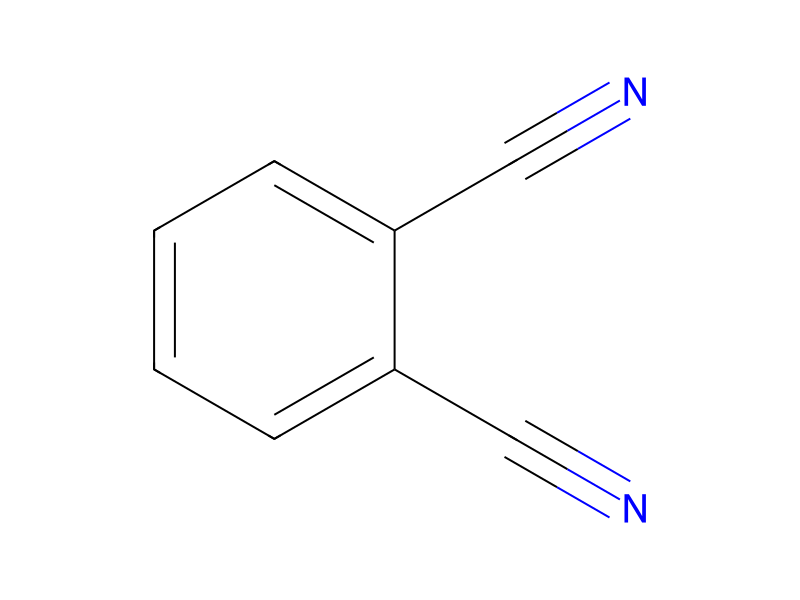
基本情報
- 標準SMILES
N#Cc1ccccc1C#N- InChIKey
XQZYPMVTSDWCCE-UHFFFAOYSA-N- 分子式
- C8H4N2
- 平均分子量
- 128.13 g/mol
- 単同位体質量
- 128.03744813
概要
Phthalonitrile is a dinitrile that is benzene which is substituted by cyano groups at positions 1 and 2. It is a member of benzenes and a dinitrile.
名称と識別子
- 優先名称
- Phthalonitrile
- IUPAC
- benzene-1,2-dicarbonitrile
- 現地名
- フタロニトリル
- 英語名
- Phthalonitrile
- 分子式
- C8H4N2
- 分子量
- 128.13
名称と別名
Phthalonitrile1,2-Dicyanobenzene91-15-61,2-BENZENEDICARBONITRILEo-Phthalodinitrilebenzene-1,2-dicarbonitrileo-Dicyanobenzeneo-Cyanobenzonitrileo-Benzenedinitrileo-Pdno-BenzenedicarbonitrilePhthalic acid dinitrile
名称をさらに表示
フタロニトリルベンゼン-1,2-ジカルボニトリル1,2-ジシアノベンゼン1,2-ベンゼンジカルボニトリルフタロジニトリルo-フタロニトリルフタル酸-o-ジニトリルフタル酸oジニトリルオルト‐フタロジニトリル1,2‐ジシアノベンゼンフタロニトリル, 98%フタル酸ジニトリルPhthalodinitrilPHTHALODINITRILEO-PHTHALONITRILEC8H4N2o-pdn[qr]usafnd-09
USAF ND-09FtalodinitrilFtalonitril1,2-Benzendikarbonitrilortho-DicyanobenzeneDTXSID8029604978627YAJUNSC-17562
データベース識別子
- CAS
91-15-6- PubChem CID
- 7042
- DTXSID
DTXSID8029604- ChEMBL
CHEMBL3185350- ChEBI
CHEBI:232056- UNII
- 978627YAJU
- EC Number
- 202-044-8
- Nikkaji
- J3.921G
物性
構造計算による物性
- XLogP
- 1
- 極性表面積
- 47.6 Ų
- 水素結合供与体数
- 0
- 水素結合受容体数
- 2
- 回転可能結合数
- 0
- 重原子数
- 10
- 形式電荷
- 0
- 複雑度
- 178
実験および物理化学的性質
Chemical ClassesNitrogen Compounds -> Nitriles
SpringerMaterials PropertiesSchoenflies notation
LogP
log Kow = 0.99
0.58
0.99
OdorSlightly aromatic
Density
1.238 g/cu cm
1.24 g/cm³
Color/Form
NEEDLES FROM WATER OR PETROLEUM ETHER
Buff-colored crystals
Faint grayish yellow
Solubility
Soluble in alcohol and ether
Soluble in acetone and benzene.
In water, 395 mg/l @ 25 °C.
Solubility in water, g/100ml at 25 °C: 0.06
Flash Point
162 °C
162 °C
Boiling Point304.5 °C
DecompositionWhen heated to decomposition it emits toxic fumes of CN- and NOx /cyanides and nitrogen oxides/.
Melting Point
138 °C
141 °C
Vapor Pressure
0.00569 [mmHg]
0.05 millibar @ 20 °C (3.75X10⁻² mm Hg)
Vapor pressure, Pa at 20 °C: 4
物理化学的性質
- 融点
- 137 · 137-139 °C (lit.)
- 沸点
- 227.54 °C · 227.54°C (rough estimate)
- 比重(密度)
- 1.24 · 1.24
- 蒸気圧
- 1 Pa · <1 Pa (25 °C)
- 屈折率
- 1.6231 · 1.6231 (estimate)
- 闪点
- 162 °C · 162°C
- 貯蔵温度
- 30 °C · Store below +30°C.
- 溶解性
- 50 mg/mL、透明 · ベンゼン: 50 mg/mL、透明
- 外見
- 結晶または結晶性粉末
- 色
- 白からベージュ
- PH
- 7 · 7 (H2O)
- 水溶解度
- 0.56 g/L · 0.56g/L(25℃)
- BRN
- 775028 · 775028
- Henry's Law Constant
- 2 · 2.0×101 mol/(m3Pa) at 25℃, HSDB (2015)
- 安定性
- 安定。強塩基、強酸、強酸化剤、強還元剤とは相容れない。
- InChI
- 1S/C8H4N2/c9-5-7-3-1-2-4-8(7)6-10/h1-4H
- InChIKey
- XQZYPMVTSDWCCE-UHFFFAOYSA-N
- SMILES
- N#Cc1ccccc1C#N
- CAS データベース
- 91 · 91-15-6(CAS DataBase Reference)
- NISTの化学物質情報
- Phthalonitrile(91-15-6)
- EPAの化学物質情報
- 1 · 1,2-Benzenedicarbonitrile (91-15-6)
化学的性質
化学的特性Phthalonitrile is a crystalline powder having a faint grayish yellow color and a slighty aromatic odor, similar to benzonitrile. Phthalonitrile was first described in 1896 when it was isolated during the diazotization of 2-aminobenzonitrile. The compound is sparingly soluble in water (ca. 1 g/L) and soluble in acetone, nitrobenzene, and benzonitrile. It cannot be distilled and polymerizes if heated above the melting point. It is not explosive and is difficult to ignite, but the dust can explode.
安全と法規制
GHS分類
GHS Classification
Danger
H300 (28.4%): Fatal if swallowed [Danger Acute toxicity, oral]
P261, P262, P264, P270, P271, P273, P280, P301+P316, P302+P352, P304+P340, P316, P321, P330, P361+P364, P403+P233, P405, and P501 (click each P-code to see the statement)
Aggregated GHS information provided per 162 reports by companies from 11 notifications to the ECHA C&L Inventory. Each notification may be associated with multiple companies.
Danger
H301: Toxic if swallowed [Danger Acute toxicity, oral]
危険有害性情報
Regulatory Information
Status: Active Update: 31-01-2022 https://echa.europa.eu/registration-dossier/-/registered-dossier/1983
Phthalonitrile: Does not have an individual approval but may be used under an appropriate group standard
Fire HazardsCombustible. Gives off irritating or toxic fumes (or gases) in a fire. Finely dispersed particles form explosive mixtures in air.
Hazards Summary
Inhalation of high concentrations may cause CNS effects; [ICSC] Emergency treatment: Benzyl cyanide; [HSDB] Lethal doses cause tremor and convulsions in rats; [RTECS] TLV Basis = convulsions and decreased body weight; Unlike the aliphatic nitriles, aromatic nitriles such as m-phthalodinitrile do not liberate cyanide in the body. [ACGIH] An acute neurotoxin; Not irritating to skin or eyes; [Reference #1] See m-Phthalodinitrile. See NITRILES.
UN ClassificationUN Hazard Class: 6.1; UN Pack Group: III
Chemical DangersDecomposes on heating. This produces toxic fumes including cyanide. On combustion, forms nitrogen oxides. Reacts with strong oxidants.
Packaging and LabellingDo not transport with food and feedstuffs.
Toxic Combustion ProductsWhen heated to decomposition it emits toxic fumes of hydrogen cyanide and NOx /cyanides and nitrogen oxides/.
Hazard Classes and Categories
Acute Tox. 2 (28.4%)
Acute toxicity (Oral) - Category 3
Acute toxicity (Oral) - Category 3
安全と保護具
Fire FightingUse dry powder, carbon dioxide, foam.
First Aid Measures
Fresh air, rest. Refer for medical attention.
Rinse skin with plenty of water or shower.
First rinse with plenty of water for several minutes (remove contact lenses if easily possible), then refer for medical attention.
Rinse mouth. Induce vomiting (ONLY IN CONSCIOUS PERSONS!). Give a slurry of activated charcoal in water to drink. Refer for medical attention .
Safe StorageSeparated from strong oxidants and food and feedstuffs.
Disposal Methods
SRP: At the time of review, criteria for land treatment or burial (sanitary landfill) disposal practices are subject to significant revision. Prior to implementing land disposal of waste residue (including waste sludge), consult with environmental regulatory agencies for guidance on acceptable disposal practices.
Spillage Disposal
Personal protection: particulate filter respirator adapted to the airborne concentration of the substance. Do NOT let this chemical enter the environment. Sweep spilled substance into covered containers. Carefully collect remainder. Then store and dispose of according to local regulations.
Eye PreventionWear safety goggles.
Fire PreventionNO open flames. Closed system, dust explosion-proof electrical equipment and lighting. Prevent deposition of dust.
Inhalation RiskA harmful concentration of airborne particles can be reached quickly when dispersed.
Skin PreventionProtective gloves.
Exposure PreventionPREVENT DISPERSION OF DUST!
Ingestion PreventionDo not eat, drink, or smoke during work.
Inhalation PreventionUse local exhaust or breathing protection.
毒性情報
Treatment
Antidotes to cyanide poisoning include hydroxocobalamin and sodium nitrite, which release the cyanide from the cytochrome system, and rhodanase, which is an enzyme occurring naturally in mammals that combines serum cyanide with thiosulfate, producing comparatively harmless thiocyanate. Oxygen therapy can also be administered. (L97)
Health Effects
Exposure to high levels of cyanide for a short time harms the brain and heart and can even cause coma, seizures, apnea, cardiac arrest and death. Chronic inhalation of cyanide causes breathing difficulties, chest pain, vomiting, blood changes, headaches, and enlargement of the thyroid gland. Skin contact with cyanide salts can irritate and produce sores. (L96, L97)
Environmental Fate
TERRESTRIAL FATE: Based on a classification scheme(1), an estimated Koc value of 82(SRC), determined from a log Kow of 0.99(2) and a regression-derived equation(3), indicates that 1,2-benzenedicarbonitrile is expected to have high mobility in soil(SRC). Volatilization of 1,2-benzenedicarbonitrile from moist soil surfaces is not expected to be an important fate process(SRC) given an estimated Henry's Law constant of 5.0X10⁻⁷ atm-cu m/mole(SRC), using a fragment constant estimation method(4). 1,2-Benzenedicarbonitrile is not expected to volatilize from dry soil surfaces(SRC) based upon a vapor pressure of 3.75X10⁻² mm Hg(5).
AQUATIC FATE: Based on a classification scheme(1), an estimated Koc value of 82(SRC), determined from a log Kow of 0.99(2) and a regression-derived equation(3), indicates that 1,2-benzenedicarbonitrile is not expected to adsorb to suspended solids and sediment(SRC). Volatilization from water surfaces is not expected(3) based upon an estimated Henry's Law constant of 5.0X10⁻⁷ atm-cu m/mole(SRC), developed using a fragment constant estimation method(4). According to a classification scheme(5), a range of BCF values of 0.8 to <5.5 for carp(6), suggests the potential for bioconcentration in aquatic organisms is low(SRC).
ATMOSPHERIC FATE: According to a model of gas/particle partitioning of semivolatile organic compounds in the atmosphere(1), 1,2-benzenedicarbonitrile, which has a vapor pressure of 3.75X10⁻² mm Hg at 25 °C(2), is expected to exist solely as a vapor in the ambient atmosphere(SRC). Vapor-phase 1,2-benzenedicarbonitrile is degraded in the atmosphere by reaction with photochemically-produced hydroxyl radicals(SRC); the half-life for this reaction in air is estimated to be 356 days(SRC), calculated from its rate constant of 4.5X10⁻¹⁴ cu cm/molecule-sec at 25 °C(SRC) determined using a structure estimation method(3).
Adverse EffectsNeurotoxin - Other CNS neurotoxin
Exposure Routes
The substance can be absorbed into the body by inhalation and by ingestion.
Oral (L96) ; inhalation (L96) ; dermal (L96)
Toxicity Summary
Organic nitriles decompose into cyanide ions both in vivo and in vitro. Consequently the primary mechanism of toxicity for organic nitriles is their production of toxic cyanide ions or hydrogen cyanide. Cyanide is an inhibitor of cytochrome c oxidase in the fourth complex of the electron transport chain (found in the membrane of the mitochondria of eukaryotic cells). It complexes with the ferric iron atom in this enzyme. The binding of cyanide to this cytochrome prevents transport of electrons from cytochrome c oxidase to oxygen. As a result, the electron transport chain is disrupted and the cell can no longer aerobically produce ATP for energy. Tissues that mainly depend on aerobic respiration, such as the central nervous system and the heart, are particularly affected. Cyanide is also known produce some of its toxic effects by binding to catalase, glutathione peroxidase, methemoglobin, hydroxocobalamin, phosphatase, tyrosinase, ascorbic acid oxidase, xanthine oxidase, succinic dehydrogenase, and Cu/Zn superoxide dismutase. Cyanide binds to the ferric ion of methemoglobin to form inactive cyanmethemoglobin. (L97)
Signs and Symptoms
Dizziness. Headache. Nausea. Vomiting. Convulsions. Unconsciousness.
Dizziness. Headache. Nausea. Vomiting. Convulsions. Unconsciousness.
Cyanide poisoning is identified by rapid, deep breathing and shortness of breath, general weakness, giddiness, headaches, vertigo, confusion, convulsions/seizures and eventually loss of consciousness. (L96, L97)
ICSC Environmental DataThe substance is harmful to aquatic organisms. This substance does enter the environment under normal use. Great care, however, should be taken to avoid any additional release, for example through inappropriate disposal.
Soil Adsorption/Mobility
The Koc of 1,2-benzenedicarbonitrile is estimated as 82(SRC), using a measured log Kow of 0.99(1) and a regression-derived equation(2). According to a classification scheme(3), this estimated Koc value suggests that 1,2-benzenedicarbonitrile is expected to have high mobility in soil(SRC).
Human Toxicity Excerpts
COMPARISON OF 20 WORKERS (AGE 32-62) WITH POSSIBLE EXPOSURE FOR 2-24 YR, FROM WHICH 7 SUFFERED ACUTE POISONING IN 1953-66, WITH CORRESPONDING CONTROL GROUP SHOWED NO SIGNIFICANT DIFFERENCES IN CHROMOSOMES.
MORTALITY RATE OF 221 EXPOSED WORKERS WAS INSIGNIFICANTLY GREATER THAN THAT OF INTERNAL OR EXTERNAL CONTROL GROUPS.
NO EVIDENCE FOR CHRONIC TOXICITY OF PHTHALONITRILE WAS FOUND. EXAM OF EXPOSED WORKERS FOR LEUKOSIS OR CARCINOGENIC EFFECTS, CLINICAL & NEUROLOGICAL EXAM OF 81 EXPOSED WORKERS, EEG STUDIES OF WORKERS GAVE RESULTS WITHIN NORMAL LIMITS.
Artificial Pollution Sources
1,2-Benzenedicarbonitrile's production and use as an intermediate in organic synthesis (esp, pigments and dyes) and as a base material for high temperature lubricants and coatings(1) may result in its release to the environment through various waste streams(SRC).
Carcinogen ClassificationNo indication of carcinogenicity to humans (not listed by IARC).
安全データ
- wgk
- 1
- tsca
- TSCA listed
- rtecs
- TI8575000
- ridadr
- UN 3439 6.1/PG 2
- 毒性
- LD50 orally in Rabbit: 85 mg/kg
- hs_code
- 29269095
- risk_code
- 25-23/24/25
- 化審法
- (3)-1799
- 安衛法
- 特化則 特定化学物質(管理第2類)
- hazard_code
- T
- safety_code
- 36/37/39-45-28A
- hazard_class
- 6.1
- packing_group
- II
- 毒劇物取締法
- 劇物
- 自然発火温度
- >580 °C
- Hazard Classifications
- Acute Tox. 3 OralAquatic Chronic 3
- ストレージクラス
- 6.1A - Combustible acute toxic Cat. 1 and 2very toxic hazardous materials
- 有毒物質データの
- 91-15-6(Hazardous Substances Data)
化学と産業
薬理情報
Mechanism of Action... systemic cyanide poisoning is suspected.
Metabolism/Metabolites
Organic nitriles are converted into cyanide ions through the action of cytochrome P450 enzymes in the liver. Cyanide is rapidly absorbed and distributed throughout the body. Cyanide is mainly metabolized into thiocyanate by either rhodanese or 3-mercaptopyruvate sulfur transferase. Cyanide metabolites are excreted in the urine. (L96)
用途と製造
Uses
Used as an intermediate mainly for the production of phthalocyanine dyes; Also used in sintering metals; [ACGIH]
Metal Extraction and Refining [Category: Industry]
Intermediate in organic synthesis, (esp pigments and dyes), base material for high temp lubricants and coatings
Insecticide, synergist /Former/
Used as a starting material for producing phthalocyanine pigments, fluorescent brighteners and photographic sensitizers.
Phthalonitrile is used as a precursor to phthalocyanine pigments (which are precursors to the blue dye in jeans), fluorescent brighteners, and photographic sensitizers. (L611)
Methods of Manufacturing
Vapor phase reaction of ammonia and phthalic anhydride over alumina catalyst @ high temp.
Produced commercially from o-xylene by ammoxidation; produced commercially from phthalic acid, phthalic anhydride, phthalamide or phthalimide by reaction with ammonia and elimination of water @ 300-500 °C in gas-phase with catalyst.
General Manufacturing Information
1,2-Benzenedicarbonitrile: ACTIVE
HIGHLY TOXIC STOMACH POISON FOR CATERPILLARS & DIPTEROUS LARVAE.
応用分野
用途フタロシアニン系染料の合成
使用Phthalonitrile is used as an intermediate for chemical synthesis in the production of building blocks for colorants and coatings, life science and agricultural chemicals. It is also used as a precursor to phthalocyanine pigments (which are precursors to the blue dye in jeans), fluorescent brighteners, and photographic sensitizers.
調製方法
製造方法Phthalonitrile can be produced from phthalic acid, phthalic anhydride, phthalamide, or phthalimide by reaction with ammonia and elimination of water at 300–500°C in the gas phase in the presence of a catalyst. In a single-stage continuous process, o-xylene is converted to phthalonitrile by reaction with ammonia and oxygen in the gas phase in a fluidized-bed reactor. Generally, metal oxide mixtures containing vanadium, antimony, chromium, and molybdenum, with further active components such as iron, tungsten, and alkali-metal oxides, on an alumina or silica support are used as catalysts.
純化方法Crystallise the nitrile from EtOH, toluene or *benzene. It has also been distilled under high vacuum. It is steam volatile. [Beilstein 9 H 815, 9 II 602, 9 III 4199, 9 IV 3268.]
上流・下流製品情報
上流原料
下流製品
サプライヤー50 社
国药集团化学试剂有限公司86-21-63210123 · [email protected]
梯希爱(上海)化成工业发展有限公司021-67121386 · [email protected]
上海阿拉丁生化科技股份有限公司400-6206333 13167063860 · [email protected]
Dayang Chem (Hangzhou) Co.,Ltd.+86-0571-88938639 17705817739 · [email protected]
Syntechem Co.,Ltd[email protected]
上海迈瑞尔生化科技有限公司4006356688 18621169109 · [email protected]
武汉易泰科技有限公司上海分公司18930552037 · [email protected]
阿法埃莎(中国)化学有限公司400-6106006 · [email protected]
太原市瑞和丰科贸有限公司+86 351 7031519 · [email protected]
安耐吉化学&3A(安徽泽升科技股份有限公司)400-0056266 · [email protected]
上海瀚鸿科技股份有限公司021-54306202 13764082696 · [email protected]
上海钰康生物科技有限公司+86-18930848214 +86-021-56762820 · [email protected]
上海景颜化工科技有限公司13817811078 · [email protected]
上海隆盛化工有限公司58099637 13585536065 · [email protected]
上海攀鸿化工科技有限公司021-56491756 13512199871 · [email protected]
合肥天健化工有限公司551-65418679 15856988503;15837135945 · [email protected]
山东西亚化学有限公司13355009207 13355009207 · [email protected]
玛雅试剂+86 (573) 82222445 (0)18006601000 452520369 · [email protected]
四川库利南科技有限公司400-1166-196 18981987031 · [email protected]
天津希恩思生化科技有限公司400 638 7771 · [email protected]
艾科试剂4008-755-333 18080918076 · [email protected]
上海思域化工科技有限公司86-21-34053660 · [email protected]
赛默飞世尔科技(中国)有限公司800-810-5118 · [email protected]
北京伊诺凯科技有限公司400-810-7969 010-59572699 · [email protected]
江苏艾康生物医药研发有限公司025-66113011 13913916777 · [email protected]
TCI AMERICA800-4238616 · [email protected]
TOKYO CHEMICAL INDUSTRY CO., LTD.03-36680489 · [email protected]
TCI Europe320-37350700 · [email protected]
上海贤鼎生物科技有限公司4009209199 · [email protected]
上海汇凯化学科技有限公司021-61995394 18916691159 · [email protected]
上海将来实业股份有限公司400-0066400 13621662912 · [email protected]
安徽科迪达化工有限公司0554-2106669 · [email protected]
日照力德士化工有限公司010-51268198 · [email protected]
美岚实业(上海)有限公司021-58958189 · [email protected]
上海爱蝶实业有限公司021-58957966 18930537195 · [email protected]
广拓化学(上海)有限公司021-60899189-8001 18918189673 · [email protected]
上海创赛科技有限公司400-6087598 15021221957 · [email protected]
上海麦克林生化科技股份有限公司15221275939 15221275939 · [email protected]
上海乾劲化工科技有限公司021-20900665 17321230821 · [email protected]
杭州杰恒化工有限公司0571-87396432 · [email protected]
上海洽凡生化科技有限公司+86-021-61654350 · [email protected]
上海有朋化工有限公司021-69005955 13701776567 · [email protected]
上海凯赛化工有限公司021-33516722 13701817765 · [email protected]
上海彤源化工有限公司021-021-69182866 13701855675 · [email protected]
上海容立化学科技有限公司021-69992220 13701886816 · [email protected]
上海康拓化工有限公司021-69185552 13701777608 · [email protected]
Sigma-Aldrich西格玛奥德里奇(上海)贸易有限公司021-61415566 800-8193336 · [email protected]
桦特昇生物科技(武汉)有限公司027-59207879 1972026995 18140587686 · [email protected]
成都瑞欧克科技有限公司028-64353063 · [email protected]
Henan Alfa Chemical Co., Ltd+8618339805032 · [email protected]
関連反応
108 件


関連ノート
読み込み中…