ホームMCPワークベンチSkills
ホームワークベンチ通知マイページ
llms.txt · MCPガイドプライバシーポリシー · 利用規約 · サポートv1.8.0
  1. ホーム
  2. /化合物

シクロペンタノール

Cyclopentanol

HCID 7298
ノートを作成反応を作成見積依頼を出す
印刷プレビュー

データを補完しています。しばらくしてからページを更新すると最新の内容を表示できます
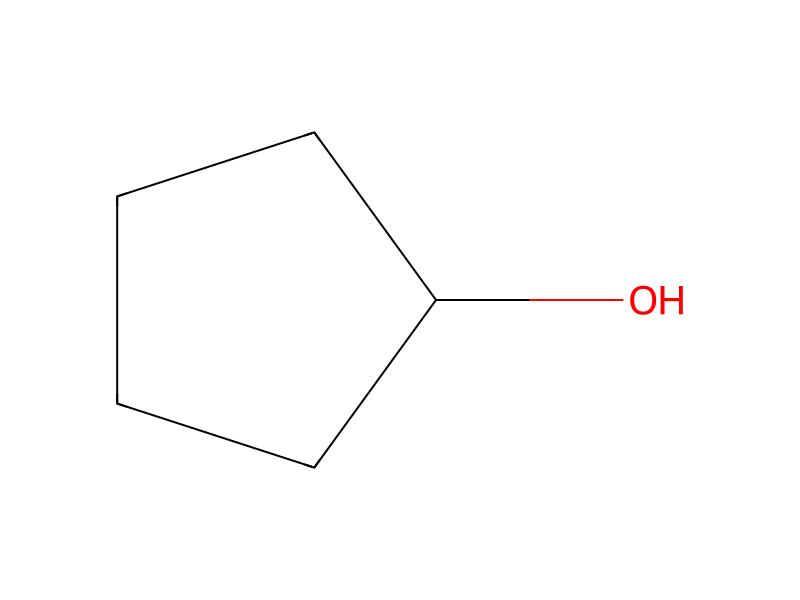
基本情報概要名称と識別子物性安全と法規制化学と産業関連反応化合物ノート
部分構造検索類似構造を探す

基本情報

CAS
96-41-3
標準SMILES
OC1CCCC1
InChIKey
XCIXKGXIYUWCLL-UHFFFAOYSA-N
分子式
C5H10O
平均分子量
86.13 g/mol
単同位体質量
86.07316494

概要

Cyclopentanol appears as a colorless viscous liquid with a pleasant odor. Slightly less dense than water. Vapors heavier than air. Used to make perfumes and pharmaceuticals.

名称と識別子

優先名称
Cyclopentanol
IUPAC
cyclopentanol
現地名
シクロペンタノール
英語名
Cyclopentanol
分子式
C5H10O
分子量
86.13

名称と別名

CYCLOPENTANOL96-41-3Cyclopentyl alcoholHydroxycyclopentaneDTXSID1033371UN22441L43Q07TBUNSC-49117DTXCID9013371CHEBI:16133UN-2244RefChem:129864
名称をさらに表示
シクロペンタノールシクロペンチルアルコール1-シクロペンタノールシクロペンタン-1-オールシクロペンタノ-ルヒドロキシシクロペンタンopentanoLCyclopentanol>Cyclopentanol-D8Cyclopentanol,99%Cyclopentanol 99%Cyclopentanol, 98%+
202-504-81-cyclopentanolMFCD00001363CAS-96-41-3HSDB 2821EINECS 202-504-8NSC 49117cydopentanol

データベース識別子

CAS
96-41-3
PubChem CID
7298
DTXSID
DTXSID1033371
ChEMBL
CHEMBL288998
ChEBI
CHEBI:16133
UNII
1L43Q07TBU
EC Number
202-504-8
Nikkaji
J43.298I

物性

構造計算による物性補完中

XLogP
0.8
極性表面積
20.2 Ų
水素結合供与体数
1
水素結合受容体数
1
回転可能結合数
0
重原子数
6
形式電荷
0
複雑度
37.2

実験および物理化学的性質

Chemical ClassesFlammable agents - 2nd degree
SolventsSolvents -> Alcohols (<C12)
SpringerMaterials PropertiesBoiling point
LogPlog Kow = 0.71
Odor · 2 件

Odor of amyl alcohol, somewhat like peppermint

Pleasant odor

Density0.9478 @ 20 °C/4 °C
Flavoring AgentsEU Flavoring substances
Color/FormColorless, viscous liquid
Solubility · 2 件

SOL IN ALCOHOL, ETHER, ACETONE; SLIGHTLY SOL IN WATER

Sparingly soluble in water. Soluble in ethanol.

Flash Point · 2 件

124 °F (NFPA, 2010)

124 °F (51 °C) (CLOSED CUP)

Boiling Point140.4 °C @ 760 MM HG

安全と法規制

安全情報は参考情報です。供給元の安全データシート(SDS)、適用法令、専門家による評価に代わるものではありません。

GHS分類

GHS Classification · 6 件

Warning

H226 (100%): Flammable liquid and vapor [Warning Flammable liquids]

P210, P233, P240, P241, P242, P243, P280, P303+P361+P353, P370+P378, P403+P235, and P501 (click each P-code to see the statement)

Aggregated GHS information provided per 57 reports by companies from 3 notifications to the ECHA C&L Inventory.

Danger

H226: Flammable liquid and vapor [Warning Flammable liquids]

危険有害性情報

Regulatory Information · 5 件

Chemical: Cyclopentanol

Commission Regulation (EC) No 1565/2000 (Repealed by Com. Implementing Reg. (EU) No 872/2012)

Status: Active Update: 30-05-2018 https://echa.europa.eu/registration-dossier/-/registered-dossier/15902

Cyclopentanol: HSNO Approval: HSR001247 Approved with controls

The New Jersey Worker and Community Right to Know Act requires public and private employers to provide information about hazardous substances at their workplaces. (N.J.S.A. 34:5A-1 et. seq.)

DOT LabelFlammable Liquid
Fire Hazards · 2 件

Excerpt from ERG Guide 129 [Flammable Liquids (Water-Miscible / Noxious)]:

· HIGHLY FLAMMABLE: Will be easily ignited by heat, sparks or flames.

Fire PotentialMODERATE, IN PRESENCE OF HEAT OR FLAME.
Health Hazards · 2 件

Excerpt from ERG Guide 129 [Flammable Liquids (Water-Miscible / Noxious)]:

· May cause toxic effects if inhaled or absorbed through skin.

Hazards SummaryCan defat skin and cause CNS depression; [HSDB] An eye irritant; [eChemPortal: ERMA] An irritant; [MSDSonline]

化学と産業

用途と製造

Uses · 3 件

Used as a solvent (perfumes and pharmaceuticals) and for organic synthesis; [Hawley]

Perfume and pharmaceutical solvent, intermediate for dyes, pharmaceuticals, and other organics.

In the preparation of quingestanol acetate.

Methods of Manufacturing · 3 件

BY REDUCTION OF CYCLOPENTANONE WITH LIALH4 IN ETHER @ ROOM TEMP.

...BY MODIFIED MEERWEIN-PONDORF-VERLEY REDUCTION OF CYCLOPENTANONE IN PRESENCE OF ALUMINUM ISOPROPOXIDE & SODIUM HYDROXIDE. BY CATALYTIC HYDROGENATION OF PURE CYCLOPENTANONE WITH COPPER CHROMITE @ 150 °C & 150 ATM.

BY CATALYTIC HYDROGENATION OF CYCLOPENTANONE WITH PLATINUM OXIDE & PLATINUM BLACK @ 2-3 ATM: NOLLER, ADAMS, J AM CHEM SOC 48, 1084 (1926); BY HYDRATION OF CYCLOPENTENE IN AQ H2SO4: HEPP, US PATENT 2,414,646 (1947 TO PHILLIPS PETR)...

General Manufacturing InformationCyclopentanol: ACTIVE
応用分野 · 5 件

解説シクロペンタノール (Cyclopentanol) とは、の水素が一つヒドロキシ基で置換された構造をしている有機化合物です。 環状アルコールの1種にあたります。CAS登録番号は96-41-3です。分子式C5H10O、分子量86.13、融点-19℃、沸点139-140℃です。常温では無色からわずかにうすい黄色の液体となっており、 不快臭を放つとされています。密度は0.949g/mLです。 他の名称には、「シクロペンチルアルコール (Cyclopentyl alcohol) 」「ヒドロキシシクロペンタン (Hydroxycyclopentane) 」などがあります。水には難溶ですが、アルコール、エーテルおよびには極めて容易に溶けます。

用途香水や医薬品の中間体溶剤、染料、医薬品などの有機物

使用Cyclopentanol is a versatile compound used as a building block, intermediate and solvent.

一般的な説明A colorless viscous liquid with a pleasant odor. Slightly less dense than water. Flash point 124°F. Vapors heavier than air. Used to make perfumes and pharmaceuticals.

使用用途図2. シクロペンタノールの酸化によるシクロペンタノンの合成の例 シクロペンタノールの主な用途は、一般的な溶剤、香料調剤用の溶剤、医薬・農薬原料などです。また、シクロペンタノールは、のであり、TEMPOなどの安価な触媒で極めて高選択的にシクロペンタノンを製造することができます。 シクロペンタノンは各種産業用途で利用価値が高い化合物であるため、この変換反応は非常に重要です。例えば、特定フロンや1,1,1-は、金属材料に付着する油の洗浄液として有益ですが、環境に影響があるため、新しい代替洗浄液が必要となっています。 そこで、生分解性が良好であるシクロペンタノンが、近年代替洗浄液として注目を集めています。また、シクロペンタノン (及びその前駆体のシクロペンタノール) は、各種医薬品の合成中間体であるため、合成化学的にも重要な化合物と言えます。

関連反応

380 件
反応記録を作成
HRID 6450 の反応式
HRID 6450反応物としてuspto-grants-1993_09
HRID 18821 の反応式
HRID 18821反応物としてuspto-grants-2010_06
HRID 21480 の反応式
HRID 21480反応物としてuspto-grants-1995_06
HRID 21481 の反応式
HRID 21481反応物としてuspto-grants-1995_06
HRID 23031 の反応式
HRID 23031反応物としてuspto-grants-2005_02
HRID 33195 の反応式
HRID 33195反応物としてuspto-grants-2008_09
HRID 33357 の反応式
HRID 33357反応物としてuspto-grants-2008_09
HRID 49944 の反応式
HRID 49944反応物としてuspto-grants-2004_03
1 / 48 ページ

化合物ノート

読み込み中…

このページの内容基本情報概要名称と識別子物性安全と法規制化学と産業関連反応化合物ノート
その他の操作
ノートを作成反応を作成見積依頼を出す
Melting Point
-19 °C

物理化学的性質

融点
-19 °C · -19 °C (lit.)
沸点
139 · 139-140 °C (lit.)
比重(密度)
0.948 g/mL · 0.948 g/mL at 20 °C 0.949 g/mL at 25 °C (lit.)
屈折率
20 · n20/D 1.453(lit.)
闪点
124 °F · 124 °F
貯蔵温度
Flammables area
溶解性
Chloroform (Soluble), Methanol (Sparingly)
酸解離定数(Pka)
15.31 · 15.31±0.20(Predicted)
外見
液体
色
無色透明~微黄色透明
水溶解度
わずかに溶ける
比熱容量
2.12 J/ · Cp(liquid): 2.12 J/(g·K), at 25℃
Merck
14 · 14,2742
BRN
1900556 · 1900556
Henry's Law Constant
4.2 · 4.2×100 mol/(m3Pa) at 25℃, Plyasunov and Shock (2000)
Dielectric constant
18 · 18.0(20℃)
安定性
安定。可燃性。強力な酸化剤、酸塩化物、酸無水物とは相容れない。
InChI
1S/C5H10O/c6-5-3-1-2-4-5/h5-6H,1-4H2
InChIKey
XCIXKGXIYUWCLL-UHFFFAOYSA-N
SMILES
OC1CCCC1
LogP
0.71 · 0.710
表面張力
32.7 mN/m · 32.7mN/m at 20°C
CAS データベース
96 · 96-41-3(CAS DataBase Reference)
NISTの化学物質情報
Cyclopentanol(96-41-3)
EPAの化学物質情報
Cyclopentanol (96-41-3)

化学的性質

化学的特性シクロペンタノールは化学式C5H10Oで表される有機化合物ですこの化合物は五メンバーリングのシクロアルカンであるシクロペンタンにヒドロキシル基OHが結合した構造を持っていますシクロペンタノールはアルコールの一種であり特に二級アルコールに分類されますその特徴として水とも有機溶剤とも混和可能であることが挙げられます

DOT ID and Guide
2244 129
Reactive GroupAlcohols and Polyols
Reactivity Profile · 1 件

CYCLOPENTANOL is an alcohol. Flammable and/or toxic gases are generated by the combination of alcohols with alkali metals, nitrides, and strong reducing agents. They react with oxoacids and carboxylic acids to form esters plus water. Oxidizing agents convert them to aldehydes or ketones. Alcohols exhibit both weak acid and weak base behavior. They may initiate the polymerization of isocyanates and epoxides.

DOT Emergency Guidelines · 5 件

/GUIDE 129: FLAMMABLE LIQUIDS (Polar/Water-Miscible/Noxious)/ Fire or Explosion: HIGHLY FLAMMABLE: Will be easily ignited by heat, sparks or flames. Vapors may form explosive mixtures with air. Vapors may travel to source of ignition and flash back. Most vapors are heavier than air. They will spread along ground and collect in low or confined areas (sewers, basements, tanks). Vapor explosion hazard indoors, outdoors or in sewers. Those substances designated with a (P) may polymerize explosively when heated or involved in a fire. Runoff to sewer may create fire or explosion hazard. Containers may explode when heated. Many liquids are lighter than water.

/GUIDE 129: FLAMMABLE LIQUIDS (Polar/Water-Miscible/Noxious)/ Health: May cause toxic effects if inhaled or absorbed through skin. Inhalation or contact with material may irritate or burn skin and eyes. Fire will produce irritating, corrosive and/or toxic gases. Vapors may cause dizziness or suffocation. Runoff from fire control or dilution water may cause pollution.

/GUIDE 129: FLAMMABLE LIQUIDS (Polar/Water-Miscible/Noxious)/ Public Safety: CALL Emergency Response Telephone Number on Shipping Paper first. If Shipping Paper not available or no answer, refer to appropriate telephone number listed on the inside back cover. As an immediate precautionary measure, isolate spill or leak area for at least 50 meters (150 feet) in all directions. Keep unauthorized personnel away. Stay upwind. Keep out of low areas. Ventilate closed spaces before entering.

/GUIDE 129: FLAMMABLE LIQUIDS (Polar/Water-Miscible/Noxious)/ Protective Clothing: Wear positive pressure self-contained breathing apparatus (SCBA). Structural firefighters' protective clothing will only provide limited protection.

For more DOT Emergency Guidelines (Complete) data for CYCLOPENTANOL (8 total), please visit the HSDB record page.

DOT Hazard Classification · 4 件

Cyclopentanol

UN2244

Class 3 Flammable and combustible liquid (49 eCFR § 173.120)

PG III: the degree of danger presented by the material is minor

Air and Water ReactionsFlammable. Soluble in water.

安全と保護具

Fire FightingExcerpt from ERG Guide 129 [Flammable Liquids (Water-Miscible / Noxious)]:
Accidental Release Measures · 2 件

· CALL 911. Then call emergency response telephone number on shipping paper. If shipping paper not available or no answer, refer to appropriate telephone number listed on the inside back cover.

· ELIMINATE all ignition sources (no smoking, flares, sparks or flames) from immediate area.

First Aid · 2 件

Excerpt from ERG Guide 129 [Flammable Liquids (Water-Miscible / Noxious)]:

General First Aid:

Exposure Control and Personal Protection· Wear positive pressure self-contained breathing apparatus (SCBA).
Fire Fighting Procedures · 1 件

If material on fire or involved in fire: Do not extinguish fire unless flow can be stopped or safely confined. Use water in flooding quantities as fog. Solid streams of water may be ineffective. Use "alcohol" foam, dry chemical or carbon dioxide. Cool all affected containers with flooding quantities of water. Apply water from as far a distance as possible. Keep run-off water out of sewers and water sources.

Storage Conditions · 1 件

IN GENERAL, MATERIALS WHICH ARE TOXIC AS STORED OR WHICH CAN DECOMP INTO TOXIC COMPONENTS...SHOULD BE STORED IN COOL, WELL-VENTILATED PLACE, OUT OF DIRECT RAYS OF SUN, AWAY FROM AREAS OF HIGH FIRE HAZARD & SHOULD BE PERIODICALLY INSPECTED & MONITORED.

Nonfire Spill ResponseExcerpt from ERG Guide 129 [Flammable Liquids (Water-Miscible / Noxious)]:
Disposal Methods · 1 件

SRP: At the time of review, criteria for land treatment or burial (sanitary landfill) disposal practices are subject to significant revision. Prior to implementing land disposal of waste residue (including waste sludge), consult with environmental regulatory agencies for guidance on acceptable disposal practices.

Preventive Measures · 2 件

If material not on fire and not involved in fire: Keep sparks, flames, and other sources of ignition away. Keep material out of water sources and sewers. Build dikes to contain flow as necessary. Attempt to stop leak if without undue personnel hazard.

Personnel protection: Keep upwind. Avoid breathing vapors. ... Do not handle broken packages unless wearing appropriate personal protective equipment.

Isolation and Evacuation · 2 件

Excerpt from ERG Guide 129 [Flammable Liquids (Water-Miscible / Noxious)]:

Immediate precautionary measure

Personal Protective Equipment (PPE) · 2 件

Excerpt from ERG Guide 129 [Flammable Liquids (Water-Miscible / Noxious)]:

... Wear appropriate chemical protective gloves, boots and goggles. Wear positive pressure self-contained breathing apparatus. ...

Emergency Response Planning GuidelinesCAUTION: The majority of these products have a very low flash point. Use of water spray when fighting fire may be inefficient.

毒性情報

Environmental Fate · 3 件

TERRESTRIAL FATE: Based on a recommended classification scheme(1), an estimated Koc value of 58(SRC), determined from a measured log Kow(2) and a recommended regression-derived equation(3), indicates that cyclopentanol will have high mobility in soil(SRC); leaching of this compound may be important under some environmental conditions(SRC). In soil, cyclopentanol is expected to readily biodegrade(SRC). In tests using activated sludge inocula, 95% of the inital COD (cyclopentanol at 200 mg/L COD), was removed over 120 hours(4); 97%(5) of the theoretical BOD was obtained within 5 days (cyclopentanol at 100 mg/L). Volatilization of cyclopentanol should be important from dry soil surfaces(SRC) given a measured vapor pressure of 1892 mm Hg at 25 °C(6). Volatilization from moist soil surfaces will be very slow(SRC) based on an estimated Henry's Law constant of 2.6X10⁻⁶ atm-cu m/mole(7,SRC).

AQUATIC FATE: Based on a recommended classification scheme(1), an estimated Koc value of 58(SRC), determined from an experimental log Kow(2) and a recommended regression-derived equation(3), indicates that cyclopentanol will not adsorb to suspended solids and sediment(SRC) in the water. Cyclopentanol is expected to readily biodegrade in water(SRC). In tests using activated sludge inocula, 95% of the inital COD (cyclopentanol at 200 mg/L COD), was removed over 120 hours(4); 97%(5) of the theoretical BOD was obtained within 5 days (cyclopentanol at 100 mg/L). Cyclopentanol will volatilize from water surfaces based on an estimated Henry's Law constant of 2.6X10⁻⁶ atm-cu m/mole(SRC), developed using a fragment constant estimation method(6). Estimated half-lives for a model river and model lake are 13 and 98 days, respectively(3,SRC). An estimated BCF value of 2(3,SRC), from a measured log Kow(2), suggests that cyclopentanol will bioconcentrate in aquatic organisms(SRC) according to a recommended classification scheme(7).

ATMOSPHERIC FATE: According to a suggested classification scheme(1), a measured vapor pressure of 1892 mm Hg at 25 °C(2) indicates that cyclopentanol will mainly exist in the vapor phase in the ambient atmosphere. Vapor-phase cyclopentanol is degraded in the atmosphere by reaction with photochemically produced hydroxyl radicals(SRC); the half-life for this reaction in air is estimated to be about 1.5 days(3,SRC).

Food Survey ValuesCyclopentanol is present, at unreported concentrations, as a volatile component of aroma for both beef and pork(1).
Adverse EffectsNeurotoxin - Acute solvent syndrome
Soil Adsorption/Mobility · 1 件

The Koc of cyclopentanol is estimated as approximately 58(SRC), using a measured log Kow of 0.71(1) and a regression-derived equation(2,SRC). According to a recommended classification scheme(3), this estimated Koc value suggests that cyclopentanol has high mobility in soil(SRC).

TSCA Test Submissions · 5 件

Cyclopentanol (CAS # 96-41-3) was evaluated for acute oral toxicity. The test substance was administered by gavage to Wistar-derived male rats. Dosage and mortality data are as follows: 2.5 ml/kg (5/5); 1.25 ml/kg (5/5); and 0.625 ml/kg (5/6). Toxic signs included sluggish; unsteady gait; red fluid around eyes and mouth; and convulsions at 1.25 and 0.625 ml/kg. Gross pathology revealed mottled red and tan livers; distended and gas-filled stomachs; and pale kidneys.

Cyclopentanol (CAS # 96-41-3) was evaluated for acute dermal toxicity. The test substance was applied once to the clipped-intact skin of male New Zealand white rabbits for 24 hours. Dosages and mortality data are as follows: 1.60 ml/kg (2/2); 0.20 ml/kg (4/4); 0.10 ml/kg (0/4); and 0.05 ml/kg (0/2). The LD50 was determined to be 0.141 ml/kg. Toxic signs at 0.20 ml/kg and above, include erythema, edema, vocalization, hyperactivity, lacrimation and convulsions. Gross pathology revealed mottled red and light tan livers, and tan kidneys.

Cyclopentanol (CAS # 96-41-3) was evaluated for acute inhalation toxicity. The test substance was administered to 6 rats (strain and sex not indicated) per single exposure for 136 minutes (100% mortality) or 68 minutes (no mortalities) as a substantially saturated atmosphere at room temperature. LT50 was determined to be 96 minutes. Mortality resulted after a few hours. Toxic signs included lacrimation, hypoactivity, severe tremors, ataxia, salivation, dilated pupils, and coordination loss. Gross pathology revealed dark red lungs, and gas-filled stomach and intestines.

Cyclopentanol (CAS # 96-41-3) was evaluated for primary dermal irritation. The test substance was applied in 0.01 ml amounts to the clipped, uncovered intact skin of 5 rabbits (sex and strain not indicated), either undiluted or in dilutions of 10%, 1.0%, 0.1%, or 0.01% solvent. No irritation was noted on 4 rabbits, and moderate capillary injection was noted on one rabbit (Grade 2) at an unspecified concentration.

Cyclopentanol (CAS # 96-41-3) was evaluated for primary eye irritation. The test substance was applied to the conjunctival sac of 5 rabbits (sex and strain not indicated) at 0.005 ml, 0.02 ml, 0.10 ml, or 0.5 ml of undiluted or 0.5 ml of 40%, 15%, 5%, or 1% dilutions of test material. Moderate to severe corneal injury with iritis resulted from 0.005 ml of undiluted and 0.5 ml of 40% dilution of test material. No injury to minor corneal injury, with iritis in one rabbit, resulted from 15% dilution.

Atmospheric Concentrations · 1 件

Cyclopentanol was detected in 10% of expired air samples taken from an urban population of humans(28 subjects, 224 expired air samples); the average concentration was 0.9 ng cyclopentanol/L expired air(1). 8.5% of 387 expired air samples from 54 human subjects contained cyclopentanol at an average concentration of 0.329 ng/L expired air(2).

Human Toxicity Excerpts · 2 件

LIQUID ALICYCLIC HYDROCARBONS WILL DEHYDRATE & DELIPIDIZE SKIN ON REPEATED OR PROLONGED CONTACT & CAUSE DERMATITIS. DIRECT CONTACT...WITH LUNG TISSUE (ASPIRATION) WILL CAUSE PULMONARY EDEMA, PNEUMONITIS & HEMORRHAGE. VAPORS IN SUFFICIENT CONCN WILL CAUSE IRRITATION OF MUCOUS MEMBRANES. /ALICYCLIC HYDROCARBONS/

TOXICOLOGICALLY, THE ALICYCLIC HYDROCARBONS RESEMBLE THEIR OPEN CHAIN RELATIVES, THE ALIPHATIC HYDROCARBONS. IN GENERAL, THEY ARE ANESTHETICS & CNS DEPRESSANTS WITH A RELATIVLY LOW ORDER OF ACUTE TOXICITY. ...CUMULATIVE TOXICITY FROM REPEATED EXPOSURE TO LOW ATMOSPHERIC CONCN IS IMPROBABLE. /ALICYCLIC HYDROCARBONS/

Artificial Pollution SourcesCyclopentanol's production and use as a perfume and pharmaceutical solvent and as an intermediate for dyes, pharmaceuticals, and other organics(1) may result in its release to the environment through various waste streams.
Environmental Biodegradation · 1 件

Cyclopentanol, present at a COD of 200 mg/L, was readily biodegraded with 97% COD removal in 5 days using an adapted, activated sludge inoculum(1). A 5 day BOD test using a non-adapted sewage culture resulted in a BOD nearly 95% of the theoretical for cyclopentanol(2). Cyclopentanol at 100 mg/L had a BOD 53% of the theoretical after 24 hours, using a Warburg respirometer(2). Trichosporon cutaneum KUY-6A, a yeast strain isolated from a soil enrichment culture, was able to grow using cyclopentanol(3).

Environmental Bioconcentration · 1 件

An estimated BCF value of 2 was calculated for cyclopentanol(SRC), using a measured log Kow of 0.71(1) and a recommended regression-derived equation(2). According to a classification scheme(3), this BCF value suggests that bioconcentration in aquatic organisms will not be low(SRC).

Volatilization from Water/Soil · 1 件

The Henry's Law constant for cyclopentanol is estimated as 2.6X10⁻⁶ atm-cu m/mole(SRC) using a fragment constant estimation method(1). This value indicates that cyclopentanol will volatilize from water surfaces(2,SRC). Based on this Henry's Law constant, the volatilization half-life from a model river (1 m deep, flowing 1 m/sec, wind velocity of 3 m/sec) is estimated as approximately 13 days(2,SRC). The volatilization half-life from a model lake (1 m deep, flowing 0.05 m/sec, wind velocity of 0.5 m/sec) is estimated as approximately 98 days(2,SRC). Cyclopentanol's high vapor pressure, 1892 mm Hg(3) indicates that volatilization from dry soil surfaces should occur(SRC); based on this compound's Henry's Law constant(1,SRC), significant volatilization from moist soil surfaces is not expected(SRC).

Environmental Abiotic Degradation · 1 件

The rate constant for the vapor-phase reaction of cyclopentanol with photochemically produced hydroxyl radicals has been measured as 10.7X10⁻¹² cu cm/molecule-sec at 25 °C(1). This corresponds to an atmospheric half-life of about 1.5 days at an atmospheric concentration of 5X10+5 hydroxyl radicals per cu cm(1,SRC).

安全データ

wgk
1
tsca
TSCA listed
ridadr
UN 2244
hs_code
29061990
risk_code
10-36/37/38
化審法
(3)-2306
消防法
危-4-2-III
hazard_code
Xi
safety_code
16-36-26
hazard_class
3
packing_group
III
Hazard Classifications
Flam. Liq. 3
ストレージクラス
3 - Flammable liquids
有毒物質データの
96-41-3(Hazardous Substances Data)

上流・下流製品情報

上流原料

アジピン酸白金水酸化バリウムシクロペンタノンリチウムクロロシクロペンタンBorane, tricyclopentyl-シクロペンチルシクロペンタン

下流製品

シクロペンチルマロン酸シクロペンテンブロモシクロペンタン2-シクロペンチルフェノールN-メチルシクロペンタンアミンヨードシクロペンタンシクロペンタン-1-カルボン酸メチル2-メチルシクロペンタノンクロロギ酸シクロペンチル 塩化物2-メチルプロペン酸シクロペンチル

補足説明

定義ChEBI: Cyclopentanol is the simplest member of the class of cyclopentanols bearing a single hydroxy substituent. The parent of the class of cyclopentanols.