
N-メチルジエタノールアミン
N-Methyldiethanolamine
データを補完しています。しばらくしてからページを更新すると最新の内容を表示できます

基本情報
- CAS
105-59-9- 標準SMILES
CN(CCO)CCO- InChIKey
CRVGTESFCCXCTH-UHFFFAOYSA-N- 分子式
- C5H13NO2
- 平均分子量
- 119.16 g/mol
- 単同位体質量
- 119.09462866
概要
Methyldiethanolamine is a colorless liquid. (USCG, 1999)
名称と識別子
- 優先名称
- N-Methyldiethanolamine
- IUPAC
- 2-[2-hydroxyethyl(methyl)amino]ethanol
- 現地名
- N-メチルジエタノールアミン
- 英語名
- N-Methyldiethanolamine
- 分子式
- C5H13NO2
- 分子量
- 119.16
名称と別名
N-METHYLDIETHANOLAMINE105-59-9MethyldiethanolamineMethyl diethanolamineN-MethylaminodiglycolEthanol, 2,2'-(methylimino)bis-2,2'-(Methylimino)diethanolN-MethyliminodiethanolDiethanolmethylamineMethyliminodiethanolUSAF DO-52Bis(2-hydroxyethyl)methylamine
名称をさらに表示
N-メチルジエタノールアミン2,2'-(メチルイミノ)ジエタノールメチルジエタノールアミンビス(2-ヒドロキシエチル)メチルアミン2,2'-メチルイミノビスエタノール2,2'-メチルイミノビス(エタノール)ジエタノールメチルアミンMDEA【ジオール】2,2'-(メチルイミノ)ビスエタノールジェフオリートMS-100メチルイミノジエタノールN-メチル-N-(2-ヒドロキシエチル)-2-ヒドロキシエタンアミンN-メチルアミノジグリコールN,N-ビス(2-ヒドロキシエチル)メタンアミン2,2'-(メチルイミノ)ビス(エタノール)2,2'-(N-メチルイミノ)ジエタノール2,2'-メチルイミノジエタノールガススペックCS-2000N-メチル-N,N-ジエタノールアミンメチルビス(2-ヒドロキシエチル)アミンMDEAMethyldiethanolaminN-Methyldiethanolamin2-[2-hydroxyethyl(methyl)amino]ethanolFC MDEAusafdo-52Mdea (diol)
Methylbis(2-hydroxyethyl)amineN-Methyl-2,2'-iminodiethanolN-MethyldiethanolimineN,N-Bis(2-hydroxyethyl)methylamineEthanol, 2,2'-(methylimino)di-N,N-Di(2-hydroxyethyl)-N-methylamineDTXSID80255912-(N-2-Hydroxyethyl-N-methylamino)ethanol
データベース識別子
- CAS
105-59-9- PubChem CID
- 7767
- DTXSID
DTXSID8025591- ChEMBL
CHEMBL3185149- UNII
- 3IG3K131QJ
- EC Number
- 203-312-7
- Nikkaji
- J38.148I
物性
構造計算による物性補完中
- XLogP
- -1.1
- 極性表面積
- 43.7 Ų
- 水素結合供与体数
- 2
- 水素結合受容体数
- 3
- 回転可能結合数
- 4
- 重原子数
- 8
- 形式電荷
- 0
- 複雑度
- 43.7
実験および物理化学的性質
Chemical ClassesNitrogen Compounds -> Ethanolamines
SpringerMaterials Properties15N nuclear magnetic resonance spectrum
FragrancesFragrance Ingredient (Ethanol, 2,_2'-_(methylimino)_bis-) -> IFRA transparency List
LogP-1.08
OdorAmine-like odor
Density
1.0377 at 68 °F (USCG, 1999) - Denser than water; will sink
1.043 g/cu cm at 25 °C
Bulk density: 8.7 lb/gal, vapor pressure less than 0.01 mm Hg at 20 °C
Relative density (water = 1): 1.04
Viscosity101 mPa-sec at 20 °C
Color/Form
Colorless liquid
Liquid
Solubility
Very soluble (NTP, 1992)
In water, 1.0X10+6 mg/L, temp not specified (miscible)
Miscible with water
Very soluble in water
Miscible with benzene
Solubility in water, g/100ml at 25 °C: 100
Flash Point
260 °F (NTP, 1992)
127 °C (261 °F) - closed cup
260 °F (127 °C) (Open Cup)
136 °C c.c.
Boiling Point
477 °F at 760 mmHg (NTP, 1992)
245 °C
247 °C
DecompositionWhen heated to decomposition it emits toxic fumes of /nitrogen oxides/.
物理化学的性質
- 融点
- 21 °C; · −21.00 °C; −5.80 °F; 252.15 K
- 沸点
- 247.1 °C; · 247.1 °C; 476.7 °F; 520.2 K
- 比重(密度)
- 1.038 g · 1.038 g mL−1
- 蒸気密度
- 4 · 4 (vs air)
- 蒸気圧
- 0.01 mm · 0.01 mm Hg ( 20 °C)
- 屈折率
- 1.4694 · 1.4694
- 闪点
- 127 °C · 127 °C (261 °F; 400 K)
- 貯蔵温度
- 30 °C · Store below +30°C.
- 溶解性
- Chloroform (Slightly), Methanol (Slightly)
- 酸解離定数(Pka)
- 14.41 · 14.41±0.10(Predicted)
- 外見
- liquid
- 色
- Colorless
- 臭い (Odor)
- アンモニカル
- PH
- 11.5 · 11.5 (100g/l, H2O, 20℃)
- 爆発限界(explosive limit)
- 0.9 · 0.9-8.4%(V)
- 水溶解度
- 混和性
- BRN
- 1734441 · 1734441
- Henry's Law Constant
- 3.3 · 3.3×103 mol/(m3Pa) at 25℃, Du et al. (2017)
- 安定性
- 安定。可燃性。強力な酸化剤とは相容れない。
- 化粧品成分の機能
- フィルム形成
- InChI
- 1S/C5H13NO2/c1-6(2-4-7)3-5-8/h7-8H,2-5H2,1H3
- InChIKey
- CRVGTESFCCXCTH-UHFFFAOYSA-N
- SMILES
- N(CCO)(CCO)C
- LogP
- -1.16 at · -1.16 at 23℃
- 表面張力
- 33.5 mN/m · 33.5 mN/m at 303.15K
- CAS データベース
- 105 · 105-59-9(CAS DataBase Reference)
- NISTの化学物質情報
- Methyldiethanolamine(105-59-9)
- EPAの化学物質情報
- N-Methyldiethanolamine (105-59-9)
化学的性質
化学的特性N-Methyldiethanolamine (MDEA) is a colorless to yellow viscous liquid with an ammonia-like odor. It is completely soluble in water. N-Methyldiethanolamine is an alkyl alkanolamine.It combines the chemical characteristics of both amines and alcohols so that it is capable of undergoing reactions typical of both alcohols and amines: forming quaternary amine salts, soaps, and esters.
安全と法規制
安全情報は参考情報です。供給元の安全データシート(SDS)、適用法令、専門家による評価に代わるものではありません。
GHS分類
GHS Classification
Warning
H319: Causes serious eye irritation [Warning Serious eye damage/eye irritation]
P264+P265, P280, P305+P351+P338, and P337+P317 (click each P-code to see the statement)
This chemical does not meet GHS hazard criteria for < 0.1% (1 of 1451) of reports.
Warning
H319 (> 99.9%): Causes serious eye irritation [Warning Serious eye damage/eye irritation]
危険有害性情報
Regulatory Information
Chemical: Ethanol, 2,2'-(methylimino)bis-
Ethanol, 2,2'-(methylimino)bis- is listed on the EPA's Chemical Data Reporting (CDR) system. Manufacturers and importers of Ethanol, 2,2'-(methylimino)bis- are required to report information about their production and use of this chemical to the EPA under the Toxic Substances Control Act (TSCA). (40 eCFR Part 711)
Status: Active Update: 22-12-2022 https://echa.europa.eu/registration-dossier/-/registered-dossier/14521
Methyl diethanolamine: Does not have an individual approval but may be used under an appropriate group standard
Other Safety InformationIMAP assessments - Ethanol,2,2'-(methylimino)bis-: Human health tier II assessment
Fire Hazards
Special Hazards of Combustion Products: Irritating vapors and toxic gases, such as nitrogen oxides and carbon monoxide, may be formed when involved in fire. (USCG, 1999)
Combustible.
Health HazardsExposure can cause irritation of eyes, nose and throat. (USCG, 1999)
Hazards Summary
Causes ataxia and diarrhea in oral lethal-dose studies of rats; Causes changes in bladder and adrenal weights and methemoglobinemia-carboxyhemoglobin in 9-day intermittent dermal studies of rats; [RTECS] Not a skin sensitizer in guinea pig maximization study; Moderate to severe skin irritation but no systemic toxicity observed in 90-day dermal study of rats at doses up to 750 mg/kg/day; [IUCLID] A skin and eye irritant; [ICSC] An eye, nose, throat, and strong skin irritant; May cause second degree skin burns after a few minutes contact; [CHRIS] A mild skin and strong eye irritant; Harmful by ingestion; [Sigma-Aldrich MSDS]
Reactive GroupAlcohols and Polyols
EC ClassificationSymbol: Xi; R: 36; S: (2)-24
Special Reports
Organization for the Prohibition of Chemical Weapons; Convention on the Prohibition of the Development, Production, Stockpiling and Use of Chemical Weapons and Their Destruction. The Chemical Weapons Convention (CWC) is an international treaty which bans the development, production, stockpiling, and transfer or use of chemical weapons. The Convention mandates the destruction and prohibition of chemical weapons and related facilities and provides for restrictions on international trade in toxic chemicals and precursors.[Available from, as of November 12, 2008: http://www.opcw.org]
Reactivity Profile
METHYLDIETHANOLAMINE is an aminoalcohol. Amines are chemical bases. They neutralize acids to form salts plus water. These acid-base reactions are exothermic. The amount of heat that is evolved per mole of amine in a neutralization is largely independent of the strength of the amine as a base. Amines may be incompatible with isocyanates, halogenated organics, peroxides, phenols (acidic), epoxides, anhydrides, and acid halides. Flammable gaseous hydrogen is generated by amines in combination with strong reducing agents, such as hydrides. This compound may react with oxidizing materials. (NTP, 1992)
Chemical DangersDecomposes on heating. This produces toxic fumes. The solution in water is a medium strong base. Reacts violently with acids and oxidants.
Physical DangersThe vapour is heavier than air.
Air and Water ReactionsVery water soluble (NTP, 1992).
安全と保護具
Fire Fighting
Fire Extinguishing Agents Not to Be Used: Water.
Use foam, alcohol-resistant foam, dry powder, water spray.
First Aid Measures
Fresh air, rest.
Rinse skin with plenty of water or shower.
First rinse with plenty of water for several minutes (remove contact lenses if easily possible), then refer for medical attention.
Rinse mouth. Do NOT induce vomiting. Refer for medical attention .
First Aid
EYES: First check the victim for contact lenses and remove if present. Flush victim's eyes with water or normal saline solution for 20 to 30 minutes while simultaneously calling a hospital or poison control center. Do not put any ointments, oils, or medication in the victim's eyes without specific instructions from a physician. IMMEDIATELY transport the victim after flushing eyes to a hospital even if no symptoms (such as redness or irritation) develop.
Safe StorageStore in an area without drain or sewer access. Separated from strong acids.
Exposure Control and Personal Protection2.0 [mg/m3]
Fire Fighting Procedures
Suitable extinguishing media: Use water spray, alcohol-resistant foam, dry chemical or carbon dioxide.
Advice for firefighters: Wear self contained breathing apparatus for fire fighting if necessary.
Storage ConditionsKeep container tightly closed in a dry and well-ventilated place.
Cleanup Methods
ACCIDENTAL RELEASE MEASURES: Personal precautions, protective equipment and emergency procedures: Use personal protective equipment. Avoid breathing vapors, mist or gas. Ensure adequate ventilation. Environmental precautions: Do not let product enter drains. Methods and materials for containment and cleaning up: Soak up with inert absorbent material and dispose of as hazardous waste. Keep in suitable, closed containers for disposal.
Nonfire Spill Response
SMALL SPILLS AND LEAKAGE: If you should spill this chemical, use absorbent paper to pick up all liquid spill material. Seal the absorbent paper, as well as any of your clothing which may be contaminated, in a vapor-tight plastic bag for eventual disposal. Wash any surfaces you may have contaminated with a strong soap and water solution. Do not reenter the contaminated area until the Safety Officer (or other responsible person) has verified that the area has been properly cleaned.
Disposal Methods
SRP: Recycle any unused portion of the material for its approved use or return it to the manufacturer or supplier. Ultimate disposal of the chemical must consider: the material's impact on air quality; potential migration in air, soil or water; effects on animal, aquatic and plant life; and conformance with environmental and public health regulations. If it is possible or reasonable use an alternative chemical product with less inherent propensity for occupational harm/injury/toxicity or environmental contamination.
Product: Offer surplus and non-recyclable solutions to a licensed disposal company. Contact a licensed professional waste disposal service to dispose of this material. Contaminated packaging: Dispose of as unused product.
Principles and methods for destruction of chemical weapons: ... "Destruction of chemical weapons" means a process by which chemicals are converted in an essentially irreversible way to a form unsuitable for production of chemical weapons, and which in an irreversible manner renders munitions and other devices unusable as such. ... Each ... /nation/ shall determine how it shall destroy chemical weapons, except that the following processes may not be used: dumping in any body of water, land burial or open-pit burning. It shall destroy chemical weapons only at specifically designated and appropriately designed and equipped facilities. ... Each ... /nation/ shall ensure that its chemical weapons destruction facilities are constructed and operated in a manner to ensure the destruction of the chemical weapons; and that the destruction process can be verified under the provisions of this Convention.
Spillage Disposal
Personal protection: filter respirator for organic gases and vapours adapted to the airborne concentration of the substance. Do NOT let this chemical enter the environment. Collect leaking and spilled liquid in covered containers as far as possible. Absorb remaining liquid in sand or inert absorbent. Then store and dispose of according to local regulations.
Preventive Measures
ACCIDENTAL RELEASE MEASURES: Personal precautions, protective equipment and emergency procedures: Use personal protective equipment. Avoid breathing vapors, mist or gas. Ensure adequate ventilation. Environmental precautions: Do not let product enter drains.
Precautions for safe handling: Avoid contact with skin and eyes. Avoid inhalation of vapor or mist.
Appropriate engineering controls: Handle in accordance with good industrial hygiene and safety practice. Wash hands before breaks and at the end of workday.
Gloves must be inspected prior to use. Use proper glove removal technique (without touching glove's outer surface) to avoid skin contact with this product. Dispose of contaminated gloves after use in accordance with applicable laws and good laboratory practices. Wash and dry hands.
SRP: The scientific literature for the use of contact lenses by industrial workers is inconsistent. The benefits or detrimental effects of wearing contact lenses depend not only upon the substance, but also on factors including the form of the substance, characteristics and duration of the exposure, the uses of other eye protection equipment, and the hygiene of the lenses. However, there may be individual substances whose irritating or corrosive properties are such that the wearing of contact lenses would be harmful to the eye. In those specific cases, contact lenses should not be worn. In any event, the usual eye protection equipment should be worn even when contact lenses are in place.
毒性情報
Environmental Fate
TERRESTRIAL FATE: Based on a classification scheme(1), an estimated Koc value of 1(SRC), determined from a structure estimation method(2), indicates that N-methyldiethanolamine is expected to have very high mobility in soil(SRC). The pKa of N-methyldiethanolamine is 8.52(3), indicating that this compound will exist partially in the cation form in the environment and cations generally adsorb more strongly to soils containing organic carbon and clay than their neutral counterparts(4). Volatilization of the cation from moist soil is not expected because cations do not volatilize(SRC). Volatilization of neutral N-methyldiethanolamine from moist soil surfaces is not expected to be an important fate process(SRC) given an estimated Henry's Law constant of 3.1X10⁻¹¹ atm-cu m/mole(SRC) based upon its vapor pressure, 2.0X10⁻⁴ mm Hg(5), and assigned value for water solubility of 1X10+6 mg/L (miscible)(6). N-Methyldiethanolamine is not expected to volatilize from dry soil surfaces(SRC) based upon its vapor pressure(5). N-Methyldiethanolamine did not biodegrade after 28 days in activated sludge, but degraded >96% after 40 days in a continuous-flow experiment where the inoculum had time to acclimate(7). These data indicate that biodegradation of N-methyldiethanolamine in soil may only be important under acclimated conditions(7).
AQUATIC FATE: Based on a classification scheme(1), an estimated Koc value of 1(SRC), determined from a structure estimation method(2), indicates that N-methyldiethanolamine is not expected to adsorb to suspended solids and sediment(SRC). A pKa of 8.52(3) indicates N-methyldiethanolamine will exist partially in the cation form at pH values of 5 to 9 and, therefore, volatilization of the cation from water surfaces is not expected to be an important fate process(SRC). Volatilization of neutral N-methyldiethanolamine from water surfaces is not expected(4) based upon an estimated Henry's Law constant of 3.1X10⁻¹¹ atm-cu m/mole(SRC) derived from its vapor pressure, 2.0X10⁻⁴ mm Hg(5), and assigned value for water solubility of 1X10+6 mg/L (miscible)(6). N-Methyldiethanolamine is not expected to undergo hydrolysis in the environment due to the lack of functional groups that hydrolyze under environmental conditions(4). According to a classification scheme(7), an estimated BCF of 3(SRC), from an estimated log Kow of -1.50(2) and a regression-derived equation(2), suggests the potential for bioconcentration in aquatic organisms is low. N-Methyldiethanolamine did not biodegrade after 28 days in activated sludge, but degraded >96% after 40 days in a continuous-flow experiment where the inoculum had time to acclimate(8). These data indicate that biodegradation of N-methyldiethanolamine in water may only occur under acclimated conditions(8). [
ATMOSPHERIC FATE: According to a model of gas/particle partitioning of semivolatile organic compounds in the atmosphere(1), N-methyldiethanolamine, which has a vapor pressure of 2.0X10⁻⁴ mm Hg at 25 °C(2), is expected to exist solely as a vapor in the ambient atmosphere. Vapor-phase N-methyldiethanolamine is degraded in the atmosphere by reaction with photochemically-produced hydroxyl radicals(SRC); the half-life for this reaction in air is estimated to be 4 hours(SRC), calculated from its rate constant of 9.7X10⁻¹¹ cu cm/molecule-sec at 25 °C(SRC) that was derived using a structure estimation method(3). N-Methyldiethanolamine does not contain chromophores that absorb at wavelengths >290 nm(4) and, therefore, is not expected to be susceptible to direct photolysis by sunlight(SRC).
Adverse EffectsMethemoglobinemia - The presence of increased methemoglobin in the blood; the compound is classified as secondary toxic effect
Exposure RoutesThe substance can be absorbed into the body by ingestion.
Toxicity Summary
IDENTIFICATION AND USE: N-Methyldiethanolamine (MDEA) is a colorless liquid. MDEA is used as an intermediate, in absorption of acidic gases, as a catalyst for polyurethane foams, and pH control agent. HUMAN STUDIES: There are no data available. ANIMAL STUDIES: MDEA was irritating to the guinea pig skin, and showed potential to induce allergic contact dermatitis. MDEA caused slight eye irritation. In rats, recurrent skin application of MDEA produced a dose-related irritant effect, but there was no evidence for systemic cumulative or specific target organ or tissue toxicity. Rat dams showed dose-dependent skin irritation following repeated cutaneous application of MDEA during pregnancy. In addition, maternal toxicity was also present as anemia in dams receiving 1000 mg/kg/day. Despite maternal toxicity, there was no evidence of developmental effects. MDEA was not genotoxic when tested in the Salmonella/microsome reverse gene mutation test, the CHO/HGPRT forward gene mutation test, a sister chromatid exchange test in cultured CHO cells, and an in vivo peripheral blood micronucleus test in mice.
Signs and Symptoms
Cough. Nausea. Sore throat.
Redness. Pain.
Redness. Pain.
Nausea. Diarrhoea. Vomiting.
Ongoing Test Status
The following link will take the user to the National Toxicology Program (NTP) Test Status of Agents Search page, which tabulates the results and current status of tests such as "Short-Term Toxicity Studies", "Long-term Carcinogenicity Studies", "Developmental Studies", "Genetic Toxicology Studies", etc., performed with this chemical. Testing status for N-methyldiethanolamine is available.[Available from, as of February 1, 2019: https://ntpsearch.niehs.nih.gov/?e=True&ContentType=Testing+Status]
EPA has released the Interactive Chemical Safety for Sustainability (iCSS) Dashboard. The iCSS Dashboard provides an interactive tool to explore rapid, automated (or in vitro high-throughput) chemical screening data generated by the Toxicity Forecaster (ToxCast) project and the federal Toxicity Testing in the 21st century (Tox21) collaboration. /The title compound was tested by ToxCast and/or Tox21 assays/[USEPA; ICSS Dashboard Application; Available from, as of February 4, 2019: http://actor.epa.gov/dashboard/]
ICSC Environmental DataThe substance is harmful to aquatic organisms.
Soil Adsorption/Mobility
Using a structure estimation method based on molecular connectivity indices(1), the Koc of N-methyldiethanolamine can be estimated to be 1(SRC). According to a classification scheme(2), this estimated Koc value suggests that N-methyldiethanolamine is expected to have very high mobility in soil. The pKa of N-methyldiethanolamine is 8.52(3), indicating that this compound will exist partially in the cation form in the environment and cations generally adsorb more strongly to soils containing organic carbon and clay than their neutral counterparts(4).
Artificial Pollution Sources
N-Methyldiethanolamine's production and use in the absorption of acidic gases, catalyst for polyurethane foams, pH control agent(1) and surfactant intermediate(2) may result in its release to the environment through various waste streams(SRC). Its use as an agent precursor(3) and possible chemical warefare agent(4) will result in its direct release to the environment(SRC).
Environmental Biodegradation
AEROBIC: N-Methyldiethanolamine (present at 40% solution obtained from a gas sweetening plant) was found to be non-biodegradable after 28 days during a standard batch test using activated sludge from a municipal wastewater treatment plant as inoculum(1). In a 40-day continuous flow experiment using activated sludge, the same solution containing N-methyldiethanolamine degraded >96% based on TOC which was probably due to the adaptation of the microorganisms to the test substance(1). N-Methyldiethanolamine, added at daily increments of 15 mg/L, reached 40.0% of its BOD during a five day biochemical oxygen demand test using acclimated sewage culture(2). The biodegradation half-life of N-methyldiethanolamine was reported as 11.6 and 10.0 hours in 3 and 7% hyper saline wastewater solutions, respectively(3).
Environmental Bioconcentration
An estimated BCF of 3 was calculated in fish for N-methyldiethanolamine(SRC), using an estimated log Kow of -1.50(1) and a regression-derived equation(1). According to a classification scheme(2), this BCF suggests the potential for bioconcentration in aquatic organisms is low.
Volatilization from Water/Soil
A pKa of 8.52(1) indicates N-methyldiethanolamine will exist partially in the cation form at pH values of 5 to 9 and, therefore, volatilization from water surfaces of the cation is not expected to be an important fate process(SRC). The Henry's Law constant for neutral N-methyldiethanolamine is estimated as 3.1X10⁻¹¹ atm-cu m/mole(SRC) derived from its vapor pressure, 2.0X10⁻⁴ mm Hg(2), and assigned value for water solubility of 1X10+6 mg/L (miscible)(3). This Henry's Law constant indicates that N-methyldiethanolamine is expected to be essentially nonvolatile from water and moist soil surfaces(4). N-Methyldiethanolamine is not expected to volatilize from dry soil surfaces(SRC) based upon its vapor pressure(2).
法規制情報
DHS Chemicals of Interest (COI)
MDEA
80
220
Chemical Weapons/Chemical Weapons Precursors chemical material that, if stolen or diverted, can be converted into weapons using simple chemistry, equipment, or techniques.
安全データ
- wgk
- 1
- tsca
- TSCA listed
- rtecs
- KL7525000
- ridadr
- 2735
- 毒性
- LD50 orally in Rabbit: 4680 mg/kg
- hs_code
- 2922 17 00
- risk_code
- 36
- 化審法
- (2)-300
- 消防法
- 危-4-3-III
- hazard_code
- Xi
- safety_code
- 24
- hazard_class
- 8
- packing_group
- II
- 自然発火温度
- 770 °F
- Hazard Classifications
- Eye Irrit. 2
- ストレージクラス
- 10 - Combustible liquids
- 有毒物質データの
- 105-59-9(Hazardous Substances Data)
- 危険度評価(NFPA 704基準/消防庁データ)
- 人的[青]=0 火災[赤]=1
化学と産業
薬理情報
Biological Half-Life... The elimination half life following cutaneous dosing /in rats/ was more than 30 hours.
Absorption, Distribution and Excretion
A study was conducted examining the pharmacokinetics and tissue distribution of N-methyldiethanolamine (MDEA) following intravenous (iv) or cutaneous exposure in the rat. The metabolic fate and disposition of MDEA was assessed following infusion of 50 or 500 mg/kg of radiolabeled MDEA into the jugular veins of Fischer-344-rats or following application of 500 mg/kg to the shaved skin. MDEA was rapidly metabolized following iv administration with only 9% and 44% of the total radioactivity remaining in the plasma as unchanged MDEA 1 hour after dosing with 50 and 500 mg/kg, respectively. The pharmacokinetics at the higher dose appeared to be nonlinear. Plasma radioactivity increased slowly following cutaneous exposure and continued to be available after the chemical was washed off of the skin. Up to 50% of the applied dose was absorbed after 72 hours of skin contact. Up to 24% and 36% of the respective iv and cutaneously administered doses remained in the carcass 72 hours after dosing. The liver and the kidneys contained the highest levels of radioactivity. The principal route of elimination after both methods of exposure was urinary; the elimination half life following cutaneous dosing was more than 30 hours. The major urinary component 72 hours after iv dosing with 500 mg/kg was the parent compound, whereas following cutaneous dosing and iv dosing with 50 mg/kg, the major urinary component was metabolites. The authors conclude that MDEA is easily absorbed from the skin, and that metabolic processes play an important role in the elimination of this compound.
用途と製造
Uses
Used as an intermediate, to absorb acidic gases, as catalyst for polyurethane foams, and pH control agent; [HSDB] Used in chemical syntheses (i.e. pharmaceuticals and cationic surfactants), as a cleaning-washing agent, pH regulator (coating manufacture), and solvent (removal of acid gases in oil refineries); [IUCLID] Used to make fine and large scale chemicals, as a catalyst in polymerization reactions, laboratory reagent, additive in coatings and concrete-cement, in gas treatment, and lubricants and metalworking fluids; [ExPub: ECHA REACH Registrations] Permitted for use as an inert ingredient in non-food pesticide products; [EPA]
Metal Machining [Category: Heat or Machine]
For N-methyldiethanolamine (USEPA/OPP Pesticide Code: 011600) there are 0 labels match. /SRP: Not registered for current use in the USA, but approved pesticide uses may change periodically and so federal, state and local authorities must be consulted for currently approved uses./
Surfactant intermediate
Intermediate, absorption of acidic gases, catalyst for polyurethane foams, pH control agent.
Methyldiethanolamine (MDEA) and solutions of MDEA have increased in use for gas treating. Additional gas treating capacity can often be obtained with the same working equipment, because of the higher amine concentrations that can be used.
U.S. Production
2023: 100,000,000 - <250,000,000 lb
Ethanol, 2,2'-(methylimino)bis- is listed as a High Production Volume (HPV) chemical (65FR81686). Chemicals listed as HPV were produced in or imported into the U.S. in >1 million pounds in 1990 and/or 1994. The HPV list is based on the 1990 Inventory Update Rule. (IUR) (40 CFR part 710 subpart B; 51FR21438).
Production volumes for non-confidential chemicals reported under the Inventory Update Rule. [Table#6298]
Non-confidential 2016 Chemical Data Reporting (CDR) information on the production and use of chemicals manufactured or imported into the United States. Chemical: N-Methyldiethanolamine:
Consumer UsesOther
Industry UsesProcessing aids, specific to petroleum production
Methods of ManufacturingReaction of the monomethylamine or dimethylamine with ethylene oxide.
Formulations/PreparationsGrade: Technical.
Household ProductsInformation on 11 consumer products that contain N-Methyldiethanolamine in the following categories is provided:
Use ClassificationFragrance Ingredients
General Manufacturing Information
All Other Chemical Product and Preparation Manufacturing
Ethanol, 2,2'-(methylimino)bis-: ACTIVE
/The Chemical Weapons Convention (CWC) is an international treaty which bans the development, production, stockpiling, and transfer or use of chemical weapons. The Convention mandates the destruction and prohibition of chemical weapons and related facilities and provides for restrictions on international trade in toxic chemicals and precursors./ The Convention's monitoring and verification measures involve submission of declarations regarding ... /Schedule 1, 2, and 3 chemicals/ and inspections by the Organization for the Prohibition of Chemical Weapons of the facilities where these chemicals are produced. ... Schedule 3 chemicals ... /may/ have been stockpiled or used as weapons, but ... are produced /and used/ in large quantities for purposes not prohibited by the Convention (2). Methyldiethanolamine is listed in the CWC Annex on Chemicals under Schedule 3 (1).
応用分野
用途接着剤、洗剤等、その他の有機化学製品、洗浄剤,ポリウレタン発泡触媒,重合触媒,ガス吸着剤,防錆剤,溶剤,PH調整剤,金属イオン封鎖剤,医薬?農薬?塗料?ゴム薬品原料
使用N-methyldiethanolamine is used as an intermediate in the synthesis of numerous products. Its unique chemistry has resulted in its use in diverse areas, including coatings, textile lubricants, polishes, detergents, pesticides, personal-care products, pharmaceuticals, urethane catalysts, and water-treatment chemicals. It is also used in absorption of acidic gases, catalyst for polyurethane foams, pH control agent.
一般的な説明Colorless liquid.
調製方法
製造方法N-methyldiethanolamine is produced by the reaction between ethylene oxide and methylamine.
上流・下流製品情報
上流原料
下流製品
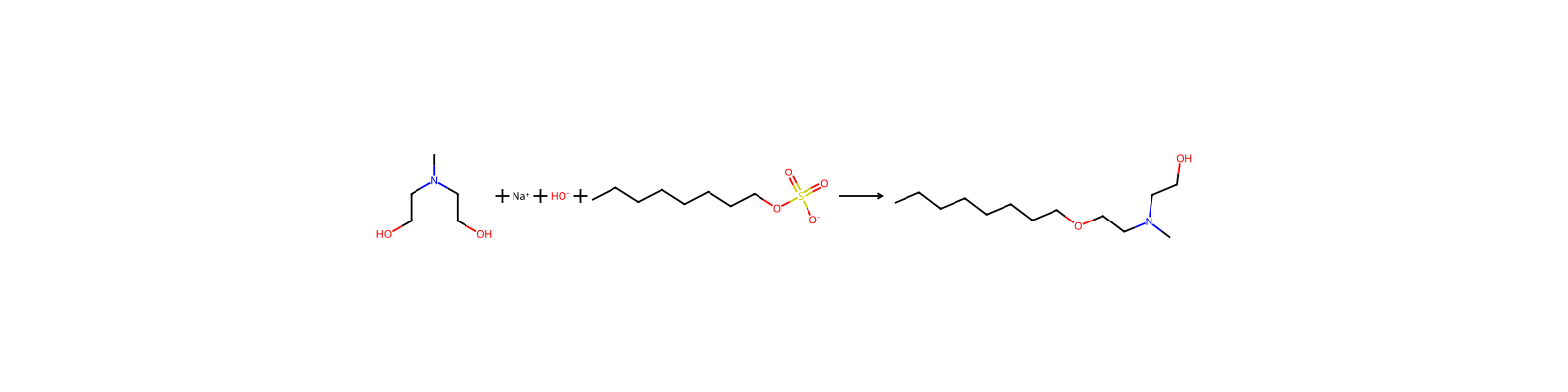
関連反応
28 件



化合物ノート
読み込み中…