ホームMCPワークベンチSkills
ホームワークベンチ通知マイページ
llms.txt · MCPガイドプライバシーポリシー · 利用規約 · サポートv1.8.0
  1. ホーム
  2. /化合物

ドデカンチオール

1-Dodecanethiol

HCID 8195
ノートを作成反応を作成見積依頼を出す
印刷プレビュー
基本情報概要名称と識別子物性安全と法規制化学と産業関連反応化合物ノート
部分構造検索類似構造を探す

基本情報

CAS
112-55-0
標準SMILES
CCCCCCCCCCCCS
InChIKey
WNAHIZMDSQCWRP-UHFFFAOYSA-N
分子式
C12H26S
平均分子量
202.4 g/mol
単同位体質量
202.17552183

概要

Lauryl mercaptan is an oily colorless liquid with a mild skunk odor. Freezing point 19 °F. (USCG, 1999)

名称と識別子

優先名称
1-Dodecanethiol
IUPAC
dodecane-1-thiol
現地名
ドデカンチオール
英語名
dodecanethiol
分子式
C12H26S
分子量
0

名称と別名

1-DODECANETHIOL112-55-0Dodecyl mercaptanLauryl mercaptann-Dodecyl mercaptann-Dodecanethiol1-Mercaptododecanen-Lauryl mercaptanN-Dodecylmercaptan1-Dodecyl mercaptanPennfloat MDodecylmercaptan
名称をさらに表示
イソドデシルメルカプタンドデカンチオールDodecanthiolIsododecyl mercaptan
1-dodecylthiolPennfloat SLauryl mercaptideM-Lauryl mercaptanM-Dodecyl mercaptanThiokalcol 20NCI-C60935DTXSID6025220

データベース識別子

CAS
112-55-0、1322-36-7、30237-11-7、6939-83-9
PubChem CID
8195
DTXSID
DTXSID6025220
ChEMBL
CHEMBL3185403
UNII
S8ZJB6X253
EC Number
203-984-1、215-338-6
Nikkaji
J22.130I

物性

構造計算による物性

XLogP
6.1
極性表面積
1 Ų
水素結合供与体数
1
水素結合受容体数
1
回転可能結合数
10
重原子数
13
形式電荷
0
複雑度
81.2

実験および物理化学的性質

Chemical ClassesOther Classes -> Thiols
SpringerMaterials PropertiesBoiling point
Odor · 2 件

MILD CHARACTERISTIC

Mild, skunk-like odor.

Food AdditivesFLAVORING AGENT OR ADJUVANT -> FDA Substance added to food
Density · 6 件

0.85 at 59 °F (USCG, 1999) - Less dense than water; will float

0.8435 at 20 °C/20 °C

Relative density (water = 1): 0.85

0.842-0.852 (20 °C)

0.85

0.8450 @ 20°C

Color/FormColorless, water-white, or pale-yellow, oily liquid [Note: A solid below 15 degrees F].
Solubility · 6 件

less than 1 mg/mL at 70 °F (NTP, 1992)

Insol in water; sol in ethanol, ether, chloroform

SOL IN METHANOL, ACETONE, BENZENE

Sol in gasoline, ethyl acetate

Solubility in water: none

Practically insoluble or insoluble in water

Flash Point · 6 件

190 °F (NTP, 1992)

128 °C

262 °F (128 °C) (Open cup)

88 °C o.c.

190 °F (open cup)

(oc) 190 °F

安全と法規制

安全情報は参考情報です。供給元の安全データシート(SDS)、適用法令、専門家による評価に代わるものではありません。

GHS分類

GHS Classification · 6 件

This chemical does not meet GHS hazard criteria for 1% (11 of 1091) of reports.

Danger

H302 (10.4%): Harmful if swallowed [Warning Acute toxicity, oral]

P233, P260, P261, P264, P264+P265, P270, P271, P272, P273, P280, P284, P301+P317, P301+P330+P331, P302+P352, P302+P361+P354, P304+P340, P305+P351+P338, P305+P354+P338, P316, P317, P319, P321, P330, P332+P317, P333+P317, P337+P317, P342+P316, P362+P364, P363, P391, P403, P403+P233, P405, and P501 (click each P-code to see the statement)

Aggregated GHS information provided per 1091 reports by companies from 36 notifications to the ECHA C&L Inventory. Each notification may be associated with multiple companies.

Danger

危険有害性情報

Regulatory Information · 5 件

Chemical: 1-Dodecanethiol

1-Dodecanethiol is listed on the EPA's Chemical Data Reporting (CDR) system. Manufacturers and importers of 1-Dodecanethiol are required to report information about their production and use of this chemical to the EPA under the Toxic Substances Control Act (TSCA). (40 eCFR Part 711)

Status: Active Update: 03-02-2023 https://echa.europa.eu/registration-dossier/-/registered-dossier/19485

1-Dodecanethiol: Does not have an individual approval but may be used under an appropriate group standard

The New Jersey Worker and Community Right to Know Act requires public and private employers to provide information about hazardous substances at their workplaces. (N.J.S.A. 34:5A-1 et. seq.)

DOT LabelClass 9
Fire Hazards · 2 件

Special Hazards of Combustion Products: Poisonous and irritating gases (e.g., sulfur dioxide) are generated in fires. (USCG, 1999)

Combustible. Above 88 °C explosive vapour/air mixtures may be formed.

Fire PotentialCombustible when exposed to heat or flame.

化学と産業

薬理情報

Metabolism/Metabolites · 1 件

Simple aliphatic and aromatic thiols undergo S-methylation in mammals to produce the corresponding methyl thioether or sulfide. Methylation is catalysed by thiopurine methyltransferase in the cytoplasm and thiol methyltransferase in microsomes, and both reactions require S-adenosyl-l-methionine as a methyl group donor. Thiopurine methyltransferase is present in human liver, kidney, and erythrocytes; preferential substrates for this enzyme include aromatic and heterocyclic thiols. S-Methylation of aliphatic thiols is catalysed by microsomal thiol methyltransferase, and the resulting methyl thioether (sulfide) metabolite would undergo S-oxidation to give the methyl sulfoxide and methyl sulfone analogues as urinary products. Thiols may react with glutathione and other endogenous thiol substances to form mixed disulfides. Both microsomal and cytoplasmic thioltransferasess have been reported to catalyse the formation of mixed disulfides. The resulting mixed disulfides can undergo reduction back to thiols, oxidative desulfuration, or oxidation to a sulfonic acid via the intermediate thiosulfinate and sulfinic acids. The principal form in the circulation would probably be a mixed disulfide formed with albumin. /Simple thiols/

用途と製造

Uses · 6 件

Used in the production of drugs, insecticides, detergents, and synthetic rubber and as a flotation agent for metal refining; [ACGIH]

Metal Extraction and Refining [Category: Industry]

Polymerization regulator for styrene-butadiene rubber

In chemical syntheses of bactericides; as complexing agent, such as for the removal of metals from wastes

In manufacture of synthetic rubber, plastics, pharmaceuticals, insecticides, fungicides; nonionic detergent

Flotation reagent

U.S. Production · 4 件

2023: 10,000,000 - <50,000,000 lb

1-Dodecanethiol is listed as a High Production Volume (HPV) chemical (65FR81686). Chemicals listed as HPV were produced in or imported into the U.S. in >1 million pounds in 1990 and/or 1994. The HPV list is based on the 1990 Inventory Update Rule. (IUR) (40 CFR part 710 subpart B; 51FR21438).

(1972) Greater than 4.54X10+5 grams

関連反応

263 件
反応記録を作成
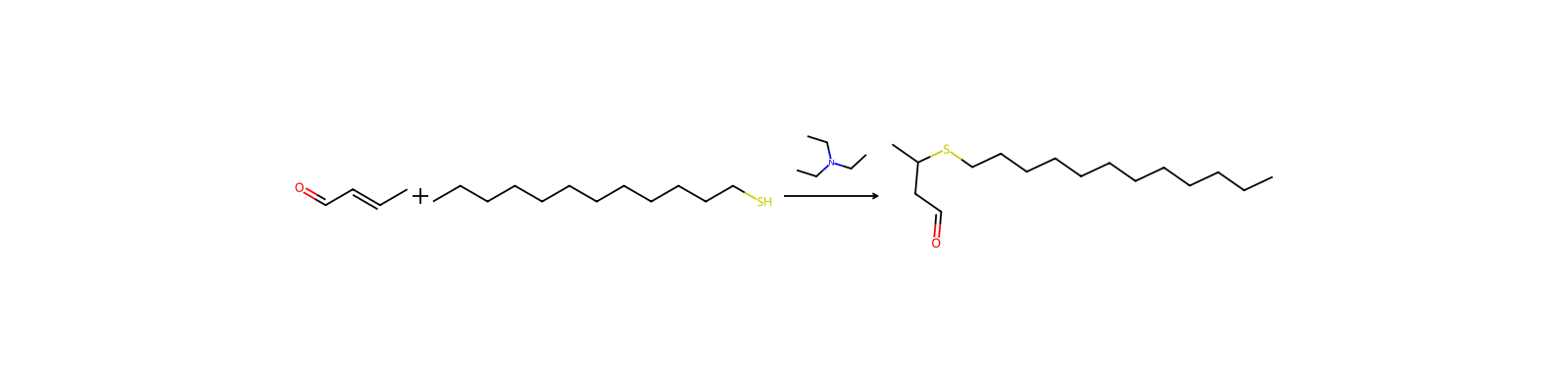
HRID 20184 の反応式
HRID 20184反応物としてuspto-grants-2010_06
HRID 35161 の反応式
HRID 35161溶媒としてuspto-grants-1988_08
HRID 39110 の反応式
HRID 39110反応物としてuspto-grants-2013_09
HRID 40445 の反応式
HRID 40445反応物としてuspto-grants-2013_09
HRID 43037 の反応式
HRID 43037反応物としてuspto-grants-2013_09
HRID 61783 の反応式
HRID 61783反応物としてuspto-grants-2016_09
HRID 65166 の反応式
HRID 65166反応物としてuspto-grants-1986_09
HRID 66451 の反応式
HRID 66451反応物としてuspto-grants-1982_08
1 / 33 ページ

化合物ノート

読み込み中…

このページの内容基本情報概要名称と識別子物性安全と法規制化学と産業関連反応化合物ノート
その他の操作
ノートを作成反応を作成見積依頼を出す
Boiling Point · 6 件

511 to 541 °F at 760 mmHg (NTP, 1992)

260-268 mm Hg at 760 mm Hg

BP: 142-145 °C @ 15 MM HG

266-285 °C

142-143 °C (16 mm Hg)

441-478 °F

DecompositionWhen heated to decomposition it emits toxic fumes of /sulfur oxides/.
Melting Point · 6 件

19 °F (NTP, 1992)

-7 °C

-7 - -9 °C

19 °F

-7 °C

15 °F

Vapor Density · 3 件

greater than 1 (estimated) (NTP, 1992) (Relative to Air)

Relative vapor density (air = 1): 7.0

>1

物理化学的性質

沸点
127 · 127-129 °C(Press: 9 Torr)
Health Hazards
Liquid is irritating to skin, eyes, and mucous membranes. Ingestion may cause nausea. Repeated skin exposure can cause dermatitis and may produce a sensitizing effect. (USCG, 1999)
Hazards Summary · 1 件

This chemical is listed in the Chemotechnique Diagnostics Shoe Series for patch testing. [Marks, p. 376] Not highly toxic after acute exposure; Rats and mice had no adverse effects after exposure to 8-9 ppm for 1 to 6 hours. Some mice died after exposure to 8 ppm (6 hours/day, 5 days/week for 4 weeks); No adverse effects in rats exposed to 329 ppm (twenty 6-hour exposures); A dermal sensitizer; [ACGIH] Danger of skin sensitization; [MAK] See THIOLS.

DOT ID and Guide1228 131
Reactive GroupSulfides, Organic
Reactivity AlertsWater-Reactive
Reactivity ProfileLAURYL MERCAPTAN is incompatible with bases, oxidizing agents, reducing agents and alkali metals. Easily oxidized to disulfide. (NTP, 1992)
Chemical DangersDecomposes on burning. This produces toxic gases. Reacts with strong oxidants.
Flammable LimitsClass IIIA Combustible Liquid: Fl.P. at or above 140 °F and below 200 °F.

安全と保護具

Fire Fighting · 2 件

Fire Extinguishing Agents Not to Be Used: Water or foam may cause frothing.

Use powder, AFFF, foam, carbon dioxide.

First Aid Measures · 4 件

Fresh air, rest. Refer for medical attention.

Remove contaminated clothes. Rinse skin with plenty of water or shower.

First rinse with plenty of water for several minutes (remove contact lenses if easily possible), then refer for medical attention.

Rinse mouth. Give one or two glasses of water to drink. Refer for medical attention .

First Aid · 2 件

EYES: First check the victim for contact lenses and remove if present. Flush victim's eyes with water or normal saline solution for 20 to 30 minutes while simultaneously calling a hospital or poison control center. Do not put any ointments, oils, or medication in the victim's eyes without specific instructions from a physician. IMMEDIATELY transport the victim after flushing eyes to a hospital even if no symptoms (such as redness or irritation) develop.

(General first aid procedures)

Safe StorageSeparated from strong oxidants.
Fire Fighting ProceduresDry chem, or carbon dioxide. Water or foam may cause frothing. Water may be ineffective on fire. Cool exposed containers with water.
Storage ConditionsSeparated from strong oxidants.
Cleanup MethodsCollect leaking and spilled liquid in sealable containers as far as possible. Carefully collect remainder. Personal protection: self-contained breathing apparatus.
Nonfire Spill Response · 1 件

SMALL SPILLS AND LEAKAGE: If you spill this chemical, use absorbent paper to pick up all liquid spill material. Your contaminated clothing and absorbent paper should be sealed in a vapor-tight plastic bag for eventual disposal. Solvent wash all contaminated surfaces with alcohol followed by washing with a strong soap and water solution. Do not reenter the contaminated area until the Safety Officer (or other responsible person) has verified that the area has been properly cleaned.

Disposal Methods · 1 件

SRP: The most favorable course of action is to use an alternative chemical product with less inherent propensity for occupational exposure or environmental contamination. Recycle any unused portion of the material for its approved use or return it to the manufacturer or supplier. Ultimate disposal of the chemical must consider: the material's impact on air quality; potential migration in soil or water; effects on animal, aquatic, and plant life; and conformance with environmental and public health regulations.

Spillage DisposalPersonal protection: self-contained breathing apparatus. Collect leaking and spilled liquid in sealable containers as far as possible. Carefully collect remainder.
Preventive Measures · 5 件

SRP: The scientific literature for the use of contact lenses in industry is conflicting. The benefit or detrimental effects of wearing contact lenses depend not only upon the substance, but also on factors including the form of the substance, characteristics and duration of the exposure, the uses of other eye protection equipment, and the hygiene of the lenses. However, there may be individual substances whose irritating or corrosive properties are such that the wearing of contact lenses would be harmful to the eye. In those specific cases, contact lenses should not be worn. In any event, the usual eye protection equipment should be worn even when contact lenses are in place.

Ventilation control: adequate ventilation is of particular concern for hazardous materials that have high vapor pressure (such as...mercaptans). /mercaptans/

The worker should immediately wash the skin when it becomes contaminated.

Work clothing that becomes wet or significantly contaminated should be removed and replaced.

For more Preventive Measures (Complete) data for 1-DODECANETHIOL (8 total), please visit the HSDB record page.

Isolation and EvacuationExcerpt from ERG Guide 171 [Substances (Low to Moderate Hazard)]:

毒性情報

Target OrgansEyes, skin, respiratory system, central nervous system, blood
Environmental Fate · 3 件

TERRESTRIAL FATE: Based on a classification scheme(1), an estimated Koc value of 1.1X10+4(SRC), determined from a structure estimation method(2), indicates that 1-dodecanethiol is expected to be immobile in soil(SRC). Volatilization of 1-dodecanethiol from moist soil surfaces is expected to be an important fate process(SRC) given an estimated Henry's Law constant of 5.9X10⁻² atm-cu m/mole(SRC), using a fragment constant estimation method(3). However, adsorption to soil is expected to attenuate volatilization(SRC). 1-Dodecanethiol is not expected to volatilize from dry soil surfaces(SRC) based upon a vapor pressure of 8.53X10⁻³ mm Hg(4). Biodegradation data were not available(SRC, 2005).

AQUATIC FATE: Based on a classification scheme(1), an estimated Koc value of 1.1X10+4(SRC), determined from a structure estimation method(2), indicates that 1-dodecanethiol is expected to adsorb to suspended solids and sediment(SRC). Volatilization from water surfaces is expected(3) based upon an estimated Henry's Law constant of 5.9X10⁻² atm-cu m/mole(SRC), developed using a fragment constant estimation method(4). Using this Henry's Law constant and an estimation method(3), volatilization half-lives for a model river and model lake are 4 hours and 6 days, respectively(SRC). However, volatilization from water surfaces is expected to be attenuated by adsorption to suspended solids and sediment in the water column. The estimated volatilization half-life from a model pond is 77 days if adsorption is considered(5). According to a classification scheme(6), an estimated BCF of 360(SRC), from an estimated log Kow of 6.2(7) and a regression-derived equation(8), suggests the potential for bioconcentration in aquatic organisms is moderate (SRC). Biodegradation data were not available(SRC, 2005).

ATMOSPHERIC FATE: According to a model of gas/particle partitioning of semivolatile organic compounds in the atmosphere(1), 1-dodecanethiol, which has a vapor pressure of 8.53X10⁻³ mm Hg at 25 °C(2), is expected to exist solely as a vapor in the ambient atmosphere. Vapor-phase 1-dodecanethiol is degraded in the atmosphere by reaction with photochemically-produced hydroxyl radicals(SRC); the half-life for this reaction in air is estimated to be 7 hours(SRC), calculated from its rate constant of 5.5X10⁻¹¹ cu cm/molecule-sec at 25 °C(SRC) that was derived using a structure estimation method(3). 1-Dodecanethiol does not contain chromophores that absorb at wavelengths >290 nm and therefore is not expected to be susceptible to direct photolysis by sunlight(SRC).

Adverse EffectsOther Poison - Chemical Asphyxiant
Exposure Routesinhalation, ingestion, skin and/or eye contact
Signs and Symptoms · 5 件

Cough. Headache. Nausea. Sore throat.

Redness.

Redness. Pain.

Nausea. Vomiting. Headache. Abdominal pain. Diarrhoea.

irritation eyes, skin, respiratory system; cough; dizziness, dyspnea (breathing difficulty), lassitude (weakness, exhaustion), confusion, cyanosis; abdominal pain, nausea; skin sensitization

Soil Adsorption/Mobility · 1 件

Using a structure estimation method based on molecular connectivity indices(1), the Koc of 1-dodecanethiol can be estimated to be 1.1X10+4(SRC). According to a classification scheme(2), this estimated Koc value suggests that 1-dodecanethiol is expected to be immobile in soil.

TSCA Test Submissions · 2 件

Teratogenicity was evaluated in pregnant female Charles River CD-1 mice (25/group) exposed by inhalation to n-dodecyl mercaptan at concentrations of 0 and 7.4 ppm for 6 hrs/day on gestation days (GD) 6-16. Cesarean sections were performed on all surviving mice on GD 17. Significant differences were observed between treated and control animals in the following: maternal mortality (19 mice died on GD 13-16, one was sacrificed in extremis on GD 16, remaining mice, which exhibited signs of extreme toxicity, were sacrificed on GD 15-16), necropsy observations (including black discoloration of the intestines, colored fluid in the stomach or intestines, and absence of stomach contents), and incidence of whole litter resorptions (7 of 20 gravid females). Since no treated animals survived to the end of the study, no comparisons between treated and control animals can be made with respect to: maternal body weight and weight gain (weight loss was observed in treated animals), GD 17 Cesarean observations, and fetal morphological examination (since the fetuses were obtained prematurely, the skeletons were partially- or non-ossified).

Teratogenicity was evaluated in pregnant female Charles River COBS CD rats (25/group) exposed by inhalation to n-dodecyl mercaptan at concentrations of 0 and 7.4 ppm for 6 hrs/day on gestation days (GD) 6-19. Cesarean sections were performed on all surviving mice on GD 20. Significant differences were observed between treated and control animals in the following: increased incidence of hair loss, reddened conjunctivae, dry brown or black material around the nose, dry, peeling skin, thinness, and a pronounced reduction in maternal body weight gain. No significant differences were observed between treated and control animals in the following: necropsy examination, mean number of viable fetuses, postimplantation loss, total implantations, corpora lutea, fetal body weight, fetal sex ratio, fetal malformations, and genetic and developmental variations.

Human Toxicity Excerpts · 5 件

/SIGNS AND SYMPTOMS/ Liquid is irritating to...mucous membranes. Ingestion may cause nausea. Repeated skin exposure can cause dermatitis... Irritating concentration of vapor unlikely, but mist can cause irritation of...upper respiratory tract. If spilled on clothing and allowed to remain, may cause smarting and reddening of the skin.

/SIGNS AND SYMPTOMS/ Ingestion /may cause/... vomiting, headache, abdominal pain, and diarrhea.

/SIGNS AND SYMPTOMS/ Repeated or prolonged contact /with/ 1-Dodecanethiol may cause skin sensitization.

/SIGNS AND SYMPTOMS/ Inhalation /may cause/ cough, headache, nausea, and sore throat.

/OTHER TOXICITY INFORMATION/ ...Workers exposed to mixt /including 1-dodecanethiol/...with polychloroprene latexes have shown a significant increase in frequency of chromosomal aberrations in the peripheral blood.

Artificial Pollution Sources · 1 件

1-Dodecanethiol's production and use in pharmaceuticals, insecticides, nonionic detergents, synthetic rubber processing, and as a froth flotation agent for metal refining(1) may result in its release to the environment through various waste streams(SRC).

Sediment/Soil Concentrations · 1 件

SEDIMENT: 1-Dodecanethiol was detected from sites adjacent to the 102nd St. Dump site, Bloody Run Creek, and Gill Creek hazardous waste disposal areas in Niagara Falls, NY at concentrations of 3 ppm, not detected (detection limit = 0.5 ppm in sediment), and not detected, respectively, sampled in June and November, 1979(1). The dumps are in the vicinity of Love Canal(1).

Environmental Bioconcentration · 1 件

An estimated BCF of 360 was calculated for 1-dodecanethiol(SRC), using an estimated log Kow of 6.18(1) and a regression-derived equation(2). According to a classification scheme(3), this BCF suggests the potential for bioconcentration in aquatic organisms is moderate(SRC), provided the compound is not metabolized by the organism(SRC).

Volatilization from Water/Soil · 1 件

The Henry's Law constant for 1-dodecanethiol is estimated as 5.9X10⁻² atm-cu m/mole(SRC) using a fragment constant estimation method(1). This Henry's Law constant indicates that 1-dodecanethiol is expected to volatilize rapidly from water surfaces(2). Based on this Henry's Law constant, the volatilization half-life from a model river (1 m deep, flowing 1 m/sec, wind velocity of 3 m/sec)(2) is estimated as 4 hours(SRC). The volatilization half-life from a model lake (1 m deep, flowing 0.05 m/sec, wind velocity of 0.5 m/sec)(2) is estimated as 6 days(SRC). However, volatilization from water surfaces is expected to be attenuated by adsorption to suspended solids and sediment in the water column. The estimated volatilization half-life from a model pond is 77 days if adsorption is considered(3). 1-Dodecanethiol's Henry's Law constant indicates that volatilization from moist soil surfaces may occur(SRC); however, the compound is reported as having extremely low volatility(4). 1-Dodecanethiol is not expected to volatilize from dry soil surfaces(SRC) based upon a vapor pressure of 8.53X10⁻³ mm Hg(5).

(1975) Probably greater than 1.36X10+6 grams

Consumer UsesAntioxidant
Industry UsesFlame retardant
Methods of Manufacturing · 2 件

Reaction of metallic hydrosulfide with n-dodecyl chloride

This mercaptan can be produced by action of hydrogen sulfide on lauryl alcohol or on dodecene.

Formulations/Preparations · 2 件

The commercial product is a mixture of isomers.

Grade: 95%

Use Classification · 2 件

Flavouring Agent -> FLAVOURING_AGENT -> JECFA Functional Classes

Flavoring Agents -> JECFA Flavorings Index

General Manufacturing Information · 3 件

Rubber Product Manufacturing

1-Dodecanethiol: ACTIVE

Thiols can be prepared by a variety of methods. The most-utilized of these synthetic methods for tertiary and secondary thiols is acid-catalyzed synthesis; for normal and secondary thiols, the most-utilized methods are free-radical-initiated, alcohol substitution, or halide substitution; for mercaptoalcohols, the most-utilized method is oxirane addition; and for mercaptoacids and mercaptonitriles, the most-utilized methods are Michael-type additions. /Thiols/