
二酢酸マンガン(II)·4水和物
Manganese acetate tetrahydrate
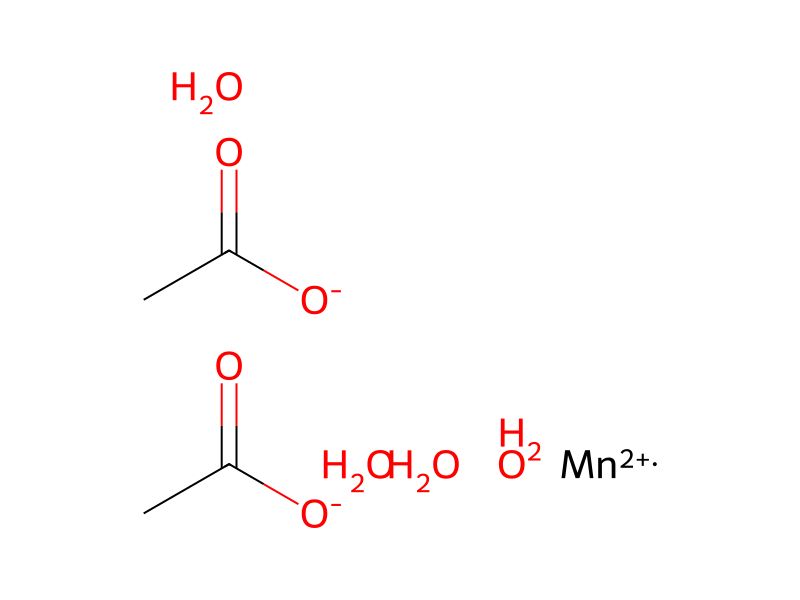
基本情報
- CAS
6156-78-1- 標準SMILES
CC(=O)[O-].CC(=O)[O-].O.O.O.O.[Mn+2]- InChIKey
CESXSDZNZGSWSP-UHFFFAOYSA-L- 分子式
- C4H6MnO4 . 4H2O
- 平均分子量
- 245.09 g/mol
- 単同位体質量
- 245.00691
概要
Manganese triacetate is a chemical compound of manganese. Manganese is a naturally occurring metal with the symbol Mn and the atomic number 25. It does not occur naturally in its pure form, but is found in many types of rocks in combination with other substances such as oxygen, sulfur, or chlorine. Manganese occurs naturally in most foods and small amounts are needed to stay healthy, as manganese ions act as cofactors for a number of enzymes. (L228, L229)
名称と識別子
- 優先名称
- Manganese acetate tetrahydrate
- IUPAC
- manganese(2+);diacetate;tetrahydrate
- 現地名
- 二酢酸マンガン(II)·4水和物
- 英語名
- Manganese(II) acetate tetrahydrate
- 分子式
- C4H14MnO8
- 分子量
- 245.09
名称と別名
6156-78-1Manganese acetate tetrahydrateManganese(II) acetate tetrahydrateManganous acetate tetrahydrateManganese diacetate, tetrahydratemanganese diacetate tetrahydrateMANGANUM ACETICUMUNII-9TO51D176NDTXSID002105669TO51D176NDTXCID30133057RefChem:59029
名称をさらに表示
二酢酸マンガン(II)·4水和物酢酸マンガン四水和物酢酸マンガン(II)四水和物酢酸マンガン(Ⅱ)四水和物酢酸マンガン(II)?四水和物酢酸マンガン(Ⅱ),四水和物酢酸マンガン(II)四水和物 PURUM P.A.,≥99.0% (KT)酢酸マンガン(II)四水和物, 99.9%酢酸マンガン(II) 四水和物酢酸マンガン(II)四水和物, 99+%酢酸マンガン(II)四水和物 (99.999%-Mn) PURATREM二酢酸マンガン(II)・4水和物酢酸マンガン(Ⅱ)(4水和物)MANGANESE ACETATEMANGANESE(II) ACETATECo-MnManganeseAcetateAracetate tetrahydrateManganese acetate, GR 99%+MANGANESE(II) ACETATE 4 H2OTetrahydrate of acetic acid
物性
構造計算による物性
- 極性表面積
- 84.3 Ų
- 水素結合供与体数
- 4
- 水素結合受容体数
- 8
- 回転可能結合数
- 0
- 重原子数
- 13
- 形式電荷
- 0
- 複雑度
- 25.5
実験および物理化学的性質
Chemical ClassesMetals -> Organic Acids, Metal Salts
Density1.59 @ 20°C
Melting Point80 °C
Physical DescriptionLight red transparent solid; [Merck Index] Light pink hygroscopic crystals; [Acros Organics MSDS]
物理化学的性質
- 融点
- 300 °C · >300 °C(lit.)
- 比重(密度)
- 1.589 g/mL · 1.589 g/mL at 25 °C(lit.)
- 蒸気圧
- 1 hPa · <1 hPa (25 °C)
- 貯蔵温度
- 30 °C · Store below +30°C.
- 溶解性
- 233 g/リットル · 233g/リットル
- 外見
- クリスタル
- 比重
- 1.589 · 1.589
- 色
- ピンク
- PH
- 7 · 7.0 (50g/l, H2O, 20℃)
- 水溶解度
- 水、メタノール、エタノール、酢酸に可溶。
- Merck
- 14 · 14,5724
- BRN
- 3730728 · 3730728
- InChI
- 1S/2C2H4O2.Mn.4H2O/c2*1-2(3)4;;;;;/h2*1H3,(H,3,4);;4*1H2/q;;+2;;;;/p-2
安全と法規制
安全情報は参考情報です。供給元の安全データシート(SDS)、適用法令、専門家による評価に代わるものではありません。
GHS分類
GHS Classification
This chemical does not meet GHS hazard criteria for 35.1% (26 of 74) of reports.
Warning
H315 (63.5%): Causes skin irritation [Warning Skin corrosion/irritation]
P261, P264, P264+P265, P271, P280, P302+P352, P304+P340, P305+P351+P338, P319, P321, P332+P317, P337+P317, P362+P364, P403+P233, P405, and P501 (click each P-code to see the statement)
Aggregated GHS information provided per 74 reports by companies from 9 notifications to the ECHA C&L Inventory. Each notification may be associated with multiple companies.
Danger
危険有害性情報
Regulatory Information
Chemical: Acetic acid, manganese(2+) salt, tetrahydrate
Acetic acid, manganese(2+) salt, tetrahydrate: Does not have an individual approval but may be used under an appropriate group standard
Other Safety InformationIMAP assessments - Soluble manganese compounds: Human health tier II assessment
Hazards SummaryAn irritant; Possible reproductive and fetal toxicant; [Acros Organics MSDS] See Manganese(II) acetate. See Manganese and linked occupational diseases.
Hazard Classes and Categories
Skin Irrit. 2 (63.5%)
Acute toxicity (ingestion) - category 4
安全と保護具
Exposure Control and Personal Protection0.2 [mg/m3], as Mn (inhalable fraction), 0.02 mg/m3, as Mn (respirable fraction)[German Research Foundation (DFG)]
Minimum Risk LevelChronic Inhalation: 0.0003 mg/m3 (L134)
化学と産業
薬理情報
Metabolism/Metabolites
Manganese is absorbed mainly via ingestion, but can also be inhaled. It binds to alpha-2-macroglobulin, albumin, or transferrin in the plasma and is distributed to the brain and all other mammalian tissues, though it tends to accumulate more in the liver, pancreas, and kidney. Manganese is capable of existing in a number of oxidation states and is believed to undergo changes in oxidation state within the body. Manganese oxidation state can influence tissue toxicokinetic behavior, and possibly toxicity. Manganese is excreted primarily in the faeces. (L228)
FDA Pharmacological Classification
MANGANESE ACETATE TETRAHYDRATE
Magnetic Resonance Contrast Activity [MoA]; Paramagnetic Contrast Agent [EPC]
MANGANUM ACETICUM
Osmotic Laxative [EPC]; Magnesium Ion Exchange Activity [MoA]; Inhibition Small Intestine Fluid/Electrolyte Absorption [PE]; Stimulation Large Intestine Fluid/Electrolyte Secretion [PE]; Increased Large Intestinal Motility [PE]; Calculi Dissolution Agent [EPC]; Osmotic Activity [MoA]; Inhibition Large Intestine Fluid/Electrolyte Absorption [PE]
用途と製造
Uses
Used as a mordant in dyeing, to make a brown pigment, and as a drying agent for paints and varnishes; [Merck Index]
Painting (Pigments, Binders, and Biocides) [Category: Paint]
応用分野
用途ファインセラミックスの製造原科。
用途酸化反応触媒、媒染剤。
使用Manganese(II) acetate tetrahydrate may be used in the sol gel synthesis of doped TiO2 containing different amounts of Mn2+.
一般的な説明Manganese(II) acetate tetrahydrate is a hydrated salt of manganese. Kinetic studies suggest that its dehydration takes place in two-step reaction involving the loss of two water molecules. Its crystal structure has been investigated by X-ray studies. Its crystals exhibit monoclinic crystal system and space group P21/c.
関連反応
46 件







化合物ノート
読み込み中…