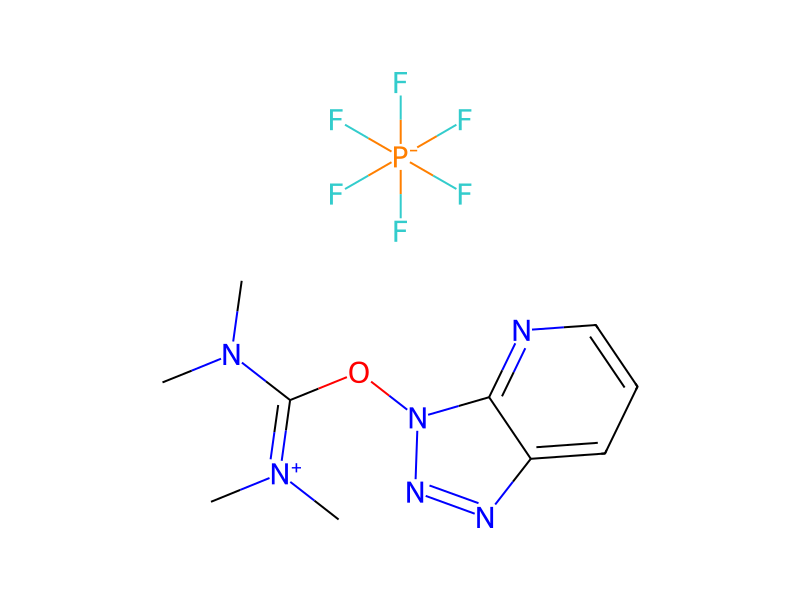
[Br:1][C:2]1[CH:7]=[CH:6][N:5]=[C:4]([C:8]([OH:10])=O)[CH:3]=1.[O:11]1[CH:15]=[N:14][N:13]=[C:12]1[C:16]1[CH:17]=[C:18]([NH2:22])[CH:19]=[CH:20][CH:21]=1.F[P-](F)(F)(F)(F)F.N1(OC(N(C)C)=[N+](C)C)C2N=CC=CC=2N=N1.C(N(C(C)C)CC)(C)C>CN(C)C=O>[O:11]1[CH:15]=[N:14][N:13]=[C:12]1[C:16]1[CH:17]=[C:18]([NH:22][C:8](=[O:10])[C:4]2[CH:3]=[C:2]([Br:1])[CH:7]=[CH:6][N:5]=2)[CH:19]=[CH:20][CH:21]=1A solution of 4-bromopyridine-2-carboxylic acid (3.76 g, 18.6 mmol), 3-[1,3,4]oxadiazol-2-yl-phenylamine (3.0 g, 18.6 mmol), (2-(7-Aza-1H-benzotriazole-1-yl)-1,1,3,3-tetramethyluronium hexafluorophosphate (HATU) (7.1 g, 18.7 mmol), and diisopropylethylamine (15 mL) in N,N-dimethylformamide was stirred at room temperature for 1 hour. The solvent was removed under reduced pressure, and the residue was stirred with acetonitrile (40 mL) and water (40 mL). The solid thus obtained was isolated by filtration, washed with water (20 mL), acetonitrile (20 mL) and diethyl ether (40 mL), and dried under reduced pressure to give N-(3-(1,3,4-oxadiazol-2-yl)phenyl)-4-bromopicolinamide as a white powder (5.2 g, 15.0 mmol, 81% yield).
読み込み中…