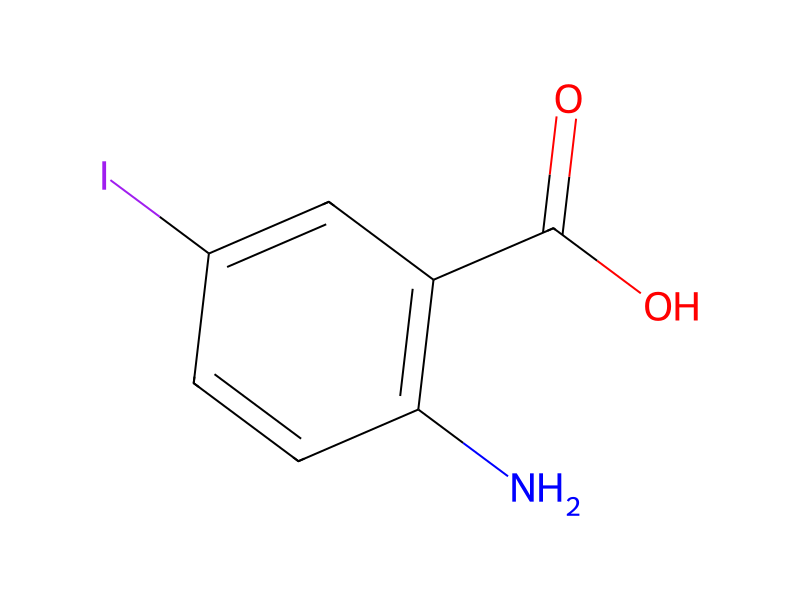
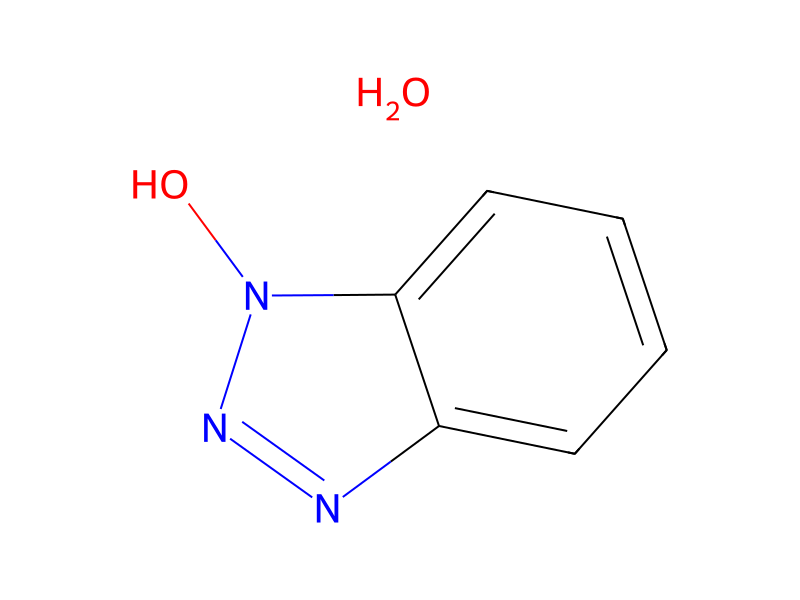
Cl.[NH2:2][CH2:3][C:4]1[CH:13]=[CH:12][C:7]([C:8]([O:10][CH3:11])=[O:9])=[CH:6][CH:5]=1.C(N(CC)CC)C.O.ON1C2C=CC=CC=2N=N1.[NH2:32][C:33]1[CH:41]=[CH:40][C:39]([I:42])=[CH:38][C:34]=1[C:35](O)=[O:36].Cl.CN(C)CCCN=C=NCC>CN(C)C=O>[NH2:32][C:33]1[CH:41]=[CH:40][C:39]([I:42])=[CH:38][C:34]=1[C:35]([NH:2][CH2:3][C:4]1[CH:5]=[CH:6][C:7]([C:8]([O:10][CH3:11])=[O:9])=[CH:12][CH:13]=1)=[O:36]To a stirred solution of 15 g (74.4 mmol) of methyl 4-(aminomethyl)benzoate hydrochloride, 300 ml of dimethylformamide and 10.3 ml (7.53 g, 74.4 mmol) of triethylamine were added, at room temperature, followed by 10.06 g (74.4 mmol) of 1-hydroxybenzotriazole hydrate, 19.6 g (74.4 mmol) of 2-amino-5-iodobenzoic acid and 14.3 g (74.4 mmol) of 1-(3-dimethylaminopropyl)-3-ethyl carbodiimide hydrochloride. After stirring at room temperature overnight, the mixture was concentrated and the residue was dissolved in 300 ml of dichloromethane. The organic phase was washed with 150 ml H2O, 150 ml HCl 1N, and 150 ml H2O, dried over sodium sulfate and concentrated. The residue was recrystallized from 170 ml acetonitrile to afford after filtration 19.6 g of the desired product (yield: 70%).
読み込み中…