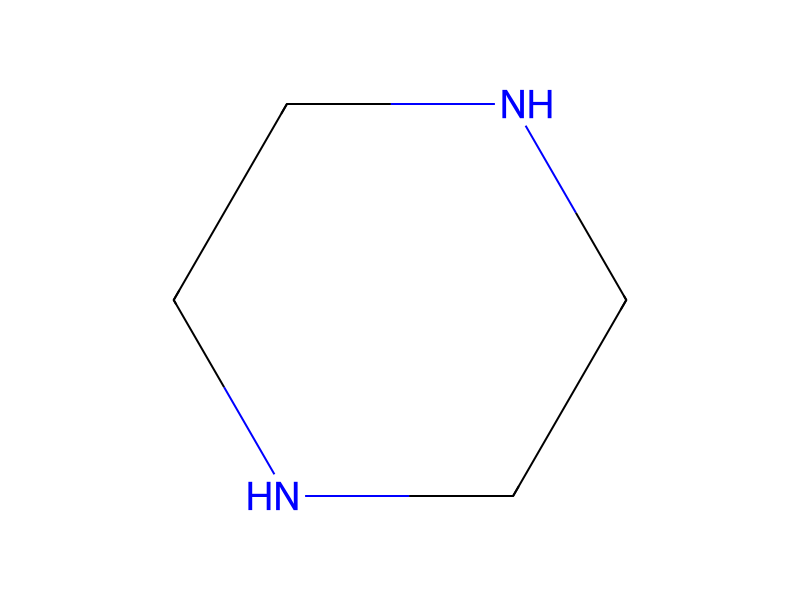
Cl[C:2]1[CH:7]=[CH:6][C:5]([C:8](=[O:18])[C:9]([CH3:17])([N:11]2[CH2:16][CH2:15][O:14][CH2:13][CH2:12]2)[CH3:10])=[CH:4][CH:3]=1.[NH:19]1[CH2:24][CH2:23][NH:22][CH2:21][CH2:20]1.C1(C)C=CC=CC=1.C1COCC1>C(OCC)C.C([O-])(=O)C.[Pd+2].C([O-])(=O)C.CC(P(C(C)(C)C)C1C(C2C=CC=CC=2)=CC=CC=1)(C)C.CC(C)([O-])C.[K+]>[CH3:10][C:9]([N:11]1[CH2:16][CH2:15][O:14][CH2:13][CH2:12]1)([CH3:17])[C:8]([C:5]1[CH:6]=[CH:7][C:2]([N:19]2[CH2:24][CH2:23][NH:22][CH2:21][CH2:20]2)=[CH:3][CH:4]=1)=[O:18]Further, in a 300 mL four-neck flask provided with a stirrer, a condenser, a thermocouple, and a nitrogen inlet tube, 16 g of 1-(4-chlorophenyl)-2-methyl-2-morpholino-propan-1-one, 20.7 g of piperazine, 140 mg of palladium acetate, 360 mg of (2-biphenyl)di-tert-butylphosphine, 100 mL of toluene, 40 mL of THF, and 9.4 mg of potassium-tert-butoxide were added, followed by reaction at room temperature for 46 hours under a nitrogen stream. The reaction product was diluted with 100 mL of diethyl ether and washed with 100 mL of water, and then an organic layer was dried with anhydrous sodium sulfate. The organic layer was concentrated and then recrystallized with dichloromethane/hexane to produce 18.3 g of 2-methyl-2-morpholin-4-yl-1-(4-piperazinylphenyl)propan-1-one (10). 1H-NMR (CDCl3): 1.34 ppm (s, 6H, —CH3), 2.60 ppm (m, 4H, —CH2—), 3.05 ppm (m, 4H, —CH2—), 3.34 ppm (m, 4H, —CH2—), 3.72 ppm (m, 4H, —CH2), 6.86 ppm (m, 2H, aromatic), 8.58 ppm (m, 2H, aromatic)