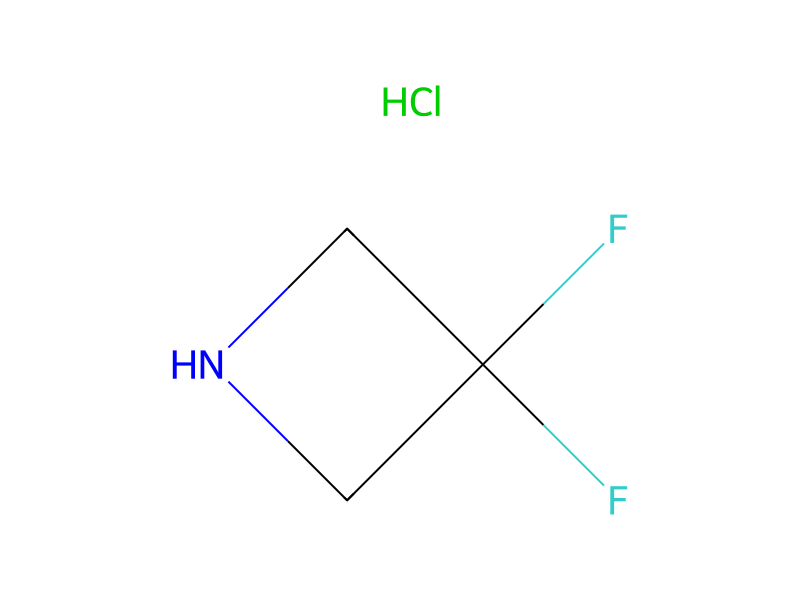
[Cl:1][C:2]1[C:3]([C:18]#[N:19])=[CH:4][C:5]2[N:6]([C:8]([S:14](Cl)(=[O:16])=[O:15])=[C:9]([CH:11]([CH3:13])[CH3:12])[N:10]=2)[CH:7]=1.Cl.[F:21][C:22]1([F:26])[CH2:25][NH:24][CH2:23]1.C(N(CC)CC)C.C(=O)([O-])O.[Na+]>C(#N)C>[Cl:1][C:2]1[C:3]([C:18]#[N:19])=[CH:4][C:5]2[N:6]([C:8]([S:14]([N:24]3[CH2:25][C:22]([F:26])([F:21])[CH2:23]3)(=[O:16])=[O:15])=[C:9]([CH:11]([CH3:13])[CH3:12])[N:10]=2)[CH:7]=16-Chloro-7-cyano-2-isopropylimidazo[1,2-a]pyridine-3-sulfonylchloride (1.00 g, 3.14 mmol) obtained in step 3 was dissolved in acetonitrile (10 mL), and the solution was stirred at room temperature for 1.25 hours after adding 3,3-difluoroazetidinehydrochloride (611 mg, 4.71 mmol) and triethylamine (1.31 mL, 9.43 mmol). A saturated sodium hydrogen carbonate aqueous solution was added to the reaction mixture. The precipitated crystals were collected by filteration, and washed with water. The resulting crude product was purified by silica gel column chromatography (heptane/ethyl acetate=80/20→50/50) to give 6-chloro-3-(3,3-difluoroazetidin-1-ylsulfonyl)-2-isopropylimidazo[1,2-a]pyridine-7-carbonitrile (1.10 g, yield 93%).