反応式

[Na].[C:2]1([CH:9]=[CH:8][C:6]([OH:7])=[CH:5][CH:4]=1)[OH:3].Br[C:11](=[CH2:19])[C:12]([O:14][CH2:15][CH2:16][CH2:17][CH3:18])=[O:13].C([O-])(=O)C=C.Cl[C:26]1[CH:31]=[CH:30][C:29]([C:32]([F:35])([F:34])[F:33])=[CH:28][N:27]=1>C(O)CCC>[F:33][C:32]([F:35])([F:34])[C:29]1[CH:30]=[CH:31][C:26]([O:3][C:2]2[CH:9]=[CH:8][C:6]([O:7][CH:11]([CH3:19])[C:12]([O:14][CH2:15][CH2:16][CH2:17][CH3:18])=[O:13])=[CH:5][CH:4]=2)=[N:27][CH:28]=1参加物






実験手順
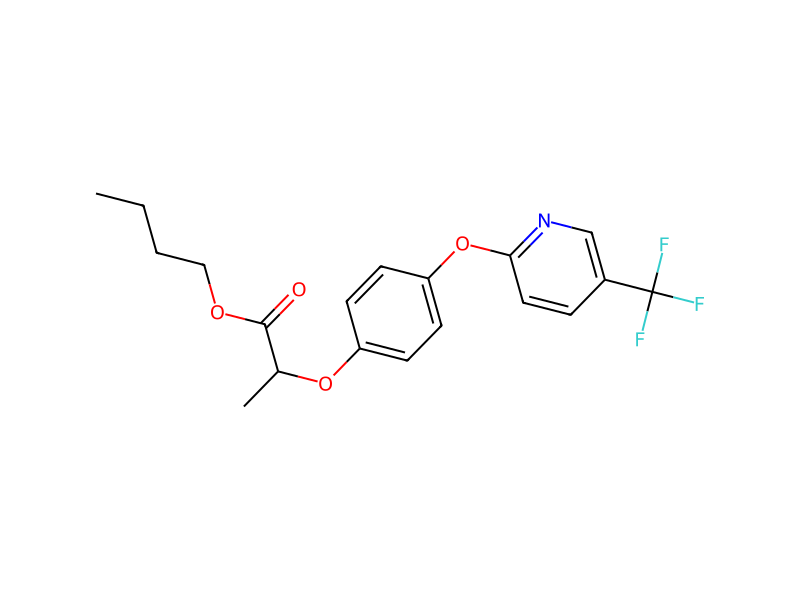
Sodium (6.9 g, 0.3 mol) was added to n-butanol (200 ml) under nitrogen. When the sodium had reacted, the solution was cooled to room temperature and hydroquinone (16.5 g, 0.15 mol) was added. The temperature was raised to 45° and n-butyl 2-bromoacrylate (26 g, 0.125 mol) was added dropwise. When the acrylate had all been added, the mixture was stirred for 20 hours and then 2-chloro-5-trifluoromethylpyridine (27.2 g, 0.15 mol) was added. The resulting mixture was heated for 30 hours at 65°, allowed to cool, treated with carbon and filtered through Celite. The resulting solution was made up to 500 ml with n-butanol and a hydrogenation catalyst (10% palladium on carbon; 0.5 g) was added. The crude product was hydrogenated at ambient temperature and pressure until hydrogen uptake ceased to give n-butyl 2-[4-(5-trifluoromethylpyridin-2-yloxy)phenoxy]propionate.
後処理
- temperatureThe temperature was raised to 45°
- additionall been added
- temperatureThe resulting mixture was heated for 30 hours at 65°
- temperatureto cool
- additiontreated with carbon
- filtrationfiltered through Celite
- additiona hydrogenation catalyst (10% palladium on carbon; 0.5 g) was added
- customwas hydrogenated at ambient temperature
出典と根拠
- ORDレコード
- ord-84acbdacc6cb4db8886cb215b4a0756b
- 出典データセット
- uspto-grants-1983_11
- 特許番号
- US04414391
関連ノート
読み込み中…