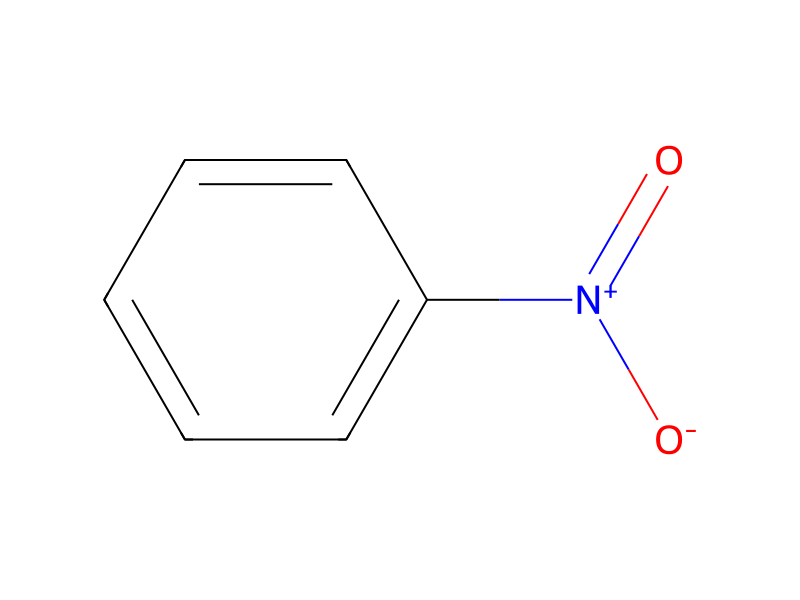
Benzene → Nitrobenzene
HRID 1689566
反応式

[N+:1]([O-:4])(O)=[O:2].S(=O)(=O)(O)O.O=[N+]=O.[CH:13]1[CH:18]=[CH:17][CH:16]=[CH:15][CH:14]=1>>[N+:1]([C:13]1[CH:18]=[CH:17][CH:16]=[CH:15][CH:14]=1)([O-:4])=[O:2]参加物
5




実験手順
The most common reagent used in conventional methods for preparing nitrobenzene is nitric acid or a mixed acid, typically, a mixed solution of concentrated nitric acid and concentrated sulfuric acid, oleum or fuming sulfuric acid. The process generally includes initially forming a nitronium ion, NO2+ by the reaction of nitric acid with concentrated sulfuric acid, as follows: HNO3+2H2SO4→NO2++H3O++2HSO4− The nitronium ion then reacts with benzene to form nitrobenzene, according to the following reaction:
出典と根拠
- ORDレコード
- ord-9df8284e80834964be11154ded81293a
- 出典データセット
- uspto-grants-2012_04
- 特許番号
- US08153077B2