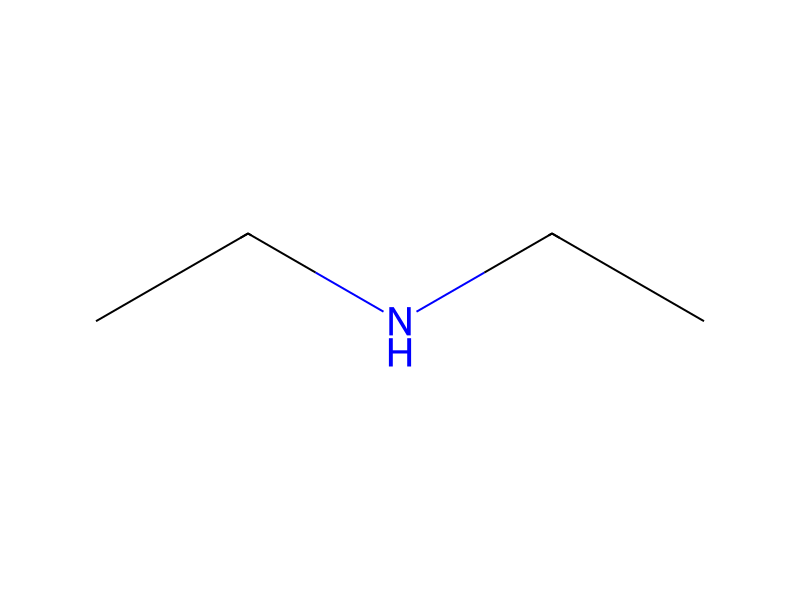
Diethylamine → 4-(N,N-diethylamino)-2-buten-1-ol
HRID 1728411
反応式

[CH2:1]([NH:3][CH2:4][CH3:5])[CH3:2].[O:6]1[CH2:10][CH:7]1[CH:8]=[CH2:9]>C1COCC1.[Pd].C1(P(C2C=CC=CC=2)C2C=CC=CC=2)C=CC=CC=1>[CH2:1]([N:3]([CH2:9][CH:8]=[CH:7][CH2:10][OH:6])[CH2:4][CH3:5])[CH3:2]参加物
5



実験手順
0.4 g of polymer-bound triphenylphosphine palladium(0) from Aldrich Chemical Co., Inc., Milwaukee, Wisconsin, Catalogue No. 24815-0 was suspended in 20 ml of THF, followed by 1.42 ml (14.3 mmol) diethylamine and 1.15 ml (14.3 mmol) 3,4-epoxy-1-butene. The reaction mixture was stirred at room temperature for 36 hours. The catalyst was removed by filtration and the filtrate was concentrated by evaporation at reduced pressure. The residue was distilled at reduced pressure. The reaction resulted in an 80% yield of 4-(N,N-diethylamino)-2-buten-1-ol. None of the isomeric 1,2 adduct was detected. The increased ratio of 4-(N,N-diethylamino)-2-buten-1-ol produced as compared to the approximately 1:1 ratio seen in Example 1 (with an unbound catalyst) has tremendous manufacturing advantages when extrapolated out to production scale synthesis.