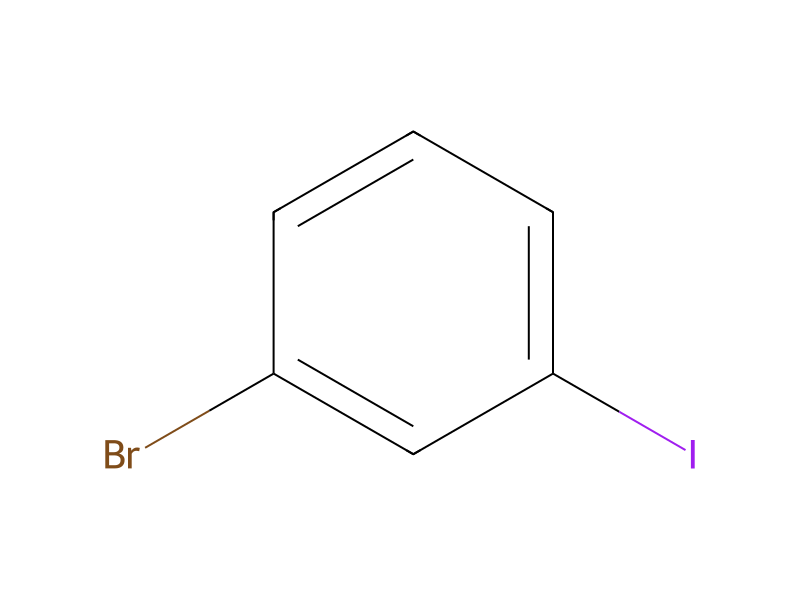
[Br:1][C:2]1[CH:7]=[CH:6][CH:5]=[C:4](I)[CH:3]=1.C[Si](C)(C)[C:11]#[C:12][CH3:13].C(N(CC)CC)C.[F-].C([N+](CCCC)(CCCC)CCCC)CCC.O1CCCC1>C1(C)C=CC=CC=1.[Cu]I.C1C=CC([P]([Pd]([P](C2C=CC=CC=2)(C2C=CC=CC=2)C2C=CC=CC=2)([P](C2C=CC=CC=2)(C2C=CC=CC=2)C2C=CC=CC=2)[P](C2C=CC=CC=2)(C2C=CC=CC=2)C2C=CC=CC=2)(C2C=CC=CC=2)C2C=CC=CC=2)=CC=1>[Br:1][C:2]1[CH:7]=[CH:6][CH:5]=[C:4]([C:11]#[C:12][CH3:13])[CH:3]=1To a solution of 1-bromo-3-iodobenzene (3.0 g, 10.6 mmol), copper(I) iodide (0.61 g, 3.2 mmol) and tetrakis(triphenylphosphine)palladium(0) (0.61 g, 0.53 mmol) in toluene (20 mL) was added 1-(trimethylsilyl)-1-propyne (1.6 mL, 10.6 mmol), triethylamine (4.9 mL, 35.0 mmol) and a 1M solution of tetrabutylammonium fluoride in tetrahydrofuran (10.6 mL, 10.6 mmol). The resulting mixture was stirred under a nitrogen atmosphere at r.t. overnight. The mixture was partitioned between water and Et2O and the organic phase was dried over magnesium sulfate and concentrated in vacuo. The residue was filtered through a plug of silica and eluted with heptane (4×25 mL) affording the title compound (1.6 g, 80% yield): 1H NMR (500 MHz, DMSO-d6) ppm 2.05 (s, 3H), 7.30 (t, 1H), 7.39 (d, 1H), 7.52-7.56 (m, 1H), 7.56-7.58 (m, 1H); MS (CI) m/z 195 [M+H]+.