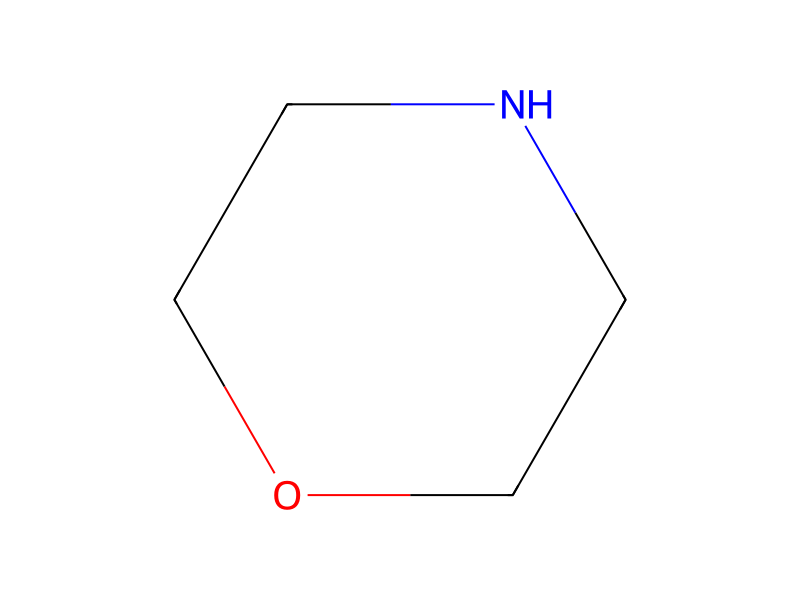
[Cl:1][C:2]1[CH:3]=[CH:4][C:5]2[O:18][CH:17]([C:19](O)=[O:20])[N:8]3[C:9]4[CH:10]=[CH:11][CH:12]=[C:13]([F:16])[C:14]=4[CH:15]=[C:7]3[C:6]=2[N:22]=1.CCN(CC)CC.[NH:30]1[CH2:35][CH2:34][O:33][CH2:32][CH2:31]1>O=S(Cl)Cl.ClCCl.O>[Cl:1][C:2]1[CH:3]=[CH:4][C:5]2[O:18][CH:17]([C:19]([N:30]3[CH2:35][CH2:34][O:33][CH2:32][CH2:31]3)=[O:20])[N:8]3[C:9]4[CH:10]=[CH:11][CH:12]=[C:13]([F:16])[C:14]=4[CH:15]=[C:7]3[C:6]=2[N:22]=1A solution of 2-chloro-11-fluoro-6H-pyrido[2′,3′:5,6][1,3]oxazino[3,4-a]indole-6-carboxylic acid (300 mg, 0.94 mmol) in SOCl2 (5 mL) was reflux for 2.0 hours, then concentrated the solution and afforded to the residue. A mixture of the residue, Et3N (0.2 mL) and morpholine (250 mg, 2.87 mmol) in dichloromethane (5 mL) was stirred at room temperature for overnight. Then the mixture was diluted with water (30 mL) and extracted with EtOAc (10 mL*3). The combined organic layer was washed with brine (30 mL), dried over Na2SO4 and concentrated in vacuo. The resulting residue was purified using prep-TLC (petroleum ether:EtOAc=1:1) to provide (2-chloro-11-fluoro-6H-pyrido[2′,3′:5,6][1,3]oxazino[3,4-a]indol-6-yl)(morpholino)methanone (120 mg, yield: 32.9%). 1H-NMR (CDCl3, 400 MHz) δ7.37˜7.47 (s, 1H), 7.24 (d, J=4.4, 1H), 7.11˜7.20 (m, 2H), 6.94 (d, J=8.4 Hz, 1H), 6.79˜6.86 (m, 1H), 6.70˜6.75 (m, 1H), 3.79˜3.90 (m, 2H), 3.62˜3.73 (m, 3.51˜3.59 (m, 1H), 3.36˜3.45 (m, 1H). MS (M+H)+: 388.