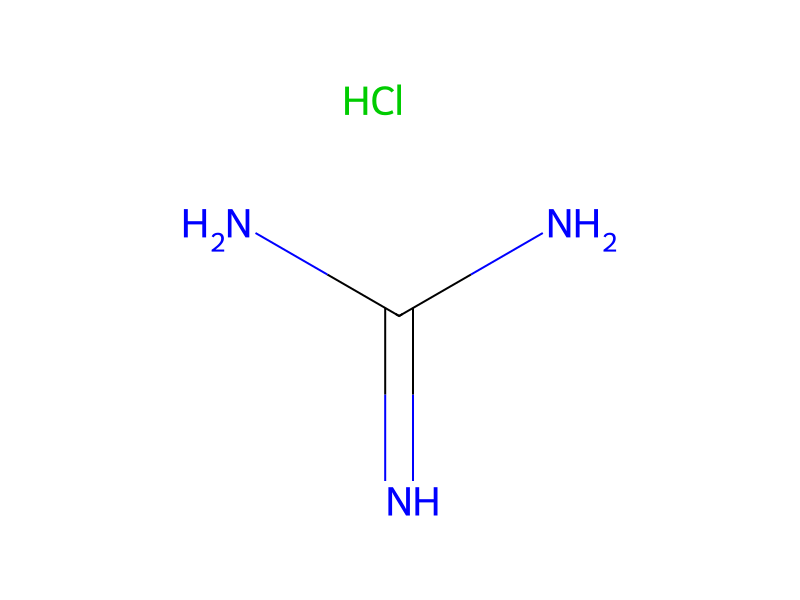
0.9 g (9.42 mmol) of guanidine hydrochloride is added to a solution of 0.51 g (9.44 mmol) of sodium methoxide in 15 mL of methanol at a temperature in the region of 22° C. under an argon atmosphere. After stirring at a temperature in the region of 22° C. for 2 hours, the solvent is evaporated off under reduced pressure (2.7 kPa). The residue, placed under an argon atmosphere, is taken up in 20 mL of a tetrahydrofuran/dichloromethane (1/1 by volume) mixture and then 0.55 g (1.88 mmol) of 3-chlorocarbonyl-1-(quinol-5-yl)-1H-pyrrole hydrochloride, dissolved in 5 mL of the same tetrahydrofuran/dichloromethane mixture, is added thereto. After stirring at a temperature in the region of 22° C. for 15 hours, the reaction mixture is concentrated to dryness under reduced pressure (2.7 kPa). The residue is triturated with water, filtered and taken up under hot conditions in 7 mL of ethanol. The insoluble material is then filtered off and discarded, and the filtrate is cooled to a temperature in the region of 22° C. The crystals formed are filtered off and dried under vacuum (2.7 kPa), to give 0.165 g of 3-guanidinocarbonyl-1-(quinol-5-yl)-1H-pyrrole in the form of a white solid melting at 260° C. Mass spectrum (EI): m/e 279 (M+.), m/e 221.