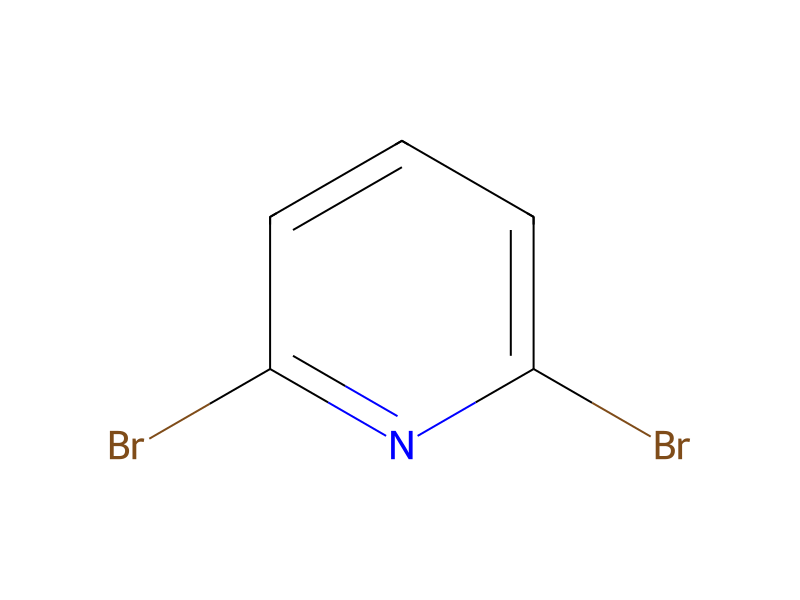
2,6-Dibromopyridine → 2-Bromo-6-cyclopentylpyridine
反応式

Br[C:2]1[CH:7]=[CH:6][CH:5]=[C:4]([Br:8])[N:3]=1.[Br-].[CH:10]1([Zn+])[CH2:14][CH2:13][CH2:12][CH2:11]1>C(OCC)(=O)C.C1C=CC([P]([Pd]([P](C2C=CC=CC=2)(C2C=CC=CC=2)C2C=CC=CC=2)([P](C2C=CC=CC=2)(C2C=CC=CC=2)C2C=CC=CC=2)[P](C2C=CC=CC=2)(C2C=CC=CC=2)C2C=CC=CC=2)(C2C=CC=CC=2)C2C=CC=CC=2)=CC=1>[Br:8][C:4]1[CH:5]=[CH:6][CH:7]=[C:2]([CH:10]2[CH2:14][CH2:13][CH2:12][CH2:11]2)[N:3]=1参加物
5




実験手順
To 2,6-dibromopyridine (5.9 g, 25 mmol) and tetrakis(triphenylphosphine)palladium(0) (1.4 g, 1.2 mmol) was added cyclopentylzinc bromide (50 ml, 0.5 M solution in tetrahydrofuran) and the mixture heated at reflux for 18 h. The reaction was diluted with ethyl acetate and washed with water. The organic phase was separated, dried over magnesium sulfate, filtered and evaporated in vacuo to give an oil. The crude product was chromatographed on silica, eluting on a gradient from 1 to 5% methanol in dichloromethane, to give 2-bromo-6-cyclopentylpyridine (3.25 g) as a white solid: δH (400 MHz, CDCl3) 1.60-1.90 (6H, m), 2.09 (2H, m), 3.17 (1H, m), 7.12 (1H, d, J 7.4), 7.28 (1H, d, J 7.4), 7.44 (1H, t, J 7.2); m/z (ES+) 226:228 (1:1) (M++H).
後処理
- temperaturethe mixture heated
- temperatureat reflux for 18 h
- washwashed with water
- customThe organic phase was separated
- dry with materialdried over magnesium sulfate
- filtrationfiltered
- customevaporated in vacuo
- customto give an oil
- customThe crude product was chromatographed on silica
- washeluting on a gradient from 1 to 5% methanol in dichloromethane
出典と根拠
- ORDレコード
- ord-a25407265d444a9bb3742ca2e2d2d71a
- 出典データセット
- uspto-grants-2006_04
- 特許番号
- US07030128B2
反応ノート
読み込み中…