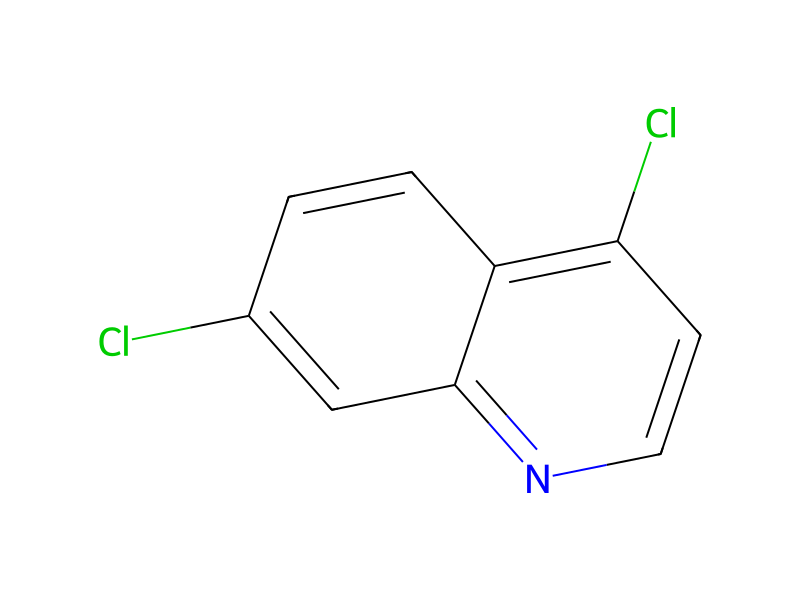
Similar to the process reported by B. S. Rauckman, et. al., J. Med. Chemn., 1989, 32, 1927-1935, 4,7-dichloroquinoline (1.02 g, 5.1 mmol) was dissolved into anh. EtOH (30 mL) under N2 at RT. Concentrated HCl (1.76 mL, 20.4 mmol) was added, followed by the addition of the NaCNBH3 (1.28 g, 20.4 mmol). This produced vigorous gas and heat evolution. The reaction was heated to 60° C. for 2 h, then cooled and stirred at RT for an additional 18 h. The reaction was quenched by adjusting the pH to approximately 9 with 2 N NaOH. This mixture was extracted 3 times with EtOAc. The EtOAC extracts were washed brine, combined, dried over Na2SO4, filtered, and concentrated, then eluted through a 30×2.5 cm column of silica gel (3.75% EtOAc/Hexane) giving 7-chloro-1,2,3,4-tetrahydro-quinoline as an orange solid: MS m/z 168=[M+H]+. Calc'd for C9H10ClN: 167.05.