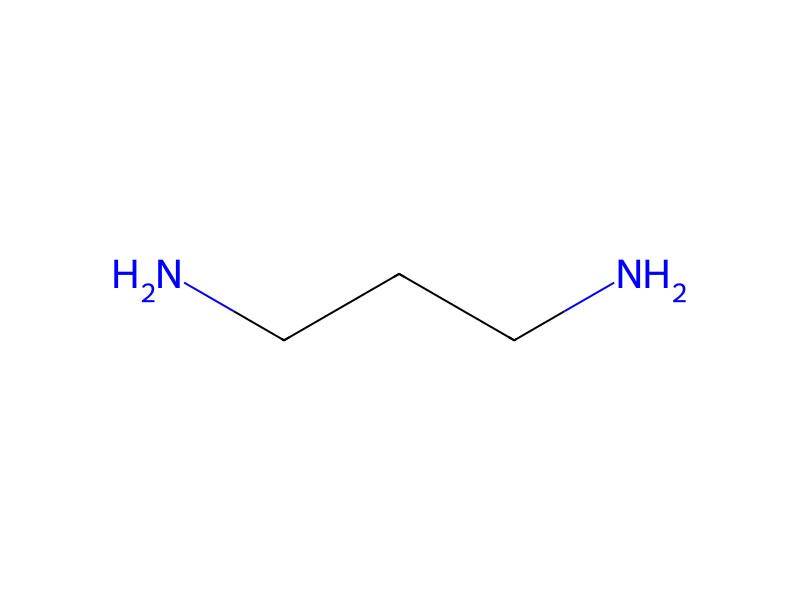
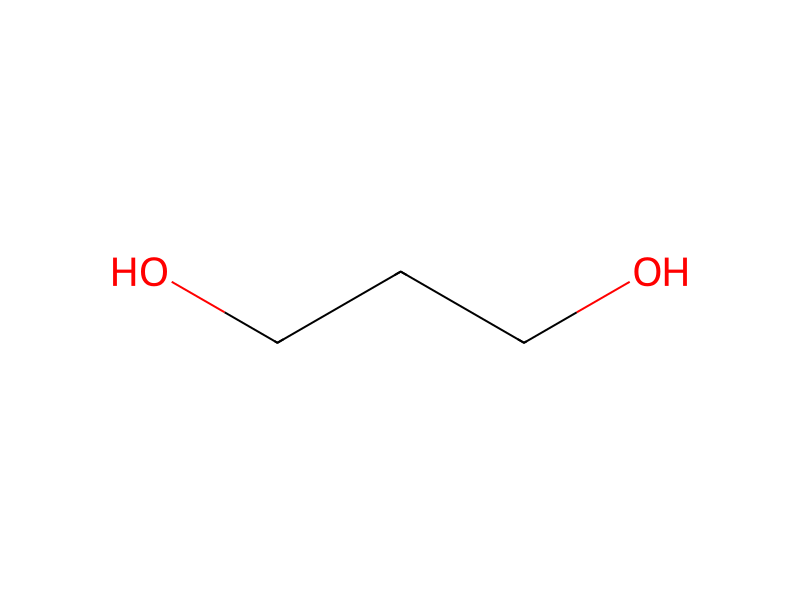
1,3-Propanediamine → 1,3-Propanediamine
HRID 1857835
反応式

[NH2:1][CH2:2][CH2:3][CH2:4][NH2:5].C(O)CC[OH:9].OC(C)C=O>[Ni]>[NH2:1][CH2:2][CH2:3][CH2:4][OH:9].[NH2:1][CH2:2][CH2:3][CH2:4][NH2:5][NH2:1][CH2:2][CH2:3][CH2:4][NH2:5].C(O)CC[OH:9].OC(C)C=O>[Ni]>[NH2:1][CH2:2][CH2:3][CH2:4][OH:9].[NH2:1][CH2:2][CH2:3][CH2:4][NH2:5]In the case of the two-step procedure for making 1,3-diaminopropane (Equations II and III), the 3-amino-1-propane (APO) intermediate was first generated in 84% yield under relatively mild hydroamination conditions (120° C., LHSV 0.4) using a supported-nickel catalyst from Engelhard (Ni-1404, T 3/16", 69% nickel, ex. 12). Identification was by gc-ms/ir. Major co-products include 1,3-propanediol (2.5%), 1,3-diaminopropane (1.2-1.6%), plus lights. Hydroxypropanal conversion was essentially quantitative. A subsequent reamination of this 3-amino-1-propanol (APO) intermediate, as an aqueous 25% solution, produced 1,3-diaminopropane in 50% selectivity at 180° C., LHSV 0.4, using the Raney cobalt catalyst, R-2796 (ex. 13). The major co-products of this second stage, higher temperature, amination were DPTA (ca. 29%) and tripropylenetetramine (TPTA, 12%). Again, there was no gc-ms/ir evidence for cyclic (piperazine-type) derivatives and N-propyl-1,3-diaminopropane was the major N-alkylated material. The 1,3-diaminopropane may be isolated from the crude, liquid, polyamine product via atmospheric distillation. Amination of APO over six days generated several hundred grams of crude DAP and its homologues. Ramping the amination temperature slightly (180-185° C.) allowed activity to be maintained and conversion held at about 85%. It may be possible to further limit the extent of DAP homologation, and thereby further raise the DAP selectivity, by lowering the water content of APO feed, raising the LHSV, and providing more ammonia partial pressure.