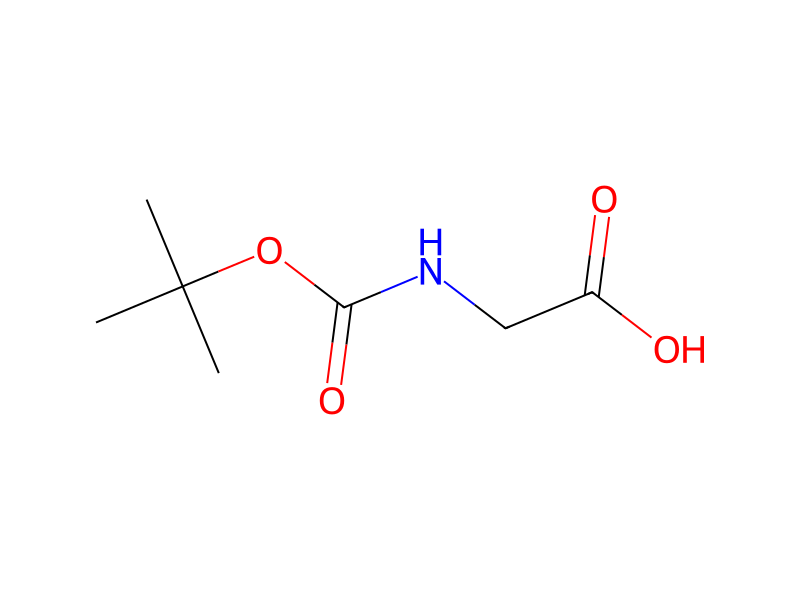
A solution of diisopropylamine (13.2 ml; 0.094 mol) in 130 ml tetrahydrofurane (THF) was cooled down to about −40° C. n-Butyllithium (37 ml of a 2.5 M solution in hexane; 0.094 mol) was added dropwise. The temperature was left to return to about 0° C. At this temperature, Boc-glycine (5 g; 0.028 mol) in solution in 30 ml THF was introduced into the mixture. After ten minutes at this temperature, 1-bromo-4-methylpentane (7.9 ml; 0.056 mol) in solution in 20 ml THF was quickly added. The temperature was then left to return to about 23° C. and the mixture agitated for about one hour at this temperature. After hydrolysis with 100 ml water and acidification with 150 ml of a saturated potassium hydrogenosulfate solution, the obtained mixture was extracted with 2 times 50 ml ethyl acetate. The organic phase was washed with 100 ml water followed by 100 ml of a saturated sodium chloride solution. After drying on magnesium sulfate and evaporation of the solvent, the residue obtained was purified on a silica column (eluent: ethyl acetate-heptane/6-4) to produce a white-colored powder with a yield of 50%. MH+=260.3.