ホームMCPワークベンチSkills
ホームワークベンチ通知マイページ
llms.txt · MCPガイドプライバシーポリシー · 利用規約 · サポートv1.8.0
  1. ホーム
  2. /反応

Acetonitrile → Propan-2-yl 4-amino-3-chloro-5-fluoro-6-(4-chloro-2-fluoro-3-methoxyphenyl)picolinate

HRID 1913937
ノート
印刷プレビュー

反応式

HRID 1913937 の反応式
[NH2:1][C:2]1[C:7]([F:8])=[C:6](Cl)[N:5]=[C:4]([C:10]([O:12][CH:13]([CH3:15])[CH3:14])=[O:11])[C:3]=1[Cl:16].[Cl:17][C:18]1[CH:23]=[CH:22][C:21](B2OCCCO2)=[C:20]([F:30])[C:19]=1[O:31][CH3:32].[F-].[Cs+].C(#N)C>Cl[Pd](Cl)([P](C1C=CC=CC=1)(C1C=CC=CC=1)C1C=CC=CC=1)[P](C1C=CC=CC=1)(C1C=CC=CC=1)C1C=CC=CC=1.O>[NH2:1][C:2]1[C:7]([F:8])=[C:6]([C:21]2[CH:22]=[CH:23][C:18]([Cl:17])=[C:19]([O:31][CH3:32])[C:20]=2[F:30])[N:5]=[C:4]([C:10]([O:12][CH:13]([CH3:15])[CH3:14])=[O:11])[C:3]=1[Cl:16]
参加物反応条件実験手順後処理出典と根拠反応ノート

参加物

7

反応物 4

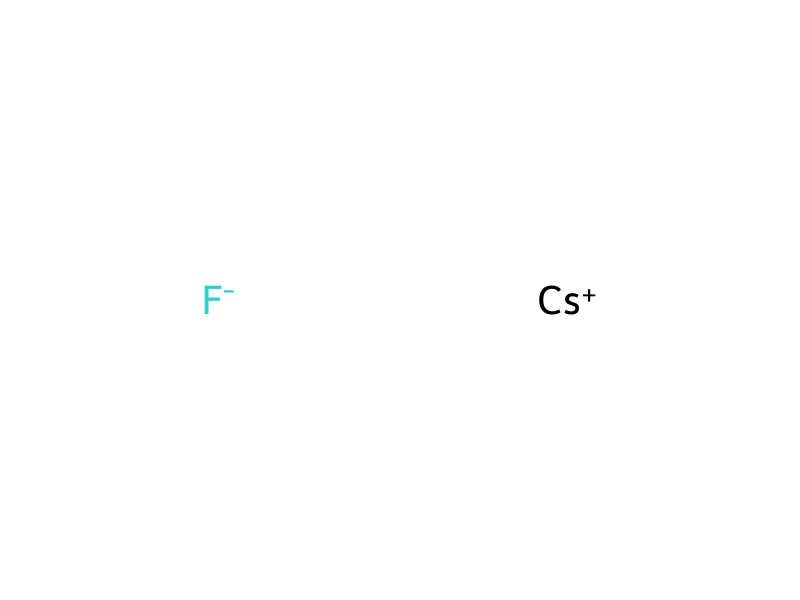
HCID 6342AcetonitrileHCID 25953Cesium fluorideHCID 577824192-(4-Chloro-2-fluoro-3-methoxyphenyl)-1,3,2-dioxaborinaneHCID 71551839Propan-2-yl 4-amino-3,6-dichloro-5-fluoropicolinate

生成物 1

HCID 70497161Propan-2-yl 4-amino-3-chloro-5-fluoro-6-(4-chloro-2-fluoro-3-methoxyphenyl)picolinate収率 82%

試薬・触媒・溶媒 2

HCID 178418476
HCID 178418476、化合物
触媒
HCID 962Water溶媒

反応条件

温度
70 °C

実験手順

A 50 mL Schlenk flask was charged with propan-2-yl 4-amino-3,6-dichloro-5-fluoropicolinate (2.162 g, 8.09 mmol), 2-(4-chloro-2-fluoro-3-methoxyphenyl)-1,3,2-dioxaborinane (2.775 g, 11.35 mmol) and CsF (2.601 g, 17.12 mmol). Acetonitrile (20 mL) and water (7 mL) were added. The solution was evacuated/backfilled with nitrogen (5×). Solid bis(triphenylphosphine)palladium(II) dichloride (Pd(PPh3)2Cl2; 281 mg, 4.9 mol %) was added. The solution was evacuated/backfilled with nitrogen (5×) and then heated at 70° C. under nitrogen for 3 h. After 3 h, the reaction mixture was allowed to cool to room temperature. The aqueous layer was separated. Water (20 mL) was added to the organic layer. The resulting dark brown precipitate was filtered and washed with water. The solid was dissolved in EtOAc (60 mL) and filtered to remove a small amount of black solid. The EtOAc solution was treated with activated carbon (175 mg) and filtered to give a wine-colored solution. Evaporation under reduced pressure gave a dark red solid. Purification (120 g silica column; 0-50% EtOAc-hexane gradient) gave a white solid (2.59 g, 82%): mp 110.6-112.1° C.; 1H NMR (400 MHz, CDCl3) δ 7.25 (m, 2H), 5.32 (septet, J=6.3 Hz, 1H, CHMe2), 5.07 (br s, 2H), 3.97 (d, JF-H=1.0 Hz, 3H, OMe), 1.40 (d, J=6.3 Hz, 6H, CHMe2); 13C{1H} NMR (101 MHz, CDCl3) δ 164.2 (CO2R), 153.8 (d, JF-C=254 Hz, C5/C2′), 145.5 (d, JF-C=258 Hz, C5/C2′), 145.0 (d, JF-C=5 Hz), 144.4 (d, JF-C=14 Hz), 140.0 (d, JF-C=13 Hz), 137.5 (d, JF-C=14 Hz), 129.7 (d, JF-C=3 Hz), 125.4 (d, JF-C=2 Hz, C5′/C6′), 125.2 (d, JF-C=3 Hz, C5′C6′), 122.7 (dd, JF-C=14, 4 Hz, C1′), 114.6 (C3), 70.2 (CHMe2), 61.5 (d, JF-C=4 Hz, OMe), 21.6 (CHMe2); 19F NMR (376 MHz, CDCl3) δ −128.16 (dd, JF-F=33.3 Hz, JF-H=2.5 Hz, phenyl F), −138.35 (d, JF-F=33.4 Hz, pyridine F5). Anal. Calcd for C16H14Cl2F2N2O3: C, 49.12; H, 3.61; N, 7.16. Found: C, 49.30; H, 3.69; N, 7.08. The product was found to be 97.5% pure by HPLC.


後処理

  1. temperatureto cool to room temperature
  2. customThe aqueous layer was separated
  3. additionWater (20 mL) was added to the organic layer
  4. filtrationThe resulting dark brown precipitate was filtered
  5. washwashed with water
  6. dissolutionThe solid was dissolved in EtOAc (60 mL)
  7. filtrationfiltered
  8. customto remove a small amount of black solid
  9. additionThe EtOAc solution was treated with activated carbon (175 mg)
  10. filtrationfiltered
  11. customto give a wine-colored solution
  12. customEvaporation under reduced pressure
  13. customgave a dark red solid
  14. customPurification (120 g silica column; 0-50% EtOAc-hexane gradient)

出典と根拠

ORDレコード
ord-95bda95067e54fcbb70ef7bc5f249113
出典データセット
uspto-grants-2013_12
DOI
10.6084/m9.figshare.5104873.v1
特許番号
US08609855B2

反応ノート

読み込み中…

このページの内容参加物反応条件実験手順後処理出典と根拠反応ノート