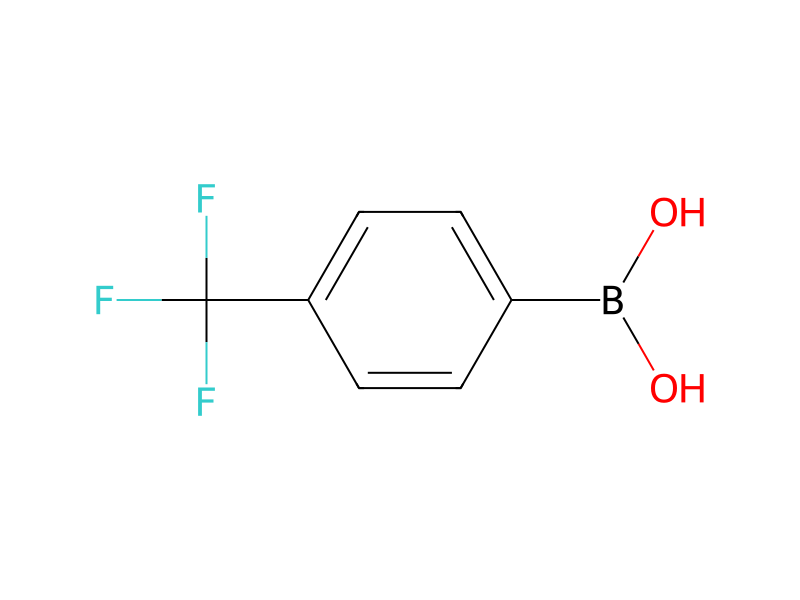
Cl[C:2]1[CH:7]=[N:6][CH:5]=[CH:4][N:3]=1.[F:8][C:9]([F:20])([F:19])[C:10]1[CH:15]=[CH:14][C:13](B(O)O)=[CH:12][CH:11]=1.C(=O)([O-])[O-].[Na+].[Na+]>O1CCOCC1.[Cl-].[Cl-].C1(P([C-]2C=CC=C2)C2C=CC=CC=2)C=CC=CC=1.[CH-]1C=CC=C1.[Fe+2].[Pd+2]>[F:8][C:9]([F:20])([F:19])[C:10]1[CH:15]=[CH:14][C:13]([C:2]2[CH:7]=[N:6][CH:5]=[CH:4][N:3]=2)=[CH:12][CH:11]=1A mixture of chloropyrazine (10, 0.087 mol), 4-(trifluoromethyl)phenylboronic acid (21 g), palladium(diphenylphosphino)ferrocene dichloride (3.5 g, 5 mol %) and sodium carbonate (100mL, 2M) in dioxane (200 mL) was degassed (×3) via Firestone valve. The mixture was heated under reflux for 1 h. Dioxane was removed in vacuo. The residue was dispersed between ethyl acetate and water and the organic phase was washed with brine, dried (MgSO4) and evaporated. The black residue was dry-loaded onto silica and purified by elution with 5-25% ethyl acetate in iso-hexane. This afforded the product as white crystals. 1H NMR (400 MHz, CDCl3): δ 7.78 (2H, d, J 8.2), 8.15 (2H, d, J 8.2), 8.59 (1H, d, J 2.5), 8.68 (1H, t, J 2.0), 9.08 (1H, d, J 1.4).