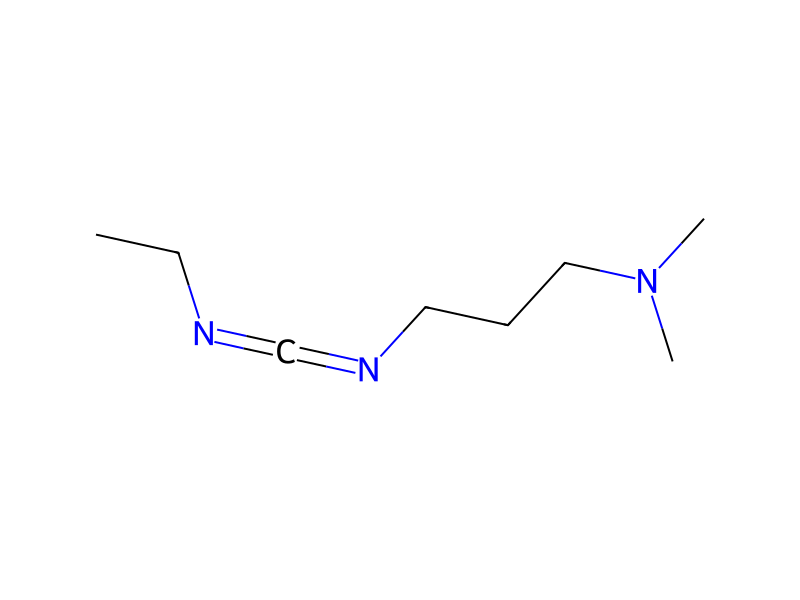
[NH:1]1[C:5]2=[N:6][CH:7]=[C:8]([NH2:10])[CH:9]=[C:4]2[CH:3]=[N:2]1.[Cl:11][C:12]1[C:17]([C:18](O)=[O:19])=[C:16]([F:21])[C:15]([NH:22][S:23]([CH2:26][CH2:27][CH3:28])(=[O:25])=[O:24])=[CH:14][CH:13]=1.CCN=C=NCCCN(C)C.C1C=CC2N(O)N=NC=2C=1>CN(C=O)C>[Cl:11][C:12]1[C:17]([C:18]([NH:10][C:8]2[CH:9]=[C:4]3[CH:3]=[N:2][NH:1][C:5]3=[N:6][CH:7]=2)=[O:19])=[C:16]([F:21])[C:15]([NH:22][S:23]([CH2:26][CH2:27][CH3:28])(=[O:25])=[O:24])=[CH:14][CH:13]=11H-Pyrazolo[3,4-b]pyridin-5-amine (1.55 g, 11.6 mmol), 6-chloro-2-fluoro-3-(propylsulfonamido)benzoic acid (3.59 g, 12.1 mmol), EDCI (2.44 g, 12.7 mmol), and HOBt (0.25 g, 0.16 mmol) were dissolved in DMF (30 mL) and stirred at room temperature for 16 hours. The reaction mixture was concentrated. The residue was diluted with ethyl acetate (500 mL), and the organic layers were washed with water (3×50 mL). The organic layers were dried, filtered and concentrated. The crude solids were washed with DCM (3×50 mL) to give 6-chloro-2-fluoro-3-(propylsulfonamido)-N-(1H-pyrazolo[3,4-b]pyridin-5-yl)benzamide (2.7 g, 58%) as a solid. 1H NMR (400 MHz, CD3OD) δ 8.7 (s, 1H), 8.6 (s, 1H), 8.1 (s, 1H), 7.7 (m, 1H), 7.4 (m, 1H), 3.1 (m, 2H), 1.9 (m, 2H), 1.1 (t, J=7.6 Hz, 3H); m/z (APCI-neg) M−1=410.2, 412.2.
読み込み中…