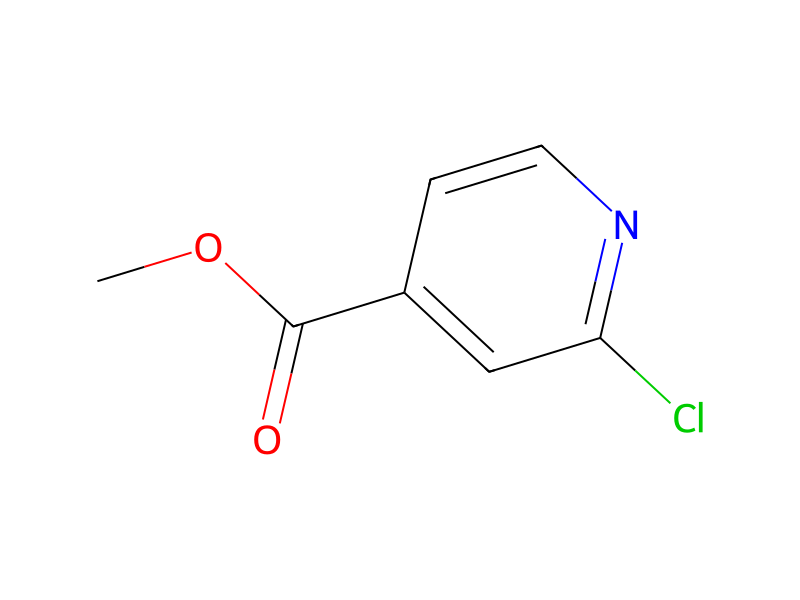
Methyl 2-chloroisonicotinate (1.7 g, 9.91 mmol), 2-(3-tert-butylphenyl)-4,4,5,5-tetramethyl-1,3,2-dioxaborolane (3.393 g, 13.04 mmol), potassium carbonate (2.054 g, 14.86 mmol) and PdCl2 (dppf) (0.215 g, 0.30 mmol) were mixed in methanol (14 mL) in a 20 mL microwave vial. The vial was capped and heated at 100° C. for 10 min in a single node microwave reactor. The reaction mixture was suspended in methanol, the solids removed by filtration and the filtrate evaporated to yield a dark red slurry. DCM and water were added and the phases separated. The water phase (pH 9) was extracted with DCM and the combined organic phase washed with brine, passed through a phase separator and evaporated to a brown solid. The solid was dissolved in MTBE (100 mL) and the solids were filtered off. Hydrogen chloride(4 M in dioxane, 3.50 mL, 13.99 mmol) was added dropwise during stirring and a suspension was formed. The suspension was stirred at room temperature for 3 days. The solid was collected by filtration and washed with MTBE to yield methyl 2-(3-tert-butylphenyl)isonicotinate hydrochloride (2.14 g, 70%) as a slightly brown solid. 1H NMR (600 MHz, cd3od) δ 1.41 (s, 9H), 4.07 (s, 3H), 7.62 (t, 1H), 7.77-7.80 (m, 2H), 8.00-8.02 (m, 1H), 8.37-8.40 (m, 1H), 8.69-8.71 (m, 1H), 8.94-8.97 (m, 1H).