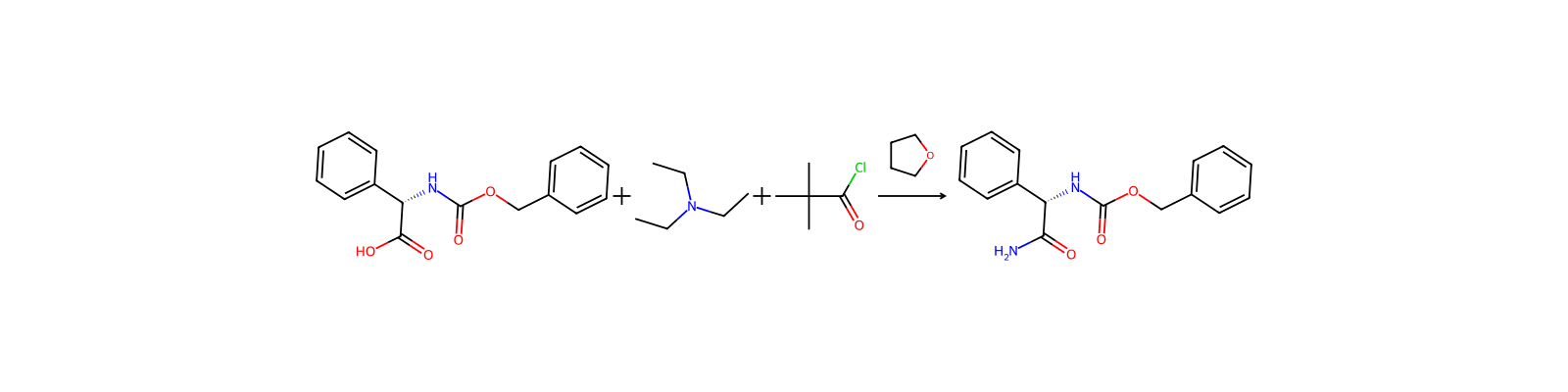
[NH:1]([C:12]([O:14][CH2:15][C:16]1[CH:21]=[CH:20][CH:19]=[CH:18][CH:17]=1)=[O:13])[C@H:2]([C:9](O)=[O:10])[C:3]1[CH:8]=[CH:7][CH:6]=[CH:5][CH:4]=1.C([N:24](CC)CC)C.C(Cl)(=O)C(C)(C)C>O1CCCC1>[NH:1]([C:12]([O:14][CH2:15][C:16]1[CH:21]=[CH:20][CH:19]=[CH:18][CH:17]=1)=[O:13])[C@H:2]([C:9]([NH2:24])=[O:10])[C:3]1[CH:8]=[CH:7][CH:6]=[CH:5][CH:4]=127.6 g (97 mmoles) of Z-L-Phg-OH are dissolved in 300 ml of dry tetrahydrofuran, and 13.55 ml (97 mmoles) of triethylamine are added to the solution. The mixture is cooled to -10° C., and 12.1 ml (97 mmoles) of pivaloyl chloride are introduced. The suspension of the mixed anhydride is stirred for 10 minutes at -10° C., thereafter cooling is stopped and ammonia is bubbled through the suspension for one hour. Next day the reaction mixture is evaporated, and the residue is processed as described for the D enantiomer. 18.90 g (68.7%) of Z-L-Phg-NH2 are obtained; m.p.: 172°-173° C., Rf4 =0.75, [α]D =+80.7° (c=1.0, in dimethyl formamide).