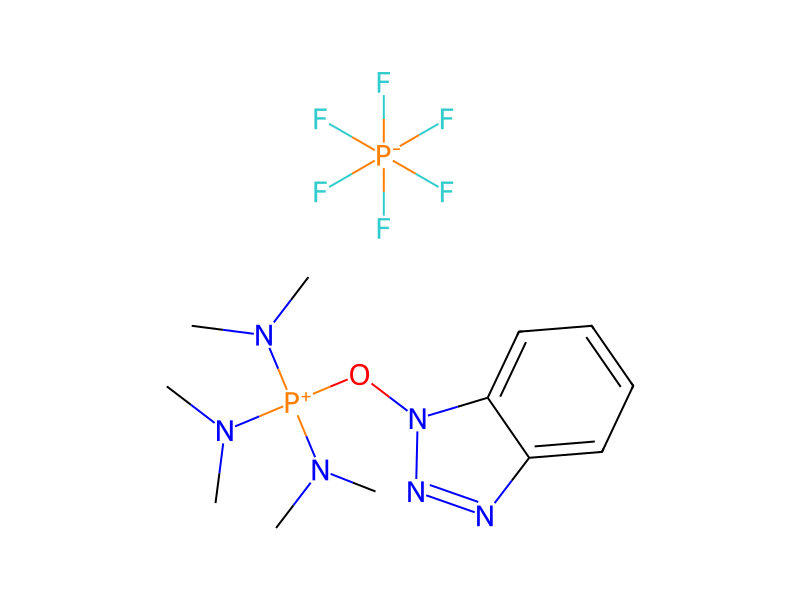
C(N(CC)C(C)C)(C)C.[Br:10][C:11]1[CH:19]=[CH:18][C:14]([C:15]([OH:17])=O)=[CH:13][C:12]=1[F:20].[CH:21]1([C@H:24]([NH2:26])[CH3:25])[CH2:23][CH2:22]1.F[P-](F)(F)(F)(F)F.N1(O[P+](N(C)C)(N(C)C)N(C)C)C2C=CC=CC=2N=N1.C(Cl)Cl.C([O-])(O)=O.[Na+]>>[Br:10][C:11]1[CH:19]=[CH:18][C:14]([C:15]([NH:26][C@@H:24]([CH:21]2[CH2:23][CH2:22]2)[CH3:25])=[O:17])=[CH:13][C:12]=1[F:20]N,N-Diisopropylethylamine (0.92 mL, 5.3 mmol) was added to a mixture of 4-bromo-3-fluorobenzoic acid (0.58 g, 2.6 mmol), (1R)-1-cyclopropylethanamine (0.27 mL, 2.9 mmol, Alfa Aesar: Cat. #H26902) and benzotriazol-1-yloxytris(dimethylamino)-phosphonium hexafluorophosphate (1.3 g, 2.9 mmol) in methylene chloride (5.8 mL, 91 mmol). The reaction mixture was stirred at room temperature for 30 minutes, worked up with aqueous NaHCO3, and extracted with dichloromethylene (3×20 mL). The combined organic layers were washed with brine, dried over MgSO4, filtered and concentrated under reduced pressure. The residue was purified by flash chromatography on a silica gel column with ethyl acetate in hexanes (0-10%) to afford the desired product (0.71 g, 94%). LCMS (M+H)+: m/z=286.0/288.0.