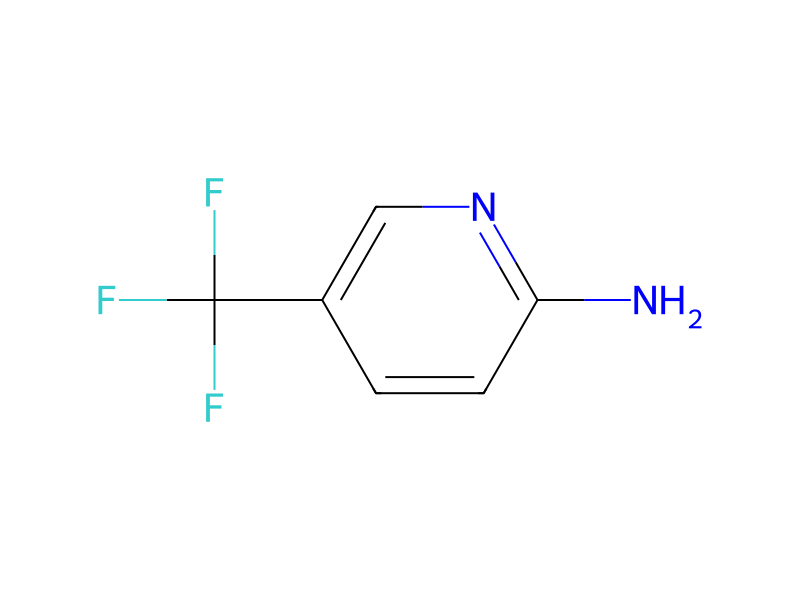
Into the same 300 ml four-necked flask as used in Example 1, 16.2 g (0.1 mol) of 2-amino-5-trifluoromethylpyridine, 20.9 g (0.115 mol) of N-chlorophthalimide and 150 g of toluene were added, and the reaction was carried out at 80° C. for one hour under heating with stirring. During the reaction, formation of 2-chloroamino-5-trifluoromethylpyridine was confirmed. After completion of the reaction, the reaction mixture was cooled to room temperature, and 50 g of a 25% sodium hydroxide aqueous solution was added thereto and stirred. An aqueous layer and an oil layer were separated. A 20% hydrochloric acid aqueous solution was added to the oil layer, and the mixture was stirred. An aqueous layer and an oil layer were separated again. The aqueous layer was neutralized with a 25% sodium hydroxide aqueous solution. Precipitated slightly yellow crystals were collected by filtration and dried to obtain 17.5 g 2-amino-3-chloro-5-trifluoromethylpyridine (purity as measured by liquid chromatography: 97%, yield: 86%).