Hydrochloric Acid → 3-Amino-3-(4-chlorophenyl)-2-methyl-thioacrylamide
HRID 2422701
反応式

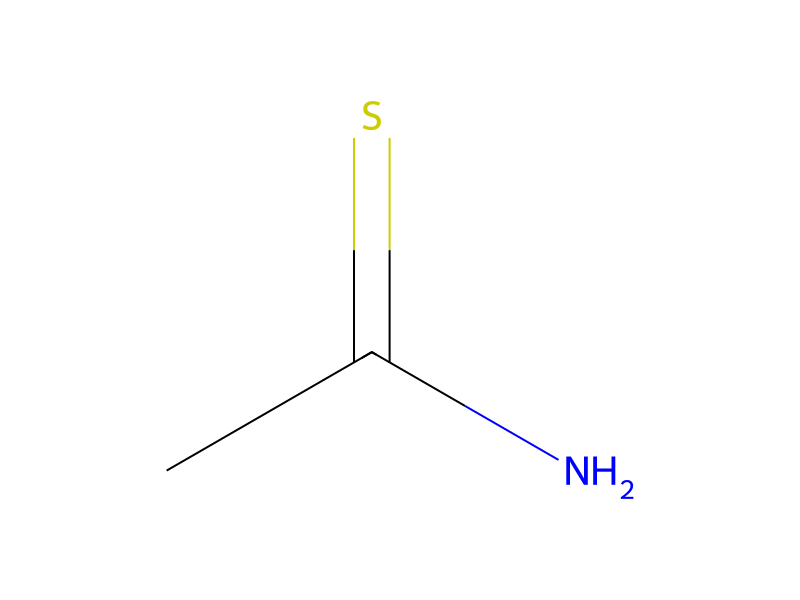
Cl.[NH2:2][C:3]([C:8]1[CH:13]=[CH:12][C:11]([Cl:14])=[CH:10][CH:9]=1)=[C:4]([CH3:7])[C:5]#[N:6].C(N)(=[S:17])C>>[NH2:2][C:3]([C:8]1[CH:9]=[CH:10][C:11]([Cl:14])=[CH:12][CH:13]=1)=[C:4]([CH3:7])[C:5]([NH2:6])=[S:17]参加物
4



実験手順
Add hydrogen chloride (4 M in 1,4-dioxane, 858 mL, 16.0 equiv; 3.43 mol) to an E-/Z-mixture of 3-amino-3-(4-chlorophenyl)-2-methylacrylonitrile (41.3 g, 1.00 equiv, 214.4 mmol) and thioacetamide (32.71 g, 2 equiv, 2.00 equiv; 428.8 mmol) in a 2 L round bottom flask RBF (fitted with rubber septum, nitrogen blanket, stir bar and cooling bath). Maintain a solution temperature below 30° C. with an ice bath until the addition is complete. Remove the ice bath, stir for 2 h, and slowly add the mixture to 1.5 L of 30% aqueous NH4OH in an ice bath with stirring. Extract the mixture 2 times with ethyl acetate. Wash the organic phase 2 times with brine, dry (K2CO3), filter, and concentrated to dryness. Crystallize the mixture from hexane and chloroform (10/90). Triturate the resulting solid from ethanol and water (10/90) to afford 3-amino-3-(4-chlorophenyl)-2-methyl-thioacrylamide (as an uncharacterized E-/Z-mixture). Yield: 82.3%. 1H NMR (CD3OD) δ 9.95 (s, 2H), 8.74 (s, 1H), 8.29 (d, J=6.0 Hz, 2H), 8.25 (s, 1H), 8.11 (d, J=6.0 Hz, 2H), 4.099 (s, 3H).