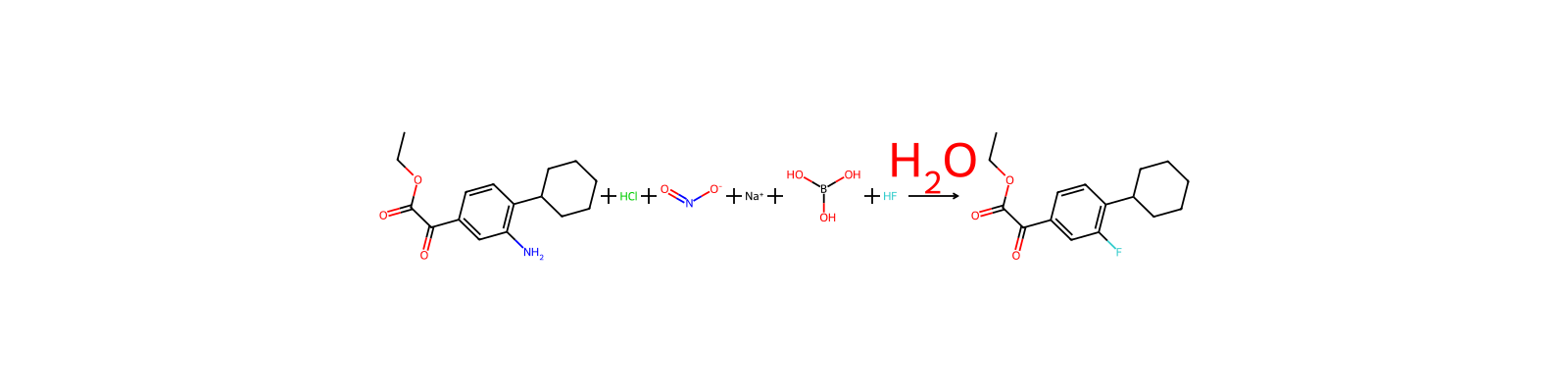
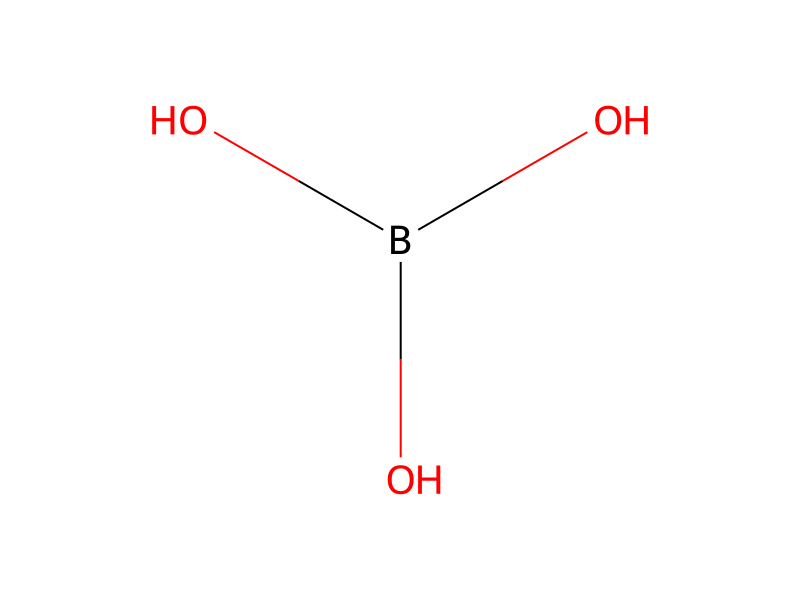
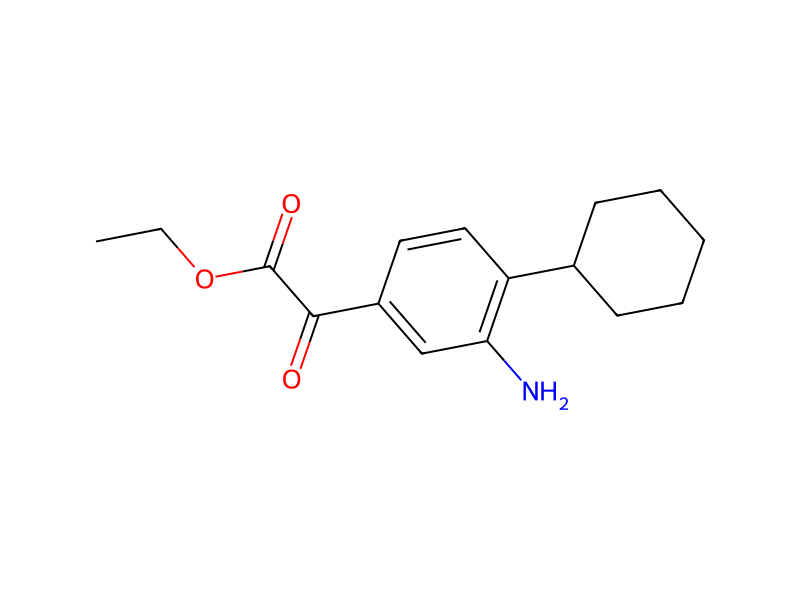
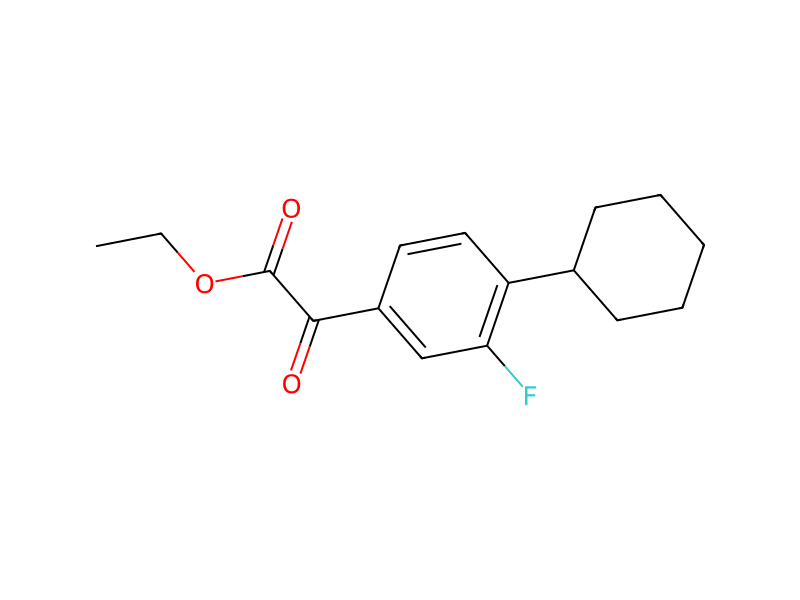
To 44.2 g. (0.15 moles) of ethyl 3-amino-4-cyclohexylphenylglyoxylate is added at 0° C. 44 ml. of 1.5 moles of concentrated hydrochloric acid. The reaction mixture is maintained at 0° C. and the diazonium salt is prepared with 23.2 g. (0.32 moles) of 95% sodium nitrite in 80 ml. of water. To this mixture is rapidly added a solution of 10.4 g. (0.17 moles) of boric acid dissolved in 22 g. (0.66 moles) of 60% hydrofluoric acid. The reaction mixture is then stirred for 1/2 hour and filtered, washed with 3 × 25 ml. of water, 2 × 25 ml. of methanol and 25 ml. of ether. The residual cake is then treated in vacuo. The treated cake is then placed in a distilling flask and heated to permit spontaneous decomposition. After the decomposition, the residue is then fractionally distilled to obtain ethyl 3-fluoro-4-cyclohexylphenylglyoxylate.