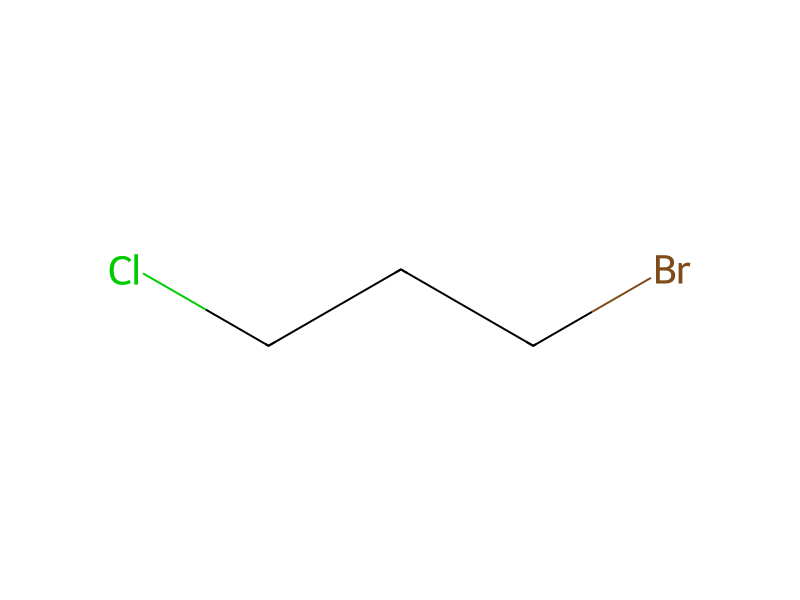
[F:1][C:2]1[CH:7]=[CH:6][C:5]([CH:8]([C:11]2[CH:16]=[CH:15][C:14]([F:17])=[CH:13][CH:12]=2)[C:9]#[N:10])=[CH:4][CH:3]=1.Br[CH2:19][CH2:20][CH2:21][Cl:22].[OH-].[Na+].CC1C=CC=CC=1>[Cl-].C([N+](CC)(CC)CC1C=CC=CC=1)C.O>[Cl:22][CH2:21][CH2:20][CH2:19][C:8]([C:11]1[CH:12]=[CH:13][C:14]([F:17])=[CH:15][CH:16]=1)([C:5]1[CH:6]=[CH:7][C:2]([F:1])=[CH:3][CH:4]=1)[C:9]#[N:10]To a stirred and cooled (ice-bath) mixture of 22.9 parts of 4-fluoro-α-(4-fluorophenyl)benzeneacetonitrile, 23.6 parts of 1-bromo-3-chloropropane and 0.4 parts of N,N,N-triethylbenzenemethanaminium chloride were added dropwise 600 parts of sodium hydroxide solution 50% at a temperature below 30° C. Upon completion, stirring was continued for 3 hours at 50°-60° C. Methylbenzene and water were added and the layers were separated. The organic phase was dried, filtered and evaporated. The residue was evaporated once more in vacuo for 30 minutes at 100° C. to remove the last traces of 1-bromo-3-chloropropane, yielding 29 parts (95%) of α-(3-chloropropyl)-4-fluoro-α-(4-fluorophenyl)benzeneacetonitrile as a residue (intermediate 14).