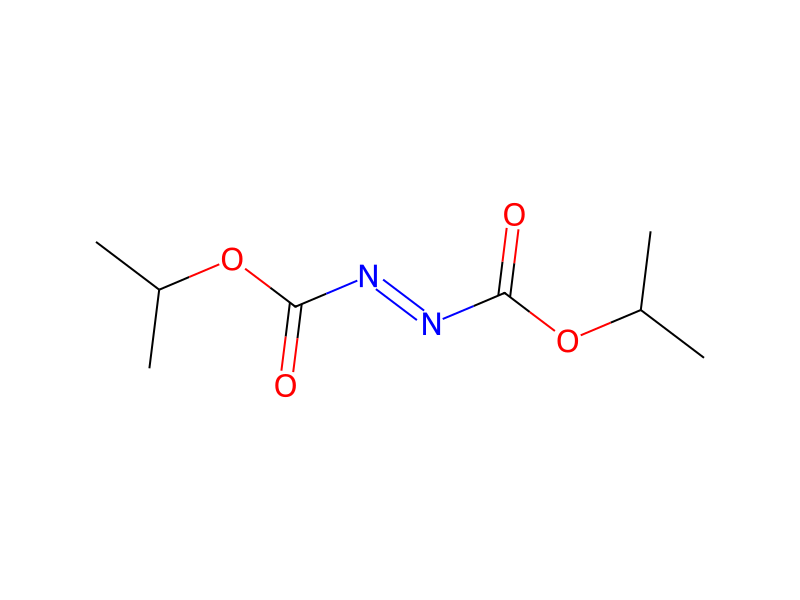
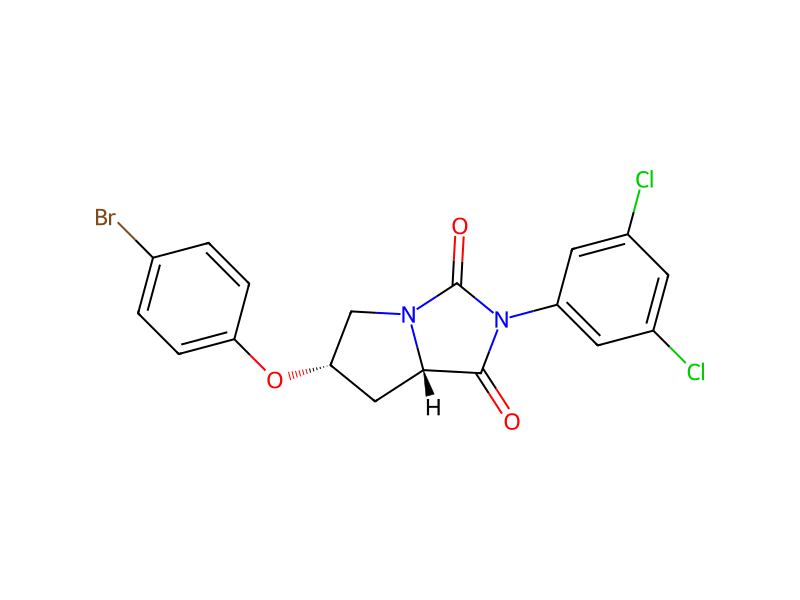
[Cl:1][C:2]1[CH:3]=[C:4]([N:9]2[C:13](=[O:14])[C@@H:12]3[CH2:15][C@@H:16]([OH:18])[CH2:17][N:11]3[C:10]2=[O:19])[CH:5]=[C:6]([Cl:8])[CH:7]=1.C1C=CC(P(C2C=CC=CC=2)C2C=CC=CC=2)=CC=1.[Br:39][C:40]1[CH:45]=[CH:44][C:43](O)=[CH:42][CH:41]=1.CC(OC(/N=N/C(OC(C)C)=O)=O)C>C1COCC1>[Cl:1][C:2]1[CH:3]=[C:4]([N:9]2[C:13](=[O:14])[C@@H:12]3[CH2:15][C@H:16]([O:18][C:43]4[CH:44]=[CH:45][C:40]([Br:39])=[CH:41][CH:42]=4)[CH2:17][N:11]3[C:10]2=[O:19])[CH:5]=[C:6]([Cl:8])[CH:7]=1To a solution of (7aS,6R)-2-(3,5-dichloro-phenyl)-6-hydroxy-tetrahydro-pyrrolo[1,2-c]imidazole-1,3-dione (0.5 g) (1.67 mmol) (Preparation 2), Ph3P (0.44 g) (1eq.) and 4-bromophenol (0.29 g) (1 eq.) in 5 mL of dry THF at 0° C. was added DIAD (0.337 g) in a minimal volume of THF. The reaction mixture was warmed to RT overnight. After evaporating the solvent, the residue was dissolved in DCM, washed with NaHCO3 solution, water, dried over MgSO4, and the solvent was evaporated under reduced pressure, to afford after SiO2 chromatography (eluent: DCM) the titled compound as a white solid (50 mg). Mp=116° C. NMR (DMSO, 200 MHz): 7.75 (1H, m), 7.5-7.4 (4H, d+d), 6.85 (2H, d), 5.1 (1H, m), 4.6 (1H, dd), 3.95 (1H, dd), 3.35 (1H, dd), 2.7-2.5 (1H, m), 2.25 (1H, bd).
読み込み中…