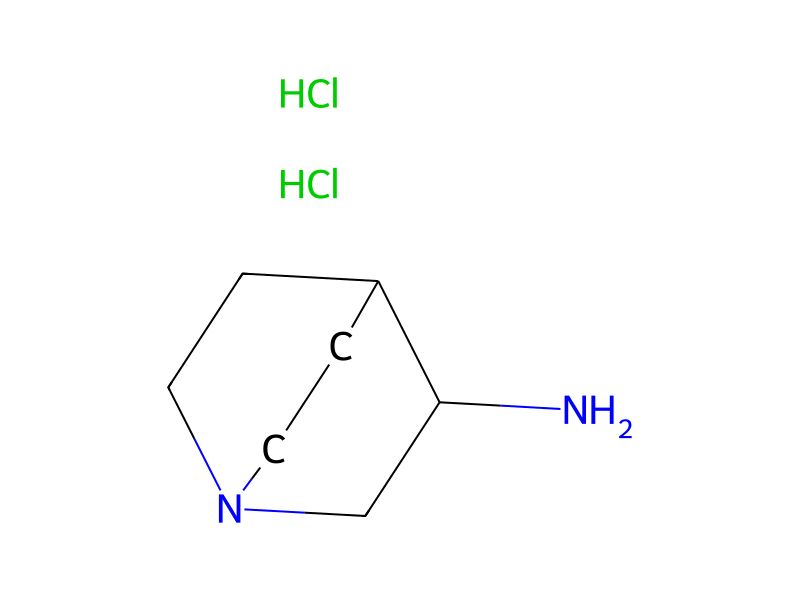
[F:1][C:2]1[CH:7]=[CH:6][C:5]([C:8]2[O:9][C:10]3[C:16]([C:17]([OH:19])=O)=[CH:15][CH:14]=[CH:13][C:11]=3[N:12]=2)=[CH:4][CH:3]=1.C1CCC(N=C=NC2CCCCC2)CC1.Cl.Cl.[NH2:37][CH:38]1[CH:43]2[CH2:44][CH2:45][N:40]([CH2:41][CH2:42]2)[CH2:39]1.C(N(CC)CC)C>C(#N)C.CN(C1C=CN=CC=1)C>[N:40]12[CH2:45][CH2:44][CH:43]([CH2:42][CH2:41]1)[CH:38]([NH:37][C:17]([C:16]1[C:10]3[O:9][C:8]([C:5]4[CH:4]=[CH:3][C:2]([F:1])=[CH:7][CH:6]=4)=[N:12][C:11]=3[CH:13]=[CH:14][CH:15]=1)=[O:19])[CH2:39]2A solution of 2-(4-fluorophenyl)benzoxazole-7-carboxylic acid (0.100 g, 0.39 mmol) in acetonitrile (10 mL) was treated with DCC (0.089 g, 0.43 mmol) and the mixture stirred at room temperature for 1 h. After this time a thick granular precipitate had formed. 3-Aminoquinuclidine dihydrochloride (0.086 g, 0.43 mmol) and DMAP (0.010 g, 0.08 mmol) were then added to the reaction followed by the dropwise addition of triethylamine (0.10 g, 1.00 mmol) over 15 min. The reaction was then stirred at room temperature overnight. Subsequent concentration of the reaction mixture and purification of the resulting solid residue by column chromatography afforded 0.100 g (70% yield) of N-(1-azabicyclo[2.2.2]oct-3-yl)-2-(4-fluorophenyl)benzoxazole-7-carboxamide as a white solid: mp 185-187° C.; 1H NMR (500 MHz, DMSO-d6) δ 8.46 (d, J=6.7 Hz, 1H), 8.24 (m, 2H), 7.95 (m, 1H), 7.70 (m, 1H), 7.51 (m, 3H), 4.06 (m, 1H), 3.21 (m, 1H), 2.92 (m, 1H), 2.74 (m, 4H), 1.96 (m, 2H), 1.64 (m, 2H), 1.44 (m, 1H); MS (ESI) m/z 366 [M+H]+.