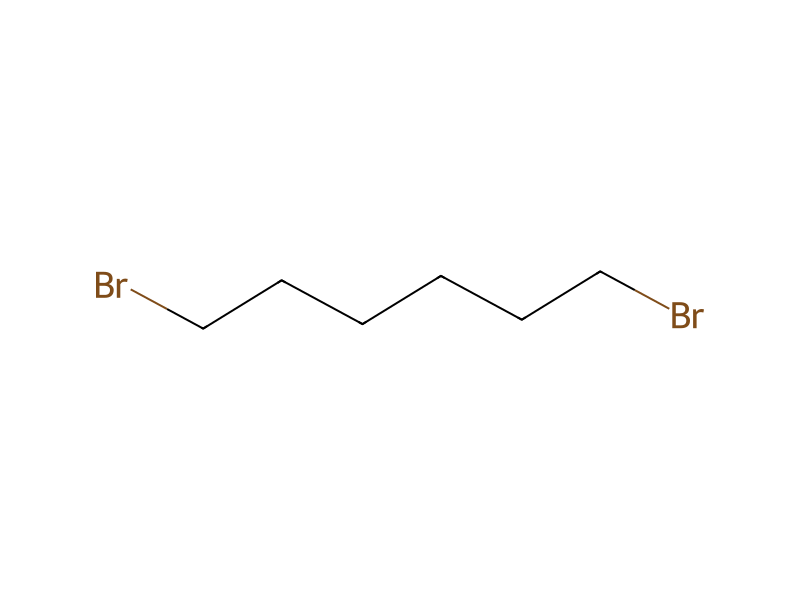
C(#N)C.[Cl:4][C:5]1[CH:10]=[C:9]([Cl:11])[C:8]([S:12][CH2:13][C:14]([F:17])([F:16])[F:15])=[CH:7][C:6]=1[OH:18].[Br:19][CH2:20][CH2:21][CH2:22][CH2:23][CH2:24][CH2:25]Br.C(=O)([O-])[O-].[K+].[K+]>[Br-].C([N+](CCCC)(CCCC)CCCC)CCC.C(OC(=O)C)C.CCCCCC>[Br:19][CH2:20][CH2:21][CH2:22][CH2:23][CH2:24][CH2:25][O:18][C:6]1[CH:7]=[C:8]([S:12][CH2:13][C:14]([F:15])([F:17])[F:16])[C:9]([Cl:11])=[CH:10][C:5]=1[Cl:4]To 30 ml of acetonitrile were added 1.0 g (3.61 mmol) of 2,4-dichloro-5-(2,2,2-trifluoroethylthio)phenol, 3.5 g (14.4 mmol) of 1,6-dibromohexane, 0.65 g (15.0 mmol) of potassium carbonate and 0.12 g (0.37 mmol) of tetra-n-butylammonium bromide. The mixture was refluxed for 3 hours under heating. The mixture was allowed to stand at room temperature, and insoluble matters were removed by filtration. Then the filtrate was concentrated under reduced pressure, and the residue was purified by silica gel column chromatography (developing solvent: a mixed solvent of n-hexane ethyl acetate=20:1), to obtain 1.51 g (yield: 95%) of an intended product.