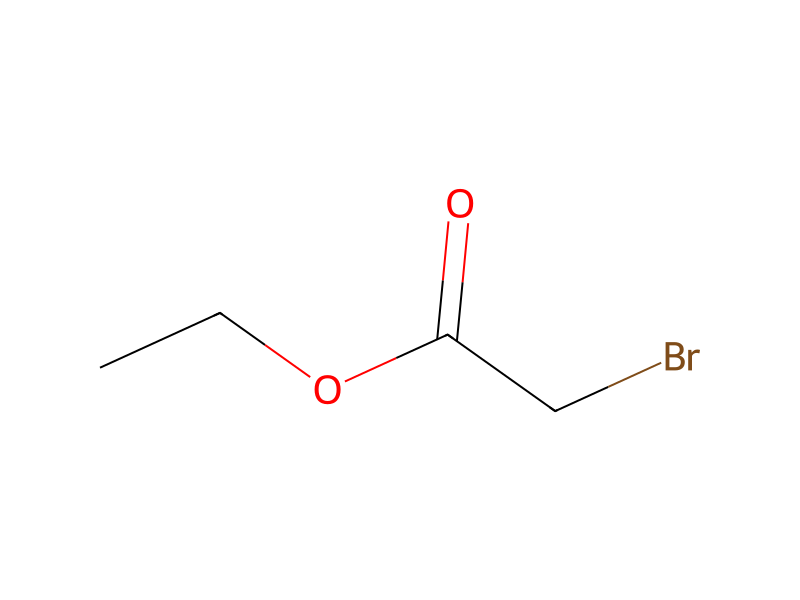
Ethyl bromoacetate → Ethyl 2-allyl-4-bromophenoxyacetate
HRID 580955
反応式

Br[CH2:2][C:3]([O:5][CH2:6][CH3:7])=[O:4].[CH2:8]([C:11]1[CH:16]=[C:15]([Br:17])[CH:14]=[CH:13][C:12]=1[OH:18])[CH:9]=[CH2:10].C(=O)([O-])[O-].[K+].[K+]>CC(=O)CC>[CH2:8]([C:11]1[CH:16]=[C:15]([Br:17])[CH:14]=[CH:13][C:12]=1[O:18][CH2:2][C:3]([O:5][CH2:6][CH3:7])=[O:4])[CH:9]=[CH2:10]参加物
5



実験手順
Ethyl bromoacetate (1.68 g) was added to a stirred suspension of 2-allyl-4-bromophenol (2.13 g) and potassium carbonate (1.50 g) in butan-2-one (15 ml). The mixture was heated at reflux for 16 hours. The reaction mixture was cooled to ambient temperature and filtered. Water (100 ml) was added to the filtrate and the aqueous phase was extracted with ethyl acetate (3×50 ml). The ethyl acetate extracts were combined, washed with brine (2×25 ml), dried (MgSO4) and evaporated to give a solid which crystallised from hexane to give ethyl 2-allyl-4-bromophenoxyacetate (2.10 g), mp 70.5° C.; microanalysis, found: C, 52.0; H, 5.10%; C13H15BrO3 requires: C, 52.2; H, 5.05%; NMR (CDCl3) 1.29 (3H, t), 3.42 (2H, d), 4.25 (2H, q), 4.58 (2H, s), 5.07-5.17 (2H, m), 5.88-6.18 (1H, m), 6.60 (1H, d) and 7.20-7.27 (2H, m); m/z 300 (M+H).