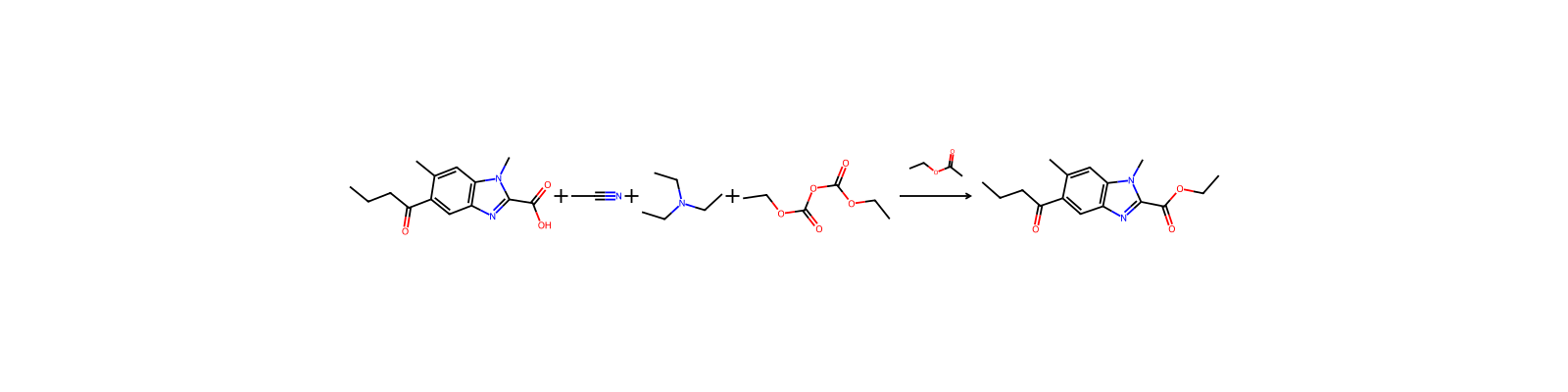
6.0 g of 5-butyryl-1,6-dimethyl-benzimidazole-2-carboxylic acid are introduced, in the course of 15 minutes, into a mixture of 150 ml of acetonitrile, 15 ml of triethylamine and 18.5 g of diethyl pyrocarbonate, while stirring at room temperature. The mixture is left to stand overnight, the acetonitrile is stripped off under reduced pressure, the residue is taken up in ethyl acetate and the resulting solution is washed with water, dried over sodium sulphate and evaporated to dryness. Ethyl 5-butyryl-1,6-dimethyl-benzimidazole-2-carboxylate, which is initially obtained as an oil but soon crystallises, is filtered off. When recrystallised from ethyl acetate/cyclohexane, it melts at 106°-108°.