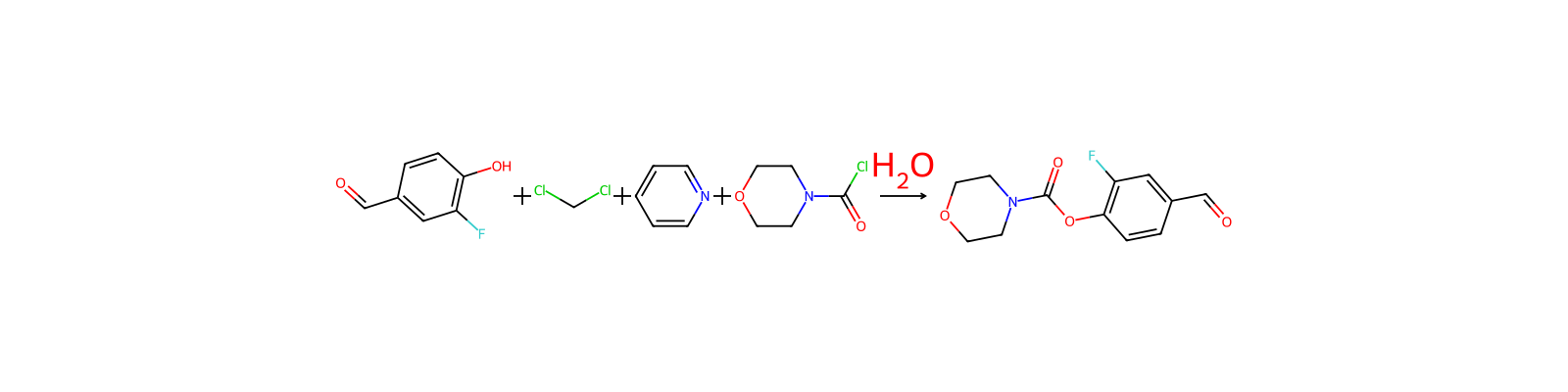
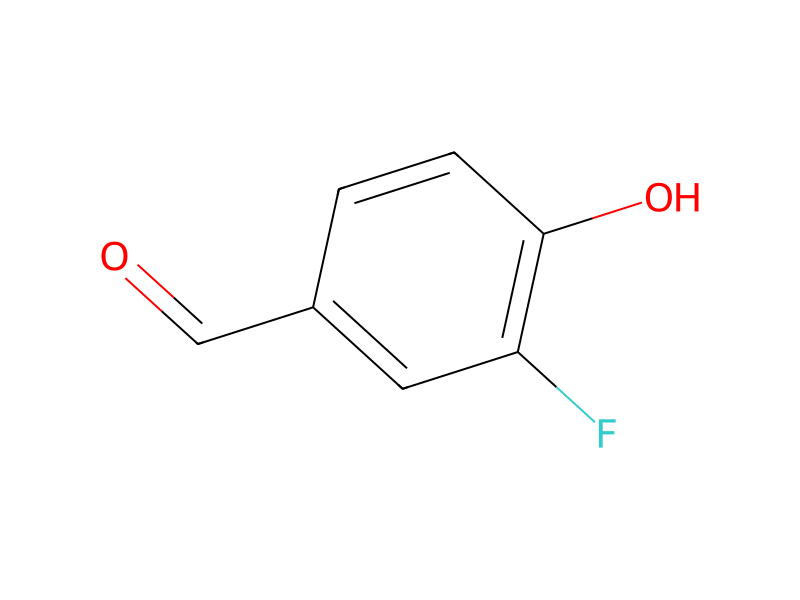
To a 250 mL dry round bottom flask were added 3-fluoro-4-hydroxybenzaldehyde (4.76 g, 34.0 mmol), anhydrous CH2Cl2 (40 mL) and pyridine (3.6 mL, 44.2 mmol). The mixture was stirred in an ice-water bath, then 4-morpholinecarbonyl chloride (4.4 mL, 37.4 mmol) was added. The mixture was stirred and warmed slowly to room temperature, then at room temperature overnight. Water (80 mL) was added to the reaction mixture. The CH2Cl2 layer was separated, and the aqueous layer was extracted continually with CH2Cl2 (50 mL×3). The combined CH2Cl2 solution was dried over Na2SO4. After removal of the solvent, the residue was purified with a silica gel chromatography (heptane/ethyl acetate, gradient eluting) to give 2-fluoro-4-formylphenyl morpholine-4-carboxylate (7.45 g) as white solid. Yield: 87%. 1H NMR (CDCl3, 300 MHz): δ=9.97 (s, 1H), 7.74-7.70 (m, 2H), 7.45 (t, J=7.8 Hz, 1H), 3.81-3.61 (m, 8H). 13C NMR (CDCl3, 75.5 MHz, mixture of two isomers): δ=189.9, 156.5, 153.1, 151.8, 144.0, 143.8, 135.0, 134.9, 126.7, 126.6, 124.8, 116.7, 116.4, 66.4, 66.3, 45.2, 44.4.