反応式
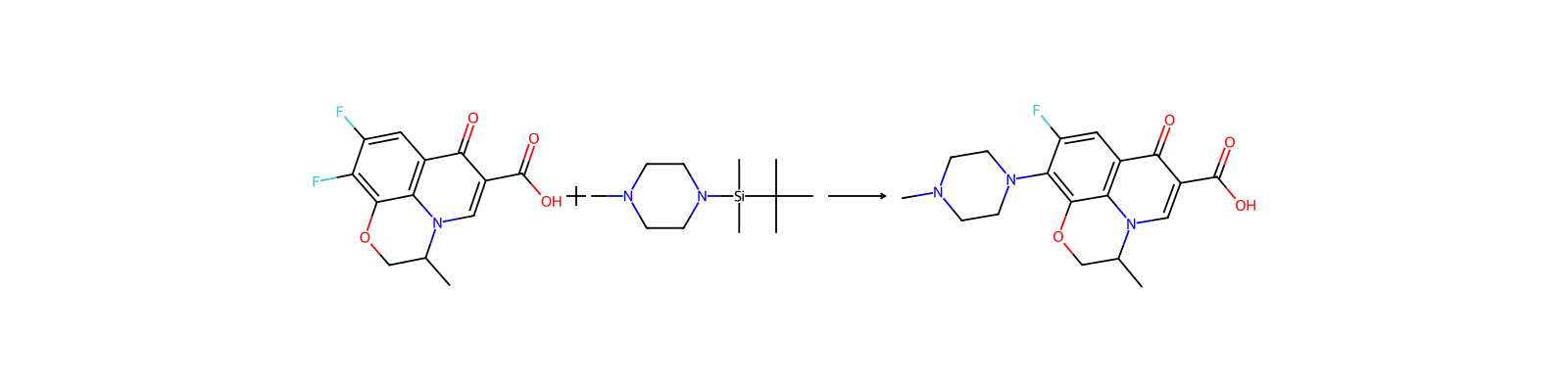
[F:1][C:2]1[C:3](F)=[C:4]2[O:9][CH2:8][CH:7]([CH3:10])[N:6]3[CH:11]=[C:12]([C:17]([OH:19])=[O:18])[C:13](=[O:16])[C:14]([CH:15]=1)=[C:5]23.[Si]([N:28]1[CH2:33][CH2:32][N:31]([CH3:34])[CH2:30][CH2:29]1)(C(C)(C)C)(C)C>>[F:1][C:2]1[C:3]([N:28]2[CH2:33][CH2:32][N:31]([CH3:34])[CH2:30][CH2:29]2)=[C:4]2[O:9][CH2:8][CH:7]([CH3:10])[N:6]3[CH:11]=[C:12]([C:17]([OH:19])=[O:18])[C:13](=[O:16])[C:14]([CH:15]=1)=[C:5]23参加物
3


実験手順
In a manner similar to that of Example 4, 9,10-difluoro-3-methyl-7-oxo-2,3-dihydro-7H-pyrido [1,2,3-de]-1,4-benzoxazin- 6-carboxylic acid (II, X: fluoro) is reacted with 4-(t-butyldimethylsilyl)-1-methylpiperazine (III, R2, R3 and R4 : methyl; R5 : t-butyl) to obtain a solid compound.
後処理
- customto obtain a solid compound
出典と根拠
- ORDレコード
- ord-13e9f7b309c54757b66a5042d743ec3c
- 出典データセット
- uspto-grants-1991_09
- 特許番号
- US05051505
関連ノート
読み込み中…