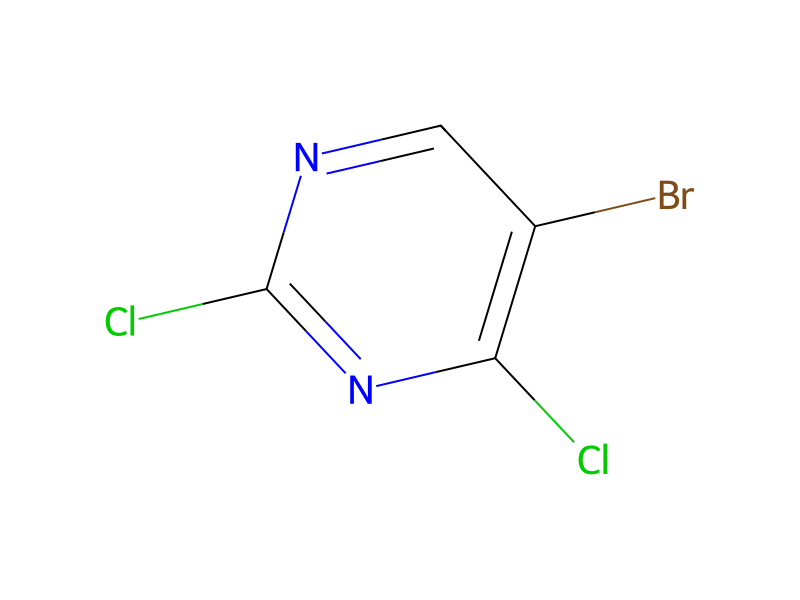
[Br:1][C:2]1[C:3](Cl)=[N:4][C:5]([Cl:8])=[N:6][CH:7]=1.C(N(CC)CC)C.[CH2:17]([O:24][C:25](=[O:33])[NH:26][CH2:27][CH2:28][CH2:29][CH2:30][CH2:31][NH2:32])[C:18]1[CH:23]=[CH:22][CH:21]=[CH:20][CH:19]=1.O>C(#N)C>[CH2:17]([O:24][C:25](=[O:33])[NH:26][CH2:27][CH2:28][CH2:29][CH2:30][CH2:31][NH:32][C:3]1[C:2]([Br:1])=[CH:7][N:6]=[C:5]([Cl:8])[N:4]=1)[C:18]1[CH:23]=[CH:22][CH:21]=[CH:20][CH:19]=1A solution of 860 mg (3.8 mmol) of 5-bromo-2,4-dichloro-pyrimidine and 1.2 ml (8.5 mmol) of triethylamine in 6 ml of acetonitrile is mixed at 0° C. with 1.0 g (3.7 mmol) of (5-amino-pentyl)-carbamic acid-benzyl ester. The reaction mixture is slowly heated to room temperature while being stirred by removal of the ice bath. After 60 hours, it is mixed with water and then extracted with ethyl acetate (2×). The combined organic phases are dried (Na2SO4), filtered and concentrated by evaporation. The residue that is formed is purified by chromatography (hexane/ethyl acetate 1:1). 1.2 g (2.8 mmol, corresponding to 77% of theory) of the product is obtained.