Ethanol → Benzene, 1,3-dichloro-5-nitro-
反応式
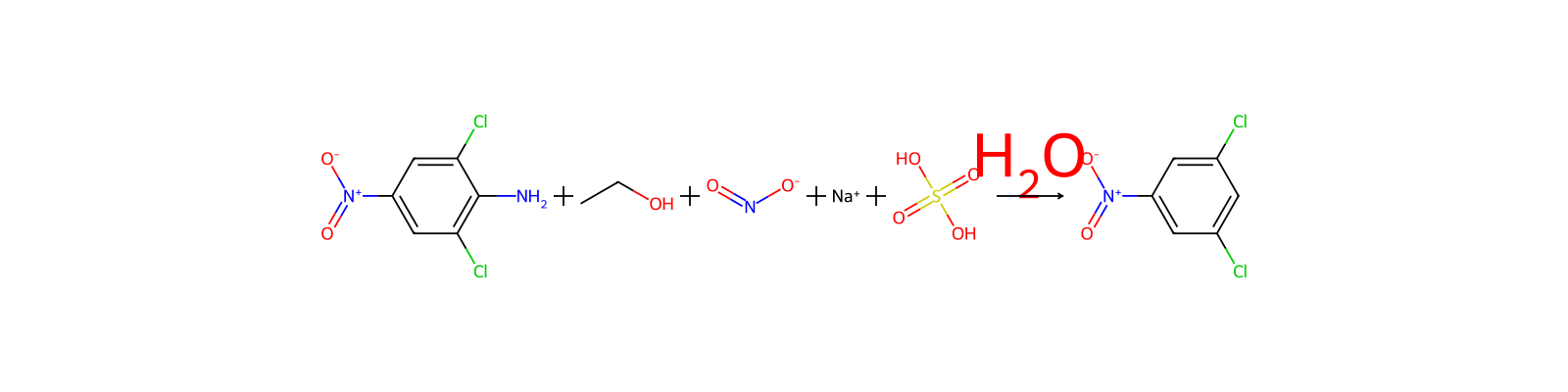
[Cl:1][C:2]1[CH:8]=[C:7]([N+:9]([O-:11])=[O:10])[CH:6]=[C:5]([Cl:12])[C:3]=1N.C(O)C.N([O-])=O.[Na+].S(=O)(=O)(O)O>O>[Cl:1][C:2]1[CH:8]=[C:7]([N+:9]([O-:11])=[O:10])[CH:6]=[C:5]([Cl:12])[CH:3]=1参加物
6





実験手順
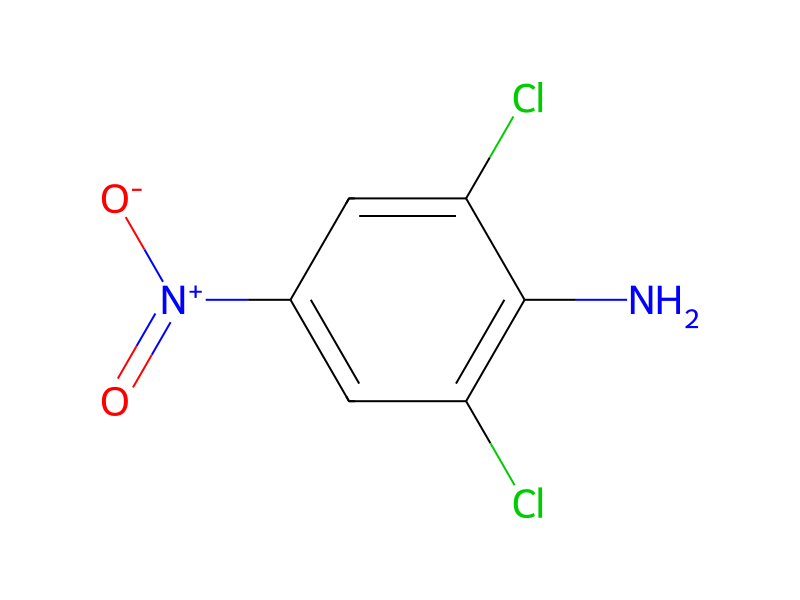
Amer. Chem. Soc., 72 (1950), 798, discloses that 2,6-dichloro-4-nitroaniline, ethanol and sodium nitrite can be reacted at the boil, in the absence of water and in the presence of concentrated sulfuric acid, to give 3,5-dichloronitrobenzene in a yield of 84%. A corresponding reaction to give the 3,5-dibromo derivative gives a yield of 91%. The process is unsatisfactory in respect of yield and purity of the end product and simple, reliable and economical operation, especially on an industrial scale.
出典と根拠
- ORDレコード
- ord-64167b01dbd041b19e0a44155c074f12
- 出典データセット
- uspto-grants-1977_10
- 特許番号
- US04053527
反応ノート
読み込み中…