
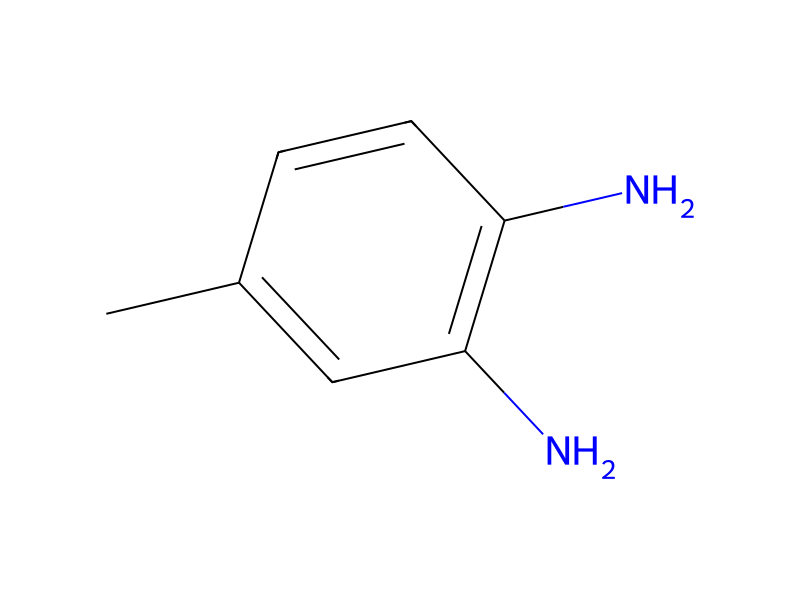
기본 정보
- 표준 SMILES
Cc1ccc(N)c(N)c1- InChIKey
DGRGLKZMKWPMOH-UHFFFAOYSA-N- 분자식
- C7H10N2
- 평균 분자량
- 122.17 g/mol
- 단동위원소 질량
- 122.08439832
개요
3,4-diaminotoluene appears as a colorless to brownish purple crystalline solid. Toxic by ingestion and inhalation and an irritant to skin and eyes. Soluble in water, alcohol and ether. Decomposes to emit toxic oxides of nitrogen when heated to high temperature. Used in making dyes.
이름 및 식별자
- 우선 이름
- 3,4-Diaminotoluene
- IUPAC
- 4-methylbenzene-1,2-diamine
- 현지명
- 3,4-디아미노톨루엔
- 영어명
- 3,4-Diaminotoluene
- 분자식
- C7H10N2
- 분자량
- 122.17
이름 및 동의어
3,4-DIAMINOTOLUENE496-72-04-Methyl-o-phenylenediamine1,2-Benzenediamine, 4-methyl-Toluene-3,4-diamine4-Methyl-1,2-benzenediamine4-Methyl-1,2-phenylenediamine3,4-Tolylenediamine1,2-Diamino-4-methylbenzene4-Methyl-1,2-diaminobenzene3,4-Toluylenediamine3,4-Diamino-1-methylbenzene
이름 더 보기
3,4-다이아미노톨루엔3,4-디아미노톨루엔톨루엔-3,4-디아민톨루엔-3,4-다이아민톨루엔-3,4-다이아민및그염류,염모제로사용될때톨루엔-3,4-다이아민및그염류1,2-다이아미노-4-메틸벤젠1,2-벤젠다이아민, 4-메틸-2-아미노-4-메틸아닐린2-아미노-5-메틸아닐린3,4-다이아미노-1-메틸벤젠3,4-디아미노메틸-벤젠3,4-톨루엔다이아민3,4-톨루일렌디아민4-메틸-1,2-벤젠디아민4-메틸-o-페닐렌다이아민페닐렌-1,2-다이아민, 4-메틸-o-Toluenediamine3,4-DATJACS-496-72-03.4-Diaminotol3,4-TOLUOLDIAMINE3,4-Dhamphetamine3,4-TOLUENEDIAMINE
NSC 1495CCRIS 4611DTXSID9024930HSDB 6070EINECS 207-826-2OE7HJ54P5CBRN 05079653,4-DIAMINOTOLUENE [HSDB]
데이터베이스 식별자
- CAS
496-72-0- PubChem CID
- 10332
- DTXSID
DTXSID9024930- ChEMBL
CHEMBL1319452- UNII
- OE7HJ54P5C
- EC Number
- 105-428-2、207-826-2
- Nikkaji
- J93.148I
물성
구조 계산 물성
- XLogP
- 0.6
- 극성 표면적
- 52 Ų
- 수소 결합 공여자 수
- 2
- 수소 결합 수용자 수
- 2
- 회전 가능 결합 수
- 0
- 무거운 원자 수
- 9
- 형식 전하
- 0
- 복잡도
- 92.9
실험 및 물리화학적 성질
Chemical ClassesNitrogen Compounds -> Amines, Aromatic
Cosmetics
Cosmetic ingredients (Toluene-3,4-Diamine) -> CIR (Cosmetic Ingredient Review)
Hair dyeing
LogP0.66
Color/FormLEAFLETS FROM PETROLEUM ETHER
Solubility
less than 1 mg/mL at 63 °F (NTP, 1992)
VERY SOL IN WATER
Boiling Point
509 °F at 760 mmHg (Sublimes) (NTP, 1992)
265 °C (sublimes)
DecompositionWhen heated to decomposition it emits very toxic fumes of /nitrogen oxides/.
Melting Point
192 to 194 °F (NTP, 1992)
80-90 °C
Physical Description
3,4-diaminotoluene appears as a colorless to brownish purple crystalline solid. Toxic by ingestion and inhalation and an irritant to skin and eyes. Soluble in water, alcohol and ether. Decomposes to emit toxic oxides of nitrogen when heated to high temperature. Used in making dyes.
Other Solid; CBI; Liquid
Solid; [HSDB] Colorless to brownish-purple solid; [CAMEO]
물리화학적 성질
- 녹는점
- 87 · 87-89 °C (lit.)
- 끓는 점
- 155 · 155-156 °C/18 mmHg (lit.)
- 밀도
- 1.2207 · 1.2207 (rough estimate)
- 굴절률
- 1.5103 · 1.5103 (estimate)
- 인화점
- 155 · 155-156°C/18mm
- 저장 조건
- Keep in dark place,Inert atmosphere,Room temperature
- 용해도
- 클로로포름(소량으로 용해), 메탄올(약간 용해됨)
- 산도 계수 (pKa)
- 4.59 · 4.59±0.10(Predicted)
- 물리적 상태
- 결정질 덩어리 또는 조각
- 색상
- 갈색~회갈색
- 수용성
- 16 g/L · 16g/L(20℃)
- BRN
- 507965 · 507965
- 안정성
- 안정적인. 강한 산화제와 호환되지 않습니다.
- 화장품 원료 기능
- 머리 염색
- InChI
- 1S/C7H10N2/c1-5-2-3-6(8)7(9)4-5/h2-4H,8-9H2,1H3
- InChIKey
- DGRGLKZMKWPMOH-UHFFFAOYSA-N
- SMILES
- Cc1ccc(N)c(N)c1
- NIST
- 1 · 1,2-Benzenediamine, 4-methyl-(496-72-0)
- EPA
- 3 · 3,4-Diaminotoluene (496-72-0)
화학적 성질
Off-white small blocks
안전 및 규제
GHS 분류
GHS Classification
Danger
H301 (79.1%): Toxic if swallowed [Danger Acute toxicity, oral]
P203, P260, P261, P264, P264+P265, P270, P271, P272, P273, P280, P301+P316, P301+P317, P302+P352, P304+P340, P305+P351+P338, P317, P318, P319, P321, P330, P332+P317, P333+P317, P337+P317, P362+P364, P391, P403+P233, P405, and P501 (click each P-code to see the statement)
Aggregated GHS information provided per 287 reports by companies from 16 notifications to the ECHA C&L Inventory. Each notification may be associated with multiple companies.
Warning
H302: Harmful if swallowed [Warning Acute toxicity, oral]
유해성 정보
Regulatory Information
Chemical: 1,2-Benzenediamine, 4-methyl-
1,2-Benzenediamine, 4-methyl- is listed on the EPA's Chemical Data Reporting (CDR) system. Manufacturers and importers of 1,2-Benzenediamine, 4-methyl- are required to report information about their production and use of this chemical to the EPA under the Toxic Substances Control Act (TSCA). (40 eCFR Part 711)
Status: Cease Manufacture Update: 15-04-2018 https://echa.europa.eu/registration-dossier/-/registered-dossier/24139
4-Methyl-1,2-phenylenediamine: Does not have an individual approval but may be used under an appropriate group standard
Other Safety InformationIMAP assessments - Ortho-toluenediamines: Human health tier II assessment
DOT LabelPoison
Fire HazardsFlash point data for this chemical are not available. It is probably combustible. (NTP, 1992)
Health HazardsSYMPTOMS: Symptoms of exposure to this compound may include skin and eye irritation.
Hazards Summary
External application to rabbit eyes scored 7 on a scale of 1-10 (10 being most severe) for degree of injury (2,3/3,4 mixture); Emergency treatment: Methemoglobinemia; [HSDB] A skin and eye irritant; [CAMEO] An irritant; Harmful by ingestion, inhalation, or skin absorption; [Aldrich MSDS] See 2,4-Diaminotoluene.
Reactive GroupAmines, Aromatic
Special Reports
REVIEW: UNITED STATES EPA; PHENYLENEDIAMINES; RESPONSE TO INTERAGENCY TESTING COMMITTEE; FED REGIST 47 (5): 973 (1982). EVIDENCE IS GIVEN SUPPORTING TESTING OF THE CLASS OF COMPOUNDS PHENYLENEDIAMINES FOR THEIR TOXIC EFFECTS ON HUMAN HEALTH AND THE ENVIRONMENT. THE RESULTS OF TOXICITY TESTING OF 22 COMPOUNDS ARE TABULATED AS ARE THE EFFECTS FOR WHICH TESTING IS BEING CONSIDERED FOR 13 COMPOUNDS, AND THE USES OR POTENTIAL USES OF 47 PHENYLENEDIAMINES. /PHENYLENEDIAMINES/
TSCA Requirements
Pursuant to section 8(d) of TSCA, EPA promulgated a model Health and Safety Data Reporting Rule. The section 8(d) model rule requires manufacturers, importers, and processors of listed chemical substances and mixtures to submit to EPA copies and lists of unpublished health and safety studies. 1,2-Benezenediamine, 4-methyl- included on this list.
Section 8(a) of TSCA requires manufacturers of this chemical substance to report preliminary assessment information concerned with production, use, and exposure to EPA as cited in the preamble of the 51 FR 41329.
Reactivity Profile
3,4-DIAMINOTOLUENE neutralizes acids in exothermic reactions to form salts plus water. May be incompatible with isocyanates, halogenated organics, peroxides, phenols (acidic), epoxides, anhydrides, and acid halides. Flammable gaseous hydrogen may be generated in combination with strong reducing agents, such as hydrides.
DOT Emergency Guidelines
/GUIDE 151: SUBSTANCES - TOXIC (NON-COMBUSTIBLE)/ Health: Highly toxic, may be fatal if inhaled, swallowed or absorbed through skin. Avoid any skin contact. Effects of contact or inhalation may be delayed. Fire may produce irritating, corrosive and/or toxic gases. Runoff from fire control or dilution water may be corrosive and/or toxic and cause pollution. /2,4-Toluenediamine; 2,4-Toluylenediamine; 2,4-Toluylenediamine, solid; 2,4-Toluylenediamine, solution/
/GUIDE 151: SUBSTANCES - TOXIC (NON-COMBUSTIBLE)/ Fire or Explosion: Non-combustible, substance itself does not burn but may decompose upon heating to produce corrosive and/or toxic fumes. Containers may explode when heated. Runoff may pollute waterways. /2,4-Toluenediamine; 2,4-Toluylenediamine; 2,4-Toluylenediamine, solid; 2,4-Toluylenediamine, solution/
/GUIDE 151: SUBSTANCES - TOXIC (NON-COMBUSTIBLE)/ Public Safety: CALL Emergency Response Telephone Number ... . As an immediate precautionary measure, isolate spill or leak area in all directions for at least 50 meters (150 feet) for liquids and at lease 25 meters (75 feet) for solids. Keep unauthorized personnel away. Stay upwind. Keep out of low areas. /2,4-Toluenediamine; 2,4-Toluylenediamine; 2,4-Toluylenediamine, solid; 2,4-Toluylenediamine, solution/
/GUIDE 151: SUBSTANCES - TOXIC (NON-COMBUSTIBLE)/ Protective Clothing: Wear positive pressure self-contained breathing apparatus (SCBA). Wear chemical protective clothing that is specifically recommended by the manufacturer. It may provide little or no thermal protection. Structural firefighters' protective clothing provides limited protection in fire situations ONLY; it is not effective in spill situations where direct contact with the substance is possible. /2,4-Toluenediamine; 2,4-Toluylenediamine; 2,4-Toluylenediamine, solid; 2,4-Toluylenediamine, solution/
For more DOT Emergency Guidelines (Complete) data for 3,4-DIAMINOTOLUENE (8 total), please visit the HSDB record page.
Air and Water ReactionsInsoluble in water.
안전 및 보호
Fire FightingFires involving this material can be controlled with a dry chemical, carbon dioxide or Halon extinguisher. (NTP, 1992)
First Aid
EYES: First check the victim for contact lenses and remove if present. Flush victim's eyes with water or normal saline solution for 20 to 30 minutes while simultaneously calling a hospital or poison control center. Do not put any ointments, oils, or medication in the victim's eyes without specific instructions from a physician. IMMEDIATELY transport the victim after flushing eyes to a hospital even if no symptoms (such as redness or irritation) develop.
Fire Fighting Procedures
If material involved in fire: Extinguish fire using agent suitable for type of surrounding fire. (Material itself does not burn or burns with difficulty.) Use water in flooding quantities as fog. Use "alcohol" foam, dry chemical or carbon dioxide. Apply water from as far a distance as possible. Keep run-off water out of sewers and water sources. /2,4-Toluenediamine/
Storage Conditions
PRECAUTIONS FOR "CARCINOGENS": Storage site should be as close as practical to lab in which carcinogens are to be used, so that only small quantities required for ... expt need to be carried. Carcinogens should be kept in only one section of cupboard, an explosion-proof refrigerator or freezer (depending on chemicophysical properties ...) that bears appropriate label. An inventory ... should be kept, showing quantity of carcinogen & date it was acquired ... Facilities for dispensing ... should be contiguous to storage area. /Chemical Carcinogens/
Cleanup Methods
PRECAUTIONS FOR "CARCINOGENS": A high-efficiency particulate arrestor (HEPA) or charcoal filters can be used to minimize amt of carcinogen in exhausted air ventilated safety cabinets, lab hoods, glove boxes or animal rooms ... Filter housing that is designed so that used filters can be transferred into plastic bag without contaminating maintenance staff is avail commercially. Filters should be placed in plastic bags immediately after removal ... The plastic bag should be sealed immediately ... The sealed bag should be labelled properly ... Waste liquids ... should be placed or collected in proper containers for disposal. The lid should be secured & the bottles properly labelled. Once filled, bottles should be placed in plastic bag, so that outer surface ... is not contaminated ... The plastic bag should also be sealed & labelled. ... Broken glassware ... should be decontaminated by solvent extraction, by chemical destruction, or in specially designed incinerators. /Chemical Carcinogens/
Nonfire Spill Response
SMALL SPILLS AND LEAKAGE: If a spill of this chemical occurs, FIRST REMOVE ALL SOURCES OF IGNITION, then you should dampen the solid spill material with acetone and transfer the dampened material to a suitable container. Use absorbent paper dampened with acetone to pick up any remaining material. Seal your contaminated clothing and the absorbent paper in a vapor-tight plastic bag for eventual disposal. Solvent wash all contaminated surfaces with acetone followed by washing with a soap and water solution. Do not reenter the contaminated area until the Safety Officer (or other responsible person) has verified that the area has been properly cleaned.
Disposal Methods
PRECAUTIONS FOR "CARCINOGENS": There is no universal method of disposal that has been proved satisfactory for all carcinogenic compounds & specific methods of chem destruction ... published have not been tested on all kinds of carcinogen-containing waste. ... summary of avail methods & recommendations ... /given/ must be treated as guide only. /Chemical Carcinogens/
PRECAUTIONS FOR "CARCINOGENS": ... Incineration may be only feasible method for disposal of contaminated laboratory waste from biological expt. However, not all incinerators are suitable for this purpose. The most efficient type ... is probably the gas-fired type, in which a first-stage combustion with a less than stoichiometric air:fuel ratio is followed by a second stage with excess air. Some ... are designed to accept ... aqueous & organic-solvent solutions, otherwise it is necessary ... to absorb soln onto suitable combustible material, such as sawdust. Alternatively, chem destruction may be used, esp when small quantities ... are to be destroyed in laboratory. /Chemical Carcinogens/
PRECAUTIONS FOR "CARCINOGENS": HEPA (high-efficiency particulate arrestor) filters ... can be disposed of by incineration. For spent charcoal filters, the adsorbed material can be stripped off at high temp & carcinogenic wastes generated by this treatment conducted to & burned in an incinerator. ... LIQUID WASTE: ... Disposal should be carried out by incineration at temp that ... ensure complete combustion. SOLID WASTE: Carcasses of lab animals, cage litter & misc solid wastes ... should be disposed of by incineration at temp high enough to ensure destruction of chem carcinogens or their metabolites. /Chemical Carcinogens/
PRECAUTIONS FOR "CARCINOGENS": ... Small quantities of ... some carcinogens can be destroyed using chem reactions ... but no general rules can be given. ... As a general technique ... treatment with sodium dichromate in strong sulfuric acid can be used. The time necessary for destruction ... is seldom known ... but 1-2 days is generally considered sufficient when freshly prepd reagent is used. ... Carcinogens that are easily oxidizable can be destroyed with milder oxidative agents, such as saturated soln of potassium permanganate in acetone, which appears to be a suitable agent for destruction of hydrazines or of compounds containing isolated carbon-carbon double bonds. Concn or 50% aqueous sodium hypochlorite can also be used as an oxidizing agent. /Chemical Carcinogens/
PRECAUTIONS FOR "CARCINOGENS": Carcinogens that are alkylating, arylating or acylating agents per se can be destroyed by reaction with appropriate nucleophiles, such as water, hydroxyl ions, ammonia, thiols & thiosulfate. The reactivity of various alkylating agents varies greatly ... & is also influenced by sol of agent in the reaction medium. To facilitate the complete reaction, it is suggested that the agents be dissolved in ethanol or similar solvents. ... No method should be applied ... until it has been thoroughly tested for its effectiveness & safety on material to be inactivated. For example, in case of destruction of alkylating agents, it is possible to detect residual compounds by reaction with 4(4-nitrobenzyl)-pyridine. /Chemical Carcinogens/
Preventive Measures
If material not involved in fire: Keep material out of water sources and sewers. Build dikes to contain flow as necessary. Attempt to stop leak if without undue personnel hazard. /Toluenediamine/
Personnel protection: Avoid breathing vapors. Keep upwind. Do not handle broken packages unless wearing appropriate personal protective equipment. /Toluenediamine/
PRECAUTIONS FOR "CARCINOGENS": Smoking, drinking, eating, storage of food or of food & beverage containers or utensils, & the application of cosmetics should be prohibited in any laboratory. All personnel should remove gloves, if worn, after completion of procedures in which carcinogens have been used. They should ... wash ... hands, preferably using dispensers of liq detergent, & rinse ... thoroughly. Consideration should be given to appropriate methods for cleaning the skin, depending on nature of the contaminant. No standard procedure can be recommended, but the use of organic solvents should be avoided. Safety pipettes should be used for all pipetting. /Chemical Carcinogens/
PRECAUTIONS FOR "CARCINOGENS": In animal laboratory, personnel should remove their outdoor clothes & wear protective suits (preferably disposable, one-piece & close-fitting at ankles & wrists), gloves, hair covering & overshoes. ... clothing should be changed daily but ... discarded immediately if obvious contamination occurs ... /also,/ workers should shower immediately. In chemical laboratory, gloves & gowns should always be worn ... however, gloves should not be assumed to provide full protection. Carefully fitted masks or respirators may be necessary when working with particulates or gases, & disposable plastic aprons might provide addnl protection. If gowns are of distinctive color, this is a reminder that they should not be worn outside of lab. /Chemical Carcinogens/
For more Preventive Measures (Complete) data for 3,4-DIAMINOTOLUENE (12 total), please visit the HSDB record page.
Isolation and EvacuationExcerpt from ERG Guide 153 [Substances - Toxic and/or Corrosive (Combustible)]:
Personal Protective Equipment (PPE)
RECOMMENDED RESPIRATOR: Where the neat test chemical is weighed and diluted, wear a NIOSH-approved half face respirator equipped with an organic vapor/acid gas cartridge (specific for organic vapors, HCl, acid gas and SO2) with a dust/mist filter. (NTP, 1992)
Wear positive pressure self-contained breathing apparatus when fighting fires involving this material. /Toluenediamine/
PRECAUTIONS FOR "CARCINOGENS": ... Dispensers of liq detergent /should be available./ ... Safety pipettes should be used for all pipetting. ... In animal laboratory, personnel should ... wear protective suits (preferably disposable, one-piece & close-fitting at ankles & wrists), gloves, hair covering & overshoes. ... In chemical laboratory, gloves & gowns should always be worn ... however, gloves should not be assumed to provide full protection. Carefully fitted masks or respirators may be necessary when working with particulates or gases, & disposable plastic aprons might provide addnl protection. ... Gowns ... /should be/ of distinctive color, this is a reminder that they are not to be worn outside the laboratory. /Chemical Carcinogens/
독성 정보
Interactions
3,4-TOLUENEDIAMINE WAS TESTED FOR ITS ABILITY TO ENHANCE THE TRANSFORMATION OF PRIMARY HAMSTER EMBRYO CELLS BY SIMIAN ADENOVIRUS 7 WHEN ADMINISTERED PRIOR TO OR AFTER VIRUS INOCULATION AND FOR THEIR ABILITY TO TRANSFORM SECONDARY HAMSTER EMBRYO CELLS. 3,4-TOLUENEDIAMINE WAS ACTIVE WHEN ADDED PRIOR TO SIMIAN ADENOVIRUS 7 AND ALSO WHEN GIVEN AFTER THE VIRUS.
Adverse EffectsOccupational hepatotoxin - Secondary hepatotoxins: the potential for toxic effect in the occupational setting is based on cases of poisoning by human ingestion or animal experimentation.
Toxicity Summary
On the basis of the data presented in this report the CIR Expert Panel concludes that toluene-2,5-diamine and toluene-2,5-diamine sulfate are safe as hair dye ingredients in the present practices of use and concentration as described in this safety assessment, but the availaale data are insufficient to support the safety of toluene-3,4 diamine as a hair dye ingredient
The available data are insufficient to support safety
Medical Surveillance
PRECAUTIONS FOR "CARCINOGENS": Whenever medical surveillance is indicated, in particular when exposure to a carcinogen has occurred, ad hoc decisions should be taken concerning ... /cytogenetic and/or other/ tests that might become useful or mandatory. /Chemical Carcinogens/
TSCA Test Submissions
The ability of 3,4-toluenediamine to induce morphological transformation in Syrian golden hamster embryo cells (Cell Transformation Assay) was evaluated prior to and after Simian adenovirus 7 inoculation. 3,4-Toluenediamine was tested in duplicate at concentrations of 12.5, 25, 50, 100 or 200ug/ml prior to virus inoculation, resulting in a range of 67% to 15% relative survival (trial I) and 96% to 23% relative survival (trial II). Assays performed after virus inoculation at concentrations of 10, 18, 32, 56 or 100ug/ml, resulting in a range of 60% to 0% relative survival. A second series of assays was performed at concentrations 20, 36, 63, 112 or 200ug/ml after virus inoculation, resulting in a range of 47% to 0% relative survival. All treatments produced greater transformation frequencies (p < 0.01) relative to the negative control. A dose-response relationship was also observed.
The ability of 3,4-toluene diamine to induce morphological transformation was evaluated in secondary Syrian hamster embryo cells (Cell Transformation Assay). Results were not statistically calculated, but were based on the sensitivity of the positive control (benzo(a)pyrene). 3,4-Toluene diamine was tested at concentrations of 2.5, 5.0, 10 or 20ug/ml, with relative cell survival ranging from 100% to 0%. Under highly sensitive conditions (positive control highly active), at least one transformed foci was observed at all treatments under 20ug/ml. A second experiment tested concentrations of 10, 15, 22, 33 or 50ug/ml, resulting in a range of 74% to 25% relative survival. Under less sensitive conditions (positive control weakly active), no transformed foci were observed in any of the treatment groups. 3,4-Toluene diamine was considered to be weakly active in the transformation assay.
The ability of 3,4-toluene diamine to induce 6-thioguanine resistant mutants in Chinese hamster ovary (CHO) cells was evaluated in the presence and absence of Aroclor-induced rat liver S9 metabolic activation. Nonactivated cultures were tested at concentration up to 500ug/ml, and activated cultures were tested up to 1,000ug/ml. Choice of test concentrations and relative growth after treatment were not reported. 3,4-Toluene diamine produced mutant frequencies greater than the negative control with and without metabolic activation, and a dose-response relationship was observed.
The ability of 3,4-diaminotoluene to induce specific locus mutations at the TK locus in cultured L5178Y mouse lymphoma cells (Mouse Lymphoma Mutagenicity Assay) was evaluated in the presence and absence of Aroclor-induced rat liver S9 metabolic activation. Based on preliminary toxicity tests, nonactivated cultures were treated with concentrations ranging from 0.239ug/ml to 37.5ug/ml, producing a range of 38.8 to 1.0% relative growth. Five S9 activated cultures treated with concentrations up to 150ug/ml produced a range of 49 to 3% relative growth. 3,4-Diaminotoluene produced mutant frequencies significantly greater than the solvent control (DMSO) with and without metabolic activation.
For more TSCA Test Submissions (Complete) data for 3,4-DIAMINOTOLUENE (7 total), please visit the HSDB record page.
Human Toxicity Excerpts
... Toluenediamine used as a dye on the eyelashes is reported in one instance to have caused keratoconjunctivitis and blepharitis with opacities of the cornea which gradually cleared in the course of several weeks. /Toluenediamine/
A POTENT SKIN SENSITIZER. ... PRODUCES SEVERAL LOCAL REACTIONS & SYSTEMIC EFFECTS FROM PERCUTANEOUS ABSORPTION & FROM INGESTION. LOCAL ACTIONS INCL SEVERE DERMATITIS & URTICARIA. IN THE EYE, CHEMOSIS, LACRIMATION, EXOPHTHALMOS, OPHTHALMIA & EVEN PERMANENT BLINDNESS. SYSTEMIC ACTIONS INCLUDE ASTHMA, GASTRITIS (REGARDLESS OF PORTAL OF ENTRY), RISE IN BLOOD PRESSURE, TRANSUDATION INTO SEROUS CAVITIES, VERTIGO, TREMORS, CONVULSIONS, & COMA. /PHENYLENEDIAMINE/
... There have been variable reports of decreased sperm count or normal sperm count with toluene diamine ... . /Toluenediamine/
Non-Human Toxicity Excerpts
IP ADMINISTRATION OF 3,4-TOLUENEDIAMINE SIGNIFICANTLY INHIBITED THE INCORPORATION OF (125)I-IODODEOXYURIDINE INTO TESTICULAR DNA IN A DOSE-DEPENDENT MANNER.
DUODENAL AND GASTRIC GLANDULAR MUCOSAL DAMAGE WERE OBSERVED 24 HOURS FOLLOWING SINGLE SC DOSES OF 3,4-TOLUENEDIAMINE IN FED, UNRESTRAINED RATS. 3,4-TOLUENEDIAMINE SIGNIFICANTLY REDUCED SECRETION FROM IN SITU BRUNNER'S GLANDS POUCHES IN PENTOBARBITAL ANESTHETIZED RATS, SUGGESTING A CORRELATION BETWEEN THE DUODENAL ULCEROGENIC AND DUODENAL ANTISECRETORY ACTIVITIES OF THIS COMPOUND.
Certain diamines (eg, toluenediamine and diaminodiphenylmethane) have potent hepatotoxic effects in experimental animals ... . /Toluenediamines/
Toluenediamines (2,3 and 3,4 mixed) rated 7 /on a scale of 1 to 10 with 10 being the most severe/ on rabbit eyes.
For more Non-Human Toxicity Excerpts (Complete) data for 3,4-DIAMINOTOLUENE (6 total), please visit the HSDB record page.
RAIS Toxicity Values
0.0001
SCREEN Current
0.001
PPRTV Current
Non-Human Toxicity Values
LDLo Rat sc 500 mg/kg
LDLo Rabbit sc 1800 mg/kg
EPA Provisional Peer-Reviewed Toxicity Values
3,4-Toluenediamine
1 x 10^-4 mg/kg-day
1 x 10^-3 mg/kg-day
PDF Document
Inadequate information to assess carcinogenic potential
2021
Hazard Quotient Level 0.1 or Cancer Risk Level 1E-06
6.30e+00
8.20e+01
2.00e+00
1.00e+03
6.20e-04
1.00e-04
Hazard Quotient Level 3 or Cancer Risk Level 1E-04
1.90e+01
2.50e+02
6.00e+00
1.00e+03
1.00e-04
Volatile
규제 정보
TSCA Requirements
Pursuant to section 8(d) of TSCA, EPA promulgated a model Health and Safety Data Reporting Rule. The section 8(d) model rule requires manufacturers, importers, and processors of listed chemical substances and mixtures to submit to EPA copies and lists of unpublished health and safety studies. 1,2-Benezenediamine, 4-methyl- included on this list.
Section 8(a) of TSCA requires manufacturers of this chemical substance to report preliminary assessment information concerned with production, use, and exposure to EPA as cited in the preamble of the 51 FR 41329.
CERCLA Reportable Quantities
Persons in charge of vessels or facilities are required to notify the National Response Center (NRC) immediately, when there is a release of this designated hazardous substance, in an amount equal to or greater than its reportable quantity of 10 lb or 4.54 kg. The toll free number of the NRC is (800) 424-8802; In the Washington D.C. metropolitan area (202) 426-2675. The rule for determining when notification is required is stated in 40 CFR 302.4 (section IV. D.3.b).
안전 데이터
- wgk
- 2
- tsca
- TSCA listed
- rtecs
- XS9820000
- ridadr
- UN 2811
- HS 번호
- 29215119
- risk_code
- 20/21/22-36/37/38-52/53-40-36-22
- hazard_code
- Xn
- safety_code
- 26-37/39-61-36/37/39
- 포장분류
- III
- 위험 등급
- 6.1(b)
- 기존화학 물질
- KE-33937
- Hazard Classifications
- Acute Tox. 4 DermalAcute Tox. 4 InhalationAcute Tox. 4 OralEye Irrit. 2Skin Irrit. 2STOT SE 3
- 스토리지 클래스
- 11 - Combustible Solids
- 유해 물질 데이터
- 496-72-0(Hazardous Substances Data)
- 함량 및 규제정보
- 물질구분: 유독물질; 혼합물(제품)함량정보: 톨루엔디아민과 그 염류 및 그 중 하나를 25% 이상 함유한 혼합물. 다만, 톨루엔-2,4-디아민(Toluene-2,4-diamine)과 이것의 황산염(Toluene-2,4-diamine sulfate)의 경우 이를 0.1% 이상 함유한 혼합물
- 유해화학물질 필터링
- 97-1-299
화학 및 산업
약리 정보
Mechanism of Action
The substituted-benzenediamines appear to be least active when the amino groups are para to one another, whereas activity increases when the para position is occupied by a nonamino substituent. Activity also tends to increase as the two amino groups become ortho to the substituted group. The degree of activity may be explained by the capacity of N-acetyltransferase to interact with particular amino groups of the substituted-benzenediamines, leading to their detoxification.
용도 및 제조
Uses
CIR ingredient: Toluene-3,4-Diamine
Used as a chemical intermediate, research chemical, and component in hair dyes; [HSDB] Only commercially available as 40:60 mixture of the ortho (2,3- and 3,4) isomers used as co-reactants or raw materials in the production of dyes, corrosion inhibitors, urethane products, and rubber antioxidants; Also used to lesser extent to make mercaptotoluimidazole and its zinc salt (specialty antioxidants in nitrile rubber elastomers) and as substitute for o-phenylenediamine in epoxy resin curing; The commercial mixture may be represented by CAS #'s 25376-45-8 and 26966-75-6 (although these CAS #'s may also be used for other isomeric mixtures); [OECD SIDS]
Dressing Hair [Category: Other]
CHEM INT FOR TOLYLTRIAZOLE USED AS A CORROSION INHIBITOR
CHEM INT FOR ANTIOXIDANTS, EG, BENZIMIDAZOLETHIOL DERIVS
RESEARCH CHEMICAL
U.S. Production
2023: 4,000,000 - <5,500,000 lb
(1977) AT LEAST 1.86X10+8 GRAMS
(1981) PROBABLY GREATER THAN 2.27X10+6 GRAMS
Industry UsesPolymerization promoter
Methods of Manufacturing
Aminotoluenes are formed by reduction of the corresponding nitrotoluenes.
NITRATION OF M-NITROTOLUENE FOLLOWED BY CATALYTIC HYDROGENATION; BYPRODUCT IN THE MFR OF 2,4- & 2,6-TOLUENEDIAMINE (CHEM INTS FOR TOLUENE DIISOCYANATE)
Formulations/Preparations65:35 MIXT OF 3,4- & 2,3-DIAMINOTOLUENES & 2,4-DIAMINOTOLUENE
Use ClassificationCosmetics -> Hair dyeing
General Manufacturing Information
All Other Basic Organic Chemical Manufacturing
1,2-Benzenediamine, 4-methyl-: ACTIVE
응용 분야
용도5-Methylbenzotriazole intermediate.
일반 설명A colorless to brownish purple crystalline solid. Toxic by ingestion and inhalation and an irritant to skin and eyes. Soluble in water, alcohol and ether. Decomposes to emit toxic oxides of nitrogen when heated to high temperature. Used in making dyes.
상·하류 제품 정보
상류 원료
하류 제품
공급사50 곳
国药集团化学试剂有限公司86-21-63210123 · [email protected]
梯希爱(上海)化成工业发展有限公司021-67121386 · [email protected]
上海阿拉丁生化科技股份有限公司400-6206333 13167063860 · [email protected]
南京科朗科技有限公司025-58748998 18951874644 · [email protected]
爱斯特(成都)生物制药股份有限公司+86-28-85122536 85324413 · [email protected]
韶远科技(上海)有限公司021-50795510 4000665055 · [email protected]
科瑞迪化学400-821-5857 021-64326257 · [email protected]
Syntechem Co.,Ltd[email protected]
上海迈瑞尔生化科技有限公司4006356688 18621169109 · [email protected]
阿法埃莎(中国)化学有限公司400-6106006 · [email protected]
安耐吉化学&3A(安徽泽升科技股份有限公司)400-0056266 · [email protected]
石家庄斯迪亚诺精细化工有限公司0311-89250318 13582355795 · [email protected]
上海瀚鸿科技股份有限公司021-54306202 13764082696 · [email protected]
超彩实业有限公司0574-83851061 · [email protected]
凯试(上海)科技有限公司021-50135380 · [email protected]
孝感深远化工有限公司15527621225; 15527621225 · [email protected]
武汉罗化科技有限公司13477084141; 13477084141 · [email protected]
山东西亚化学有限公司13355009207 13355009207 · [email protected]
玛雅试剂+86 (573) 82222445 (0)18006601000 452520369 · [email protected]
四川库利南科技有限公司400-1166-196 18981987031 · [email protected]
天津希恩思生化科技有限公司400 638 7771 · [email protected]
艾科试剂4008-755-333 18080918076 · [email protected]
上海思域化工科技有限公司86-21-34053660 · [email protected]
赛默飞世尔科技(中国)有限公司800-810-5118 · [email protected]
北京伊诺凯科技有限公司400-810-7969 010-59572699 · [email protected]
TCI AMERICA800-4238616 · [email protected]
TOKYO CHEMICAL INDUSTRY CO., LTD.03-36680489 · [email protected]
TCI Europe320-37350700 · [email protected]
上海贤鼎生物科技有限公司4009209199 · [email protected]
深圳振强药物研发有限公司0755-66853366 13670046396 · [email protected]
山东艾特化工有限公司18615658326 18615658326 · [email protected]
响水恒利达科技化工有限公司0512-63863327 13771648447 · [email protected]
上海洪创医药科技有限公司18151128828 · [email protected]
上海将来实业股份有限公司400-0066400 13621662912 · [email protected]
安徽科迪达化工有限公司0554-2106669 · [email protected]
HBCChem, Inc.+1-510-219-6317 · [email protected]
日照力德士化工有限公司010-51268198 · [email protected]
郑州阿尔法化工有限公司0371-53732842 15981811963 · [email protected]
美岚实业(上海)有限公司021-58958189 · [email protected]
上海爱蝶实业有限公司021-58957966 18930537195 · [email protected]
成都零六生物科技有限公司400-1166-196 13458535857 · [email protected]
广拓化学(上海)有限公司021-60899189-8001 18918189673 · [email protected]
上海鑫圭生物科技有限公司15121041756 · [email protected]
上海麦克林生化科技股份有限公司15221275939 15221275939 · [email protected]
上海永叶生物科技有限公司86-021-61559134 15921386130 · [email protected]
上海有朋化工有限公司021-69005955 13701776567 · [email protected]
北京海力扬化学科技有限公司13718199399 · [email protected]
北京欣赛维化学科技有限公司010-56218822 13717722232 · [email protected]
四川海诺威科技有限公司13708085536 13708085536 · [email protected]
江苏艾康生物医药研发有限公司025-66028182 17714375163 · [email protected]
관련 반응
67건


연결된 노트
불러오는 중…