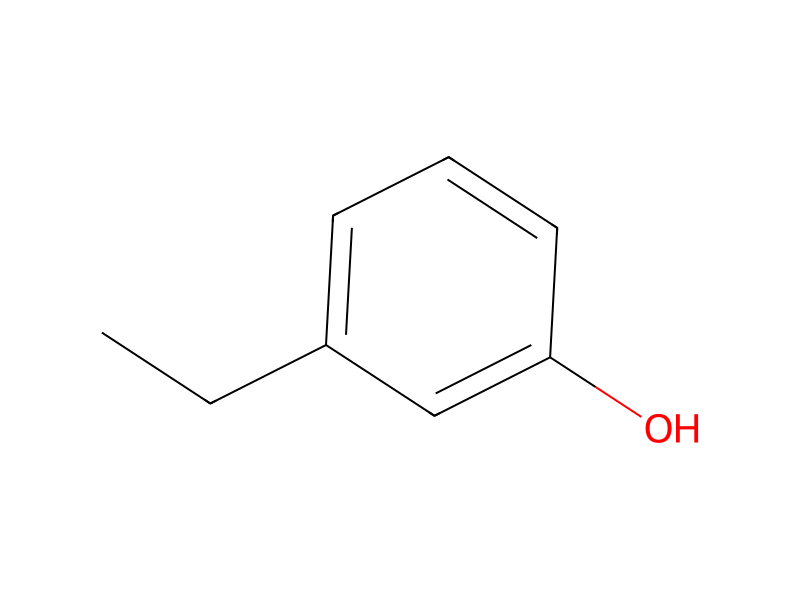
3-Ethylphenol
620-17-7CCc1cccc(O)c1HMNKTRSOROOSPP-UHFFFAOYSA-N3-Ethylphenol is a member of phenols.
620-17-7DTXSID0022480CHEMBL58052CHEBI:34332Log Kow = 2.40
2.4
0.05 [mmHg]
0.05 mm Hg at 25 °C
안전 정보는 참고용이며, 공급업체의 물질안전보건자료(SDS), 관련 법규 및 전문가 평가를 대체하지 않습니다.
Danger
H301 (39%): Toxic if swallowed [Danger Acute toxicity, oral]
P260, P261, P262, P264, P264+P265, P270, P271, P280, P301+P316, P301+P317, P301+P330+P331, P302+P352, P302+P361+P354, P304+P340, P305+P351+P338, P305+P354+P338, P316, P317, P319, P321, P330, P332+P317, P337+P317, P361+P364, P362+P364, P363, P403+P233, P405, and P501 (click each P-code to see the statement)
Aggregated GHS information provided per 200 reports by companies from 11 notifications to the ECHA C&L Inventory. Each notification may be associated with multiple companies.
Warning
H302: Harmful if swallowed [Warning Acute toxicity, oral]
Chemical: Phenol, 3-ethyl-
Commission Regulation (EC) No 1565/2000 (Repealed by Com. Implementing Reg. (EU) No 872/2012)
Phenol, 3-ethyl- is listed on the EPA's Chemical Data Reporting (CDR) system. Manufacturers and importers of Phenol, 3-ethyl- are required to report information about their production and use of this chemical to the EPA under the Toxic Substances Control Act (TSCA). (40 eCFR Part 711)
Phenol, 3-ethyl-: Does not have an individual approval but may be used under an appropriate group standard
Acute Tox. 3 (39%)
Acute toxicity - category 4
Acute toxicity (Oral) - Category 4
Used as a starting material for photochemicals; [HSDB]
Pure 3-ethylphenol is a starting material for photochemicals.
3-Ethylphenol and .... are contained in the xylenol fraction boiling between ca. 205 and 225 °C obtained from tar phenols, which is used, for example, for the production of phenolic resins.
2023: 3,255,915 lb
(1977) AT LEAST 4.54X10+5 GRAMS
3-Ethylphenol is produced by sulfonation of ethylbenzene and subsequent alkali melt of the 3-ethylbenzenesulfonic acid obtained. By sulfonation under severe conditions, the 4-ethylbenzenesulfonic acid formed initially isomerizes to form a mixture of 2-,3-, and 4-ethylbenzenesulfonic acids in a ratio of 2:58:40. The 2- and 4-ethylbenzenesulfonic acids are selectively hydrolyzed back to ethylbenzene and sulfuric acid by blowing steam through the mixture at 150-170 °C. 3-Ethylphenol is then obtained by alkali melt of the remaining 3-ethylbenzenesulfonic acid at 330-340 °C in up to 98% purity.
불러오는 중…
clear brown liquid
SRP: At the time of review, criteria for land treatment or burial (sanitary landfill) disposal practices are subject to significant revision. Prior to implementing land disposal of waste residue (including waste sludge), consult with environmental regulatory agencies for guidance on acceptable disposal practices.
TERRESTRIAL FATE: Based on a recommended classification scheme(1), an estimated Koc value of 480(SRC), determined from a measured log Kow(2) and a recommended regression-derived equation(3), indicates that 3-ethylphenol will have moderate mobility in soil(SRC). Based on limited data, biodegradation of this compound is likely. A system where water was passed through contaminated soil (initial 3-ethylphenol concn = 73 ug/L) and then through a upflow aerated column was capable of 93% removal in 37 days(4). 3-Ethylphenol's measured and estimated values for vapor pressure(5) and Henry's Law constant(6,SRC), respectively, indicate that volatilization from dry and moist soil surfaces is possible, but will not be a major fate process for this compound(SRC).
AQUATIC FATE: Based on a recommended classification scheme(1), an estimated Koc value of 480(SRC), determined from a measured log Kow(2) and a recommended regression-derived equation(3), indicates that 3-ethylphenol may adsorb to suspended solids and sediment(SRC) in the water. Based on limited data, biodegradation of this compound is likely. A system where water was passed through contaminated soil (initial 3-ethylphenol concn = 73 ug/L) and then through a upflow aerated column was capable of 93% removal in 37 days(4). 3-Ethylphenol should volatilize from water surfaces based on an estimated Henry's Law constant of 1.1X10⁻⁶ atm-cu m/mole(SRC), developed using a fragment constant estimation method(5). Estimated half-lives for a model river and model lake are 37 and 274 days, respectively(3,SRC). An estimated BCF value of 40(3,SRC), from an experimental log Kow(2), suggests that 3-ethylphenol may bioconcentrate in aquatic organisms(SRC) according to a recommended classification scheme(6).
ATMOSPHERIC FATE: According to a suggested classification scheme(1), a measured vapor pressure of 0.05 mm Hg at 25 °C(2) indicates that 3-ethylphenol will mainly exist in the vapor phase in the ambient atmosphere. Vapor-phase 3-ethylphenol is degraded in the atmosphere by reaction with photochemically produced hydroxyl radicals(SRC); the half-life for this reaction in air is estimated to be about 5 hours(3,SRC).
Final effluent collected from the Los Angeles County wastewater treatment plant contained 3-ethylphenol at an average concentration of 15 ug/L(1). 3-Ethylphenol was detected at unreported concentrations in a groundwater plume emanating from the Hipps Road Landfill, Florida(2). 3-Ethylphenol was detected in industrial wastewater from the following industries: petroleum refining (1 of 21 extracts), organic chemicals (1 of 31 extracts), and publicly-owned treatment works (1 in 44 extracts)(3). 3- and 4-ethylphenol (mixed) were detected in cigarette smoke at 1.2-2.8 mg/100 cigarettes(4). 3-Ethylphenol was detected in wastewater from the gasification of Indian Head lignite coal(5).
The Koc of 3-ethylphenol is estimated as approximately 480(SRC), using a measured log Kow of 2.40(1) and a regression-derived equation(2,SRC). According to a recommended classification scheme(3), this estimated Koc value suggests that 3-ethylphenol has moderate mobility in soil(SRC).
A xylenol fraction boiling between 216 and 218 °C containing predominantly 3- and 4-ethylphenol is obtained from brown coal low-temperature tar and used in the varnish industry.
Volcanic ash from Mount St. Helens, following th May 18, 1980 eruption, contained 3-ethylphenol(1).
3-Ethylphenol's production and use in the manufacture of photochemicals and varnishes(1), may result in its release to the environment through various waste streams(SRC). 3-Ethylphenol is also released in effluent streams from coal gasification plants(3) and from cigarette smoke(2).
A lab-scale, upflow aerated column receiving water that had first passed through a soil sample, obtained from a former asphalt production plant, (3-ethylphenol influent initially at 73 ug/L) was capable of 93% removal of this compound within 37 days(1). An on-site (at the production plant) upflow aerated column and trickling filter, after 38 days of operation, removed 86% and 22% of the initial concentration of p-ethylphenol, respectively(1). Differences between lab scale and on-site reactors were due to differences in the hydraulic load(1). Pseudomonas strain FH23, isolated by enrichment culture with 4-hydroxybiphenyl, had a oxygen uptake rate of 9 nmol/min/mg protein when grown with 3-ethylphenol as the sole carbon source(2).
An estimated BCF value of 40 was calculated for 3-ethylphenol(SRC), using a measured log Kow of 2.40(1) and a recommended regression-derived equation(2). According to a recommended classification scheme(3), this BCF value suggests that bioconcentration in aquatic organisms may be an important fate process(SRC).
The Henry's Law constant for 3-ethylphenol is estimated as 1.1X10⁻⁶ atm-cu m/mole(SRC) using a fragment constant estimation method(1). This value indicates that 3-ethylphenol will volatilize from water surfaces(2,SRC). Based on this Henry's Law constant, the volatilization half-life from a model river (1 m deep, flowing 1 m/sec, wind velocity of 3 m/sec) is estimated as approximately 37 days(2,SRC). The volatilization half-life from a model lake (1 m deep, flowing 0.05 m/sec, wind velocity of 0.5 m/sec) is estimated as approximately 274 days(2,SRC). 3-Ethylphenol's values for vapor pressure(4) and Henry's Law constant(1,SRC) indicate that volatilization from dry and moist soil surfaces is possible, but not likely to be a major fate process for this compound(SRC).
The rate constant for the vapor-phase reaction of 3-ethylphenol with photochemically produced hydroxyl radicals has been estimated as 8.4X10⁻¹¹ cu cm/molecule-sec at 25 °C(SRC) using a structure estimation method(1,SRC). This corresponds to an atmospheric half-life of about 5 hours at an atmospheric concentration of 5X10+5 hydroxyl radicals per cu cm(1,SRC). 3-Ethylphenol has a measured pKa of 9.9, indicating that under most environmental conditions this compound will exist mainly as the non-dissociated form(2).
Paint and Coating Manufacturing
Phenol, 3-ethyl-: ACTIVE
용도It is used as a photographic chemical intermediate and an intermediate for the cyan coupler of photographic paper. It has a wide application in fragrance industry.
생산 방법3-Ethylphenol is produced by sulfonation of ethylbenzene and subsequent alkali melt of the 3-ethylbenzenesulfonic acid obtained. By sulfonation under severe (thermodynamically controlled) conditions (200 ℃) the 4-ethylbenzenesulfonic acid formed initially isomerizes to form a mixture of 2-, 3-, and 4- ethylbenzenesulfonic acids in a ratio of ca. 2 : 58 : 40. The 2- and 4-ethylbenzenesulfonic acids are selectively hydrolyzed back to ethylbenzene and H2SO4 by blowing steam through the mixture at 150–170 ℃. 3-Ethylphenol is then obtained by alkali melt of the remaining 3-ethylbenzenesulfonic acid at 330–340 ℃ in up to 98% purity.
3-에틸페놀은 에틸벤젠의 설폰화와 3-에틸벤젠설폰산이 얻어지고 이어 일어나는 알칼리 용해에 의해 생성됨. 처음에 형성된 4-에틸벤젠설폰산은 2:58:40의 비율로 처음에 이성화한 2-, 3-, 및 4-에틸벤젠설폰산 혼합물의 형태로 엄격한 조건 하에서 설폰화에 의하여 형성됨. 2- 및 4-에틸벤젠설폰산은 150-170 ℃에서 혼합물의 증기분출에 의해 원래의 에틸벤젠과 황산으로 선택적으로 가수분해 됨. 3-에틸페놀은 순도 98 %까지 330-340 ℃에서 잔여 3-에틸벤젠설폰산의 알칼리 용해에 의해 얻어짐