홈MCP워크벤치Skills
홈워크벤치알림마이페이지
llms.txt · MCP 가이드개인정보처리방침 · 이용약관 · 지원v1.8.0
  1. 홈
  2. /화합물

4-Chloropyridine

HCID 12288
새 노트새 반응견적 요청하기
인쇄 미리보기
기본 정보이름 및 식별자물성안전 및 규제화학 및 산업관련 반응화합물 노트
부분 구조 검색유사 구조 찾기

기본 정보

CAS
626-61-9
표준 SMILES
Clc1ccncc1
InChIKey
PVMNPAUTCMBOMO-UHFFFAOYSA-N
분자식
C5H4ClN
평균 분자량
113.54 g/mol
단동위원소 질량
113.0032268

이름 및 식별자

우선 이름
4-Chloropyridine
IUPAC
4-chloropyridine
영어명
4-chloropyridine
분자식
C5H4ClN
분자량
113.54

이름 및 동의어

4-CHLOROPYRIDINE626-61-9DTXSID0052671RefChem:522062DTXCID608484210-956-2Pyridine, 4-chloro-4-chloro-pyridineMFCD00044570CHEMBL5290039EINECS 210-956-2BRN 0105875
이름 더 보기
gamma-ChloropyridineTrazodone Impurity 314-chloropyridine ISO 9001:2015 REACH
p-Chloropyridine4-chloro pyridine4- ChloropyridineTrazodone Impurity 20SCHEMBL6842X97LKY9QS75-20-05-00410 (Beilstein Handbook Reference)SCHEMBL207645

데이터베이스 식별자

CAS
626-61-9
PubChem CID
12288
DTXSID
DTXSID0052671
ChEMBL
CHEMBL5290039
UNII
X97LKY9QS7
EC Number
210-956-2
Nikkaji
J32.650J

물성

구조 계산 물성

XLogP
1.3
극성 표면적
12.9 Ų
수소 결합 공여자 수
0
수소 결합 수용자 수
1
회전 가능 결합 수
0
무거운 원자 수
7
형식 전하
0
복잡도
50

실험 및 물리화학적 성질

SpringerMaterials PropertiesCoriolis coupling
LogP · 2건

log Kow = 1.28

1.37

Density1.2000 g/cu cm at 25 °C
Color/FormLiquid
Solubility · 2건

Slightly soluble in water

Miscible with ethanol

Boiling Point151 °C
Melting Point-43.5 °C
Dissociation ConstantspKa = 3.84 (conjugate acid)

물리화학적 성질

녹는점
-43.5 °C · -43.5°C
끓는 점
147 ℃ · 147℃
밀도
1.2 · 1.200
굴절률
1.5304 · 1.5304 (estimate)
인화점
53 ℃ · 53℃
산도 계수 (pKa)
3.18 · 3.18±0.10(Predicted)

안전 및 규제

안전 정보는 참고용이며, 공급업체의 물질안전보건자료(SDS), 관련 법규 및 전문가 평가를 대체하지 않습니다.

안전 및 보호

Disposal Methods · 1건

SRP: Recycle any unused portion of the material for its approved use or return it to the manufacturer or supplier. Ultimate disposal of the chemical must consider: the material's impact on air quality; potential migration in air, soil or water; effects on animal, aquatic and plant life; and conformance with environmental and public health regulations. If it is possible or reasonable use an alternative chemical product with less inherent propensity for occupational harm/injury/toxicity or environmental contamination.

독성 정보

Interactions · 1건

Cobalt(II) chloride (CoCl2), non-mutagenic by itself, has been tested for mutagenic activity in the presence of 4-substituted pyridines in the test strains of Salmonella typhimurium. CoCl2 was found to be mutagenic in strains TA1537 and TA2637, when combined with pyridine, methyl isonicotinate, 4-methyl-pyridine, 4-ethylpyridine, 4-chloropyridine or 4-bromopyridine. Mixtures of CoCl2 and isonicotinic acid, 4-cyanopyridine, 4-aminopyridine, or 4-dimethylaminopyridine exhibited no mutagenicity. Judging from the spectral observations, such combined mutagenicity may be due to the formation of moderate to weak complexes between these compounds and the Co(II) cation.

Environmental Fate · 3건

TERRESTRIAL FATE: Based on a classification scheme(1), an estimated Koc value of 120(SRC), determined from a structure estimation method(2), indicates that 4-chloropyridine is expected to have high mobility in soil(SRC). Volatilization of 4-chloropyridine from moist soil surfaces is expected to be an important fate process(SRC) given an estimated Henry's Law constant of 5.2X10⁻⁶ atm-cu m/mole(SRC), developed using a fragment constant estimation method(2). 4-Chloropyridine is expected to volatilize from dry soil surfaces(SRC) based upon an estimated vapor pressure of 4.5 mm Hg at 25 °C(SRC), determined from a fragment constant method(2). 4-Chloropyridine volatilized <1% from soil incubated at 28 °C for 64 days(3). 4-Chloropyridine biodegraded approximately 67%(4) and 85%(3) in 64-day aerobic soil biodegradation studies.

AQUATIC FATE: Based on a classification scheme(1), an estimated Koc value of 120(SRC), determined from a structure estimation method(2), indicates that 4-chloropyridine is not expected to adsorb to suspended solids and sediment(SRC). Volatilization from water surfaces is expected(3) based upon an estimated Henry's Law constant of 5.2X10⁻⁶ atm-cu m/mole(SRC), developed using a fragment constant estimation method(2). Using this Henry's Law constant and an estimation method(3), volatilization half-lives for a model river and model lake are 7.8 and 60 days, respectively(SRC). 4-Chloropyridine is not expected to undergo hydrolysis in the environment due to the lack of functional groups that hydrolyze under environmental conditions(3). According to a classification scheme(4), an estimated BCF of 3(SRC), from its log Kow of 1.28(5) and a regression-derived equation(2), suggests the potential for bioconcentration in aquatic organisms is low. 4-Chloropyridine, incubated for one year anaerobically in an aquifer slurry, biodegraded approximately 73%(6).

화학 및 산업

용도 및 제조

Uses · 2건

Reaction of 4-chloropyridine with mercaptoacetic acid gives pyridylmercaptoacetic acid, which is a precursor for cephalosporin antibiotics (e.g., cephapirin sodium salt).

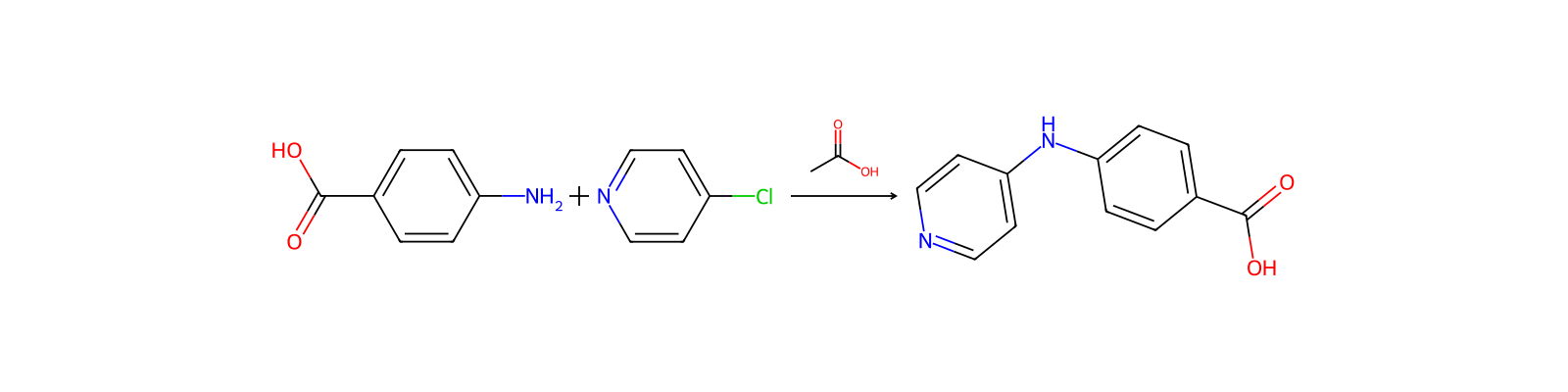
The 2- and 4-chloropyridines react with various nucleophiles to give alkyl ether, alkyl thioether, and alkylamine derivatives.

Methods of ManufacturingThe preparation of 2- and 4- chloropyridines from pyridinols is achieved by the use of halogenating reagents such as phosphoryl chloride.

상·하류 제품 정보

상류 원료

N-니트로피리딘-4-아민4,4'-디클로로-2,2'-비피리딘4-Chloropyridine N-oxide4-클로로-2-트리메틸실릴피리딘CHLORIDE STANDARD벤조페논아진1-(4-피리딜)피리디늄 클로라이드 하이드로클로라이드

하류 제품

4,4'-비피리딘4-멜캅토피리딘2-Bromo-4-chloropyridine4,4'-디피리딜황화물

관련 반응

219건
반응 기록 만들기
HRID 16702 반응식
HRID 16702반응물로uspto-grants-2010_06
HRID 17742 반응식
HRID 17742반응물로uspto-grants-2010_06
HRID 33241 반응식
HRID 33241반응물로uspto-grants-2008_09
HRID 64892 반응식
HRID 64892반응물로uspto-grants-1986_09
HRID 64895 반응식
HRID 64895반응물로uspto-grants-1986_09
HRID 78297 반응식
HRID 78297반응물로uspto-grants-2014_09
HRID 88338 반응식
HRID 88338반응물로Training data from https://doi.org/10.1039/C8SC04228D (2/10)
HRID 98907 반응식
HRID 98907반응물로Training data from https://doi.org/10.1039/C8SC04228D (2/10)
1 / 28 페이지

화합물 노트

불러오는 중…

이 페이지에서기본 정보이름 및 식별자물성안전 및 규제화학 및 산업관련 반응화합물 노트
더보기
새 노트새 반응견적 요청하기

ATMOSPHERIC FATE: According to a model of gas/particle partitioning of semivolatile organic compounds in the atmosphere(1), 4-chloropyridine, which has an estimated vapor pressure of 4.5 mm Hg at 25 °C(SRC), determined from a fragment constant method(2), is expected to exist solely as a vapor in the ambient atmosphere. Vapor-phase 4-chloropyridine is degraded in the atmosphere by reaction with photochemically-produced hydroxyl radicals(SRC); the half-life for this reaction in air is estimated to be 62 days(SRC), calculated from its rate constant of 2.6X10⁻¹³ cu cm/molecule-sec at 25 °C(SRC) that was derived using a structure estimation method(2). 4-Chloropyridine does not contain chromophores that absorb at wavelengths >290 nm(3) and, therefore, is not expected to be susceptible to direct photolysis by sunlight(SRC).

Toxicity Summary · 1건

IDENTIFICATION AND USE: 4-Chloropyridine is a liquid. HUMAN STUDIES: There are no data available. ANIMAL STUDIES: There are no data available. ECOTOXICITY STUDIES: 4-Chloropyridine was administered at 316 mg/kg as single oral dose to adult male Coturnix quail (Coturnix coturnix). It did not reduce the fertility of eggs produced by female mates by more than 50%.

Ecotoxicity Excerpts · 1건

/BIRDS and MAMMALS/ Seventy-one chemicals /(including 4-chloropyridine)/ were administered as single oral doses at about 50% of the estimated LD50 to adult male Coturnix quail (Coturnix coturnix). /The dose used for 4-chloropyridine was 316 mg/kg/. None reduced the fertility of eggs produced by female mates by more than 50%. Of six additional chemicals similarly administered to female quail at 24 to 56% of the estimated LD50, only one, P,P-bis(1-aziridinyl)-N-phenylphosphinic amide, reduced expected egg fertility by more than 50%.

Soil Adsorption/Mobility · 1건

Using a structure estimation method based on molecular connectivity indices(1), the Koc of 4-chloropyridine can be estimated to be 120(SRC). According to a classification scheme(2), this estimated Koc value suggests that 4-chloropyridine is expected to have high mobility in soil(SRC).

Artificial Pollution Sources4-Chloropyridine's production and use as a laboratory chemical and in the synthesis of other substances(1) may result in its release to the environment through various waste streams(SRC).
Environmental Biodegradation · 3건

AEROBIC: 4-Chloropyridine biodegraded approximately 67% in a 64-day aerobic soil biodegradation study. Halogens at the para-position of the pyridine ring are more susceptible to displacement than at other positions and convert readily to hydroxypyridines. Therefore, the biodegradation of 4-chloropyridine was attributed to hydroxylation(1). 4-Chloropyridine was biodegraded 85% in soil incubated at 28 °C for 64 days(2).

ANAEROBIC: 4-Chloropyridine, incubated for one year anaerobically in an aquifer slurry, biodegraded approximately 73%(1).

PURE CULTURE: Complete degradation of 4-chloropyridine was >62 days but <96 days using enrichment cultures isolated from garden soil, incubated aerobically(1). Incubated anaerobically complete degradation of 4-chloropyridine was >96 days(1).

Environmental Bioconcentration · 1건

An estimated BCF of 3 was calculated in fish for 4-chloropyridine(SRC), using a log Kow of 1.28(1) and a regression-derived equation(2). According to a classification scheme(3), this BCF suggests the potential for bioconcentration in aquatic organisms is low(SRC).

Volatilization from Water/Soil · 1건

The Henry's Law constant for 4-chloropyridine is estimated as 5.2X10⁻⁶ atm-cu m/mole(SRC) using a fragment constant estimation method(1). This Henry's Law constant indicates that 4-chloropyridine is expected to volatilize from water surfaces(2). Based on this Henry's Law constant, the volatilization half-life from a model river (1 m deep, flowing 1 m/sec, wind velocity of 3 m/sec)(2) is estimated as 7.8 days(SRC). The volatilization half-life from a model lake (1 m deep, flowing 0.05 m/sec, wind velocity of 0.5 m/sec)(2) is estimated as 60 days(SRC). 4-Chloropyridine's Henry's Law constant indicates that volatilization from moist soil surfaces may occur(SRC). 4-Chloropyridine is expected to volatilize from dry soil surfaces(SRC) based upon an estimated vapor pressure of 4.5 mm Hg(SRC), determined from a fragment constant method(1). 4-Chloropyridine volatilized <1% from soil incubated at 28 °C for 64 days(3).

Environmental Abiotic Degradation · 1건

The rate constant for the vapor-phase reaction of 4-chloropyridine with photochemically-produced hydroxyl radicals has been estimated as 2.6X10⁻¹³ cu cm/molecule-sec at 25 °C(SRC) using a structure estimation method(1). This corresponds to an atmospheric half-life of about 62 days at an atmospheric concentration of 5X10+5 hydroxyl radicals per cu cm(1). 4-Chloropyridine is not expected to undergo hydrolysis in the environment due to the lack of functional groups that hydrolyze under environmental conditions(2). 4-Chloropyridine does not contain chromophores that absorb at wavelengths >290 nm(2) and, therefore, is not expected to be susceptible to direct photolysis by sunlight(SRC). The rate constant for the reaction of hydroxyl radicals in aqueous solutions at pH 9 is 3.1X10+9 L/mol-sec(3); this corresponds to an aquatic half-life of 260 days at an aquatic concentration of 1X10-17 hydroxyl radicals per liter(4).

Probable Routes of Human Exposure · 1건

Occupational exposure to 4-chloropyridine may occur through inhalation and dermal contact with this compound at workplaces where 4-chloropyridine is produced or used. Monitoring and use data indicate that the general population is not likely to be exposed to 4-chloropyridine. (SRC)

Environmental Fate/Exposure Summary · 1건

4-Chloropyridine's production and use as a laboratory chemical and in the synthesis of other substances may result in its release to the environment through various waste streams. If released to air, a estimated vapor pressure of 4.5 mm Hg at 25 °C indicates 4-chloropyridine will exist solely as a vapor in the atmosphere. Vapor-phase 4-chloropyridine will be degraded in the atmosphere by reaction with photochemically-produced hydroxyl radicals; the half-life for this reaction in air is estimated to be 62 days. 4-Chloropyridine does not contain chromophores that absorb at wavelengths >290 nm and, therefore, is not expected to be susceptible to direct photolysis by sunlight. If released to soil, 4-chloropyridine is expected to have high mobility based upon an estimated Koc of 120. Volatilization from moist soil surfaces is expected to be an important fate process based upon an estimated Henry's Law constant of 5.2X10⁻⁶ atm-cu m/mole. 4-Chloropyridine may volatilize from dry soil surfaces based upon its estimated vapor pressure. 4-Chloropyridine volatilized <1% from soil incubated at 28 °C for 64 days. 4-Chloropyridine biodegraded approximately 67 and 85% in 64-day aerobic soil biodegradation studies. If released into water, 4-chloropyridine is not expected to adsorb to suspended solids and sediment based upon the estimated Koc. 4-Chloropyridine, incubated for one year anaerobically in an aquifer slurry, was biodegraded approximately 73%. Volatilization from water surfaces is expected based upon this compound's estimated Henry's Law constant. Estimated volatilization half-lives for a model river and model lake are 7.8 and 60 days, respectively. An estimated BCF of 3 suggests the potential for bioconcentration in aquatic organisms is low. Hydrolysis is not expected to be an important environmental fate process since this compound lacks functional groups that hydrolyze under environmental conditions (pH 5 to 9). Occupational exposure to 4-chloropyridine may occur through inhalation and dermal contact with this compound at workplaces where 4-chloropyridine is produced or used. Monitoring and use data indicate that the general population is not likely to be exposed to 4-chloropyridine. (SRC)

안전 데이터

유해 물질 데이터
626-61-9(Hazardous Substances Data)
4-(2-하이드록시에틸아미노)-피리딘
4-Chloro-3-iodopyridine
4-Chloropyridin-3-ylboronic acid, pinacol ester 98
클로로(3-)피리딘
4-Phenoxypyridine