홈MCP워크벤치Skills
홈워크벤치알림마이페이지
llms.txt · MCP 가이드개인정보처리방침 · 이용약관 · 지원v1.8.0
  1. 홈
  2. /화합물

메틸(β-)스티렌

beta-Methylstyrene
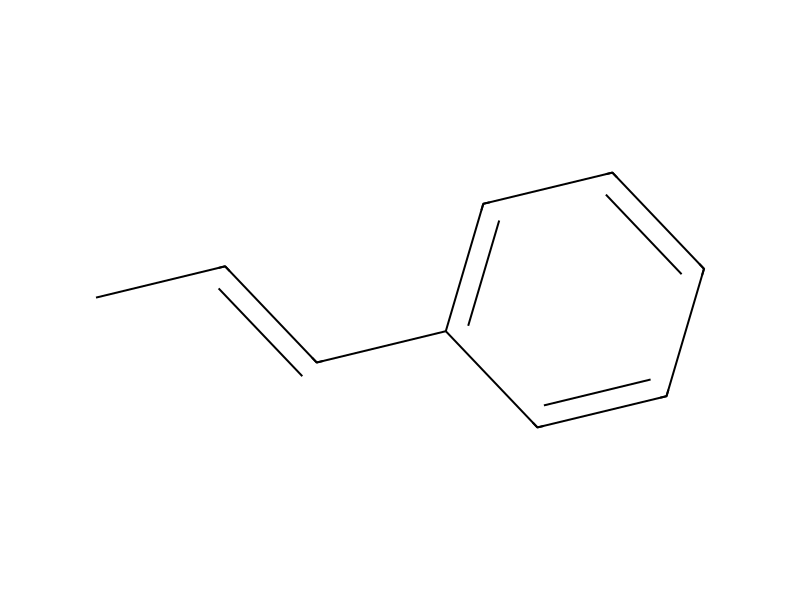
HCID 12500
새 노트새 반응견적 요청하기
인쇄 미리보기
기본 정보개요이름 및 식별자물성안전 및 규제화학 및 산업관련 반응화합물 노트
부분 구조 검색유사 구조 찾기

기본 정보

CAS
637-50-3
표준 SMILES
CC=Cc1ccccc1
InChIKey
QROGIFZRVHSFLM-UHFFFAOYSA-N
분자식
C9H10
평균 분자량
118.18 g/mol
단동위원소 질량
118.07825032

개요

cis-beta-methylstyrene has been reported in Actaea simplex with data available.

이름 및 식별자

우선 이름
beta-Methylstyrene
IUPAC
prop-1-enylbenzene
현지명
메틸(β-)스티렌
영어명
β-Methylstyrene
분자식
C9H10
분자량
118.18

이름 및 동의어

Propenyl benzeneBETA-METHYL STYRENEBenzene, 1-propenyl-DTXSID20609199367GUB59ONSC-65591RefChem:1079702DTXCID7044059211-287-91-Propenylbenzene3-Phenyl-1-Propene637-50-3
이름 더 보기
메틸(β-)스티렌베타메틸스티렌베타-메틸 스티렌트랜스베타베타메틸렌Prop-1-en-1-ylbenzeneTRANS-B-METHYLSTYRENETRANS-BETA-METHYLSTYRENEB-METHYLSTYRENEBenzene, 1-propen-1-yl-
beta-MethylstyreneIsoallylbenzenePropenylbenzeneBenzene, propenyl-Prop-1-enylbenzenemethyl-styrene[(1Z)-Prop-1-en-1-yl]benzene3-methylvinylbenzene

데이터베이스 식별자

CAS
637-50-3
PubChem CID
12500
DTXSID
DTXSID2060919
EC Number
211-287-9

물성

구조 계산 물성

XLogP
3.2
극성 표면적
0 Ų
수소 결합 공여자 수
0
수소 결합 수용자 수
0
회전 가능 결합 수
1
무거운 원자 수
9
형식 전하
0
복잡도
86.2

실험 및 물리화학적 성질

PolymersPlastics & Rubber -> Styrenes
LogPlog Kow = 3.35
Density0.9019 @ 25 °C
SolubilitySol in acetone, benzene, ether, ethanol
Boiling Point175.5 °C
Melting Point-27.3 °C
Vapor Pressure0.97 [mmHg]
Refractive IndexIndex of refraction = 1.5508 @ 20 °C
Physical DescriptionClear faintly yellow liquid; Stabilized with 0.01% butylated hydroxytoluene; [MSDSonline]

물리화학적 성질

녹는점
-27.1 °C · -27.1°C
끓는 점
175 °C · 175 °C(lit.)
밀도
0.911 g/mL · 0.911 g/mL at 25 °C(lit.)
굴절률
20 · n20/D 1.550(lit.)

안전 및 규제

안전 정보는 참고용이며, 공급업체의 물질안전보건자료(SDS), 관련 법규 및 전문가 평가를 대체하지 않습니다.

GHS 분류

GHS Classification · 4건

Danger

H226 (99.1%): Flammable liquid and vapor [Warning Flammable liquids]

P203, P210, P233, P240, P241, P242, P243, P261, P264+P265, P271, P272, P273, P280, P301+P316, P302+P352, P303+P361+P353, P304+P340, P305+P351+P338, P318, P319, P321, P331, P333+P317, P337+P317, P362+P364, P370+P378, P403+P233, P403+P235, P405, and P501 (click each P-code to see the statement)

Aggregated GHS information provided per 106 reports by companies from 3 notifications to the ECHA C&L Inventory. Each notification may be associated with multiple companies.

유해성 정보

Regulatory InformationBenzene, 1-propenyl-: Does not have an individual approval but may be used under an appropriate group standard
Hazards SummaryAn irritant; [MSDSonline] See alpha-Methyl styrene.
Hazard Classes and CategoriesFlam. Liq. 3 (99.1%)
Shipment Methods and Regulations · 3건

No person may /transport,/ offer or accept a hazardous material for transportation in commerce unless that person is registered in conformance ... and the hazardous material is properly classed, described, packaged, marked, labeled, and in condition for shipment as required or authorized by ... /the hazardous materials regulations (49 CFR 171-177)./

The International Air Transport Association (IATA) Dangerous Goods Regulations are published by the IATA Dangerous Goods Board pursuant to IATA Resolutions 618 and 619 and constitute a manual of industry carrier regulations to be followed by all IATA Member airlines when transporting hazardous materials.

The International Maritime Dangerous Goods Code lays down basic principles for transporting hazardous chemicals. Detailed recommendations for individual substances and a number of recommendations for good practice are included in the classes dealing with such substances. A general index of technical names has also been compiled. This index should always be consulted when attempting to locate the appropriate procedures to be used when shipping any substance or article.

화학 및 산업

용도 및 제조

UsesAn impurity of alpha-methylstyrene; [HSDB]
General Manufacturing Informationbeta-Methylstyrene is an impurity contained in alpha-methylstyrene at a concn of about 0.5% by weight(1).

응용 분야

용도β-Methylstyrene is a styrene derivative that is used as a chemical intermediate in the manufacture of plasticizers, resins and polymers. β-Methylstyrene is also produced from the combustion of methamp hetamine.

상·하류 제품 정보

상류 원료

1-페닐-2-프로필메탄설포네이트2-Bromo-1-phenylpropane

하류 제품

Oxirane, 2-methyl-3-phenyl-, (2R,3S)-벤질메틸카비놀1-페닐프로판-1,2-디올2-Chloropropiophenone(1R,2R)-(+)-1-Phenylpropylene oxide

관련 반응

35건
반응 기록 만들기
HRID 7082 반응식
HRID 7082반응물로uspto-grants-2006_08
HRID 13728 반응식
HRID 13728생성물로uspto-grants-2010_06
HRID 13729 반응식
HRID 13729생성물로uspto-grants-2010_06
HRID 13730 반응식
HRID 13730생성물로uspto-grants-2010_06
HRID 41910 반응식
HRID 41910반응물로uspto-grants-2013_09
HRID 47396 반응식
HRID 47396반응물로uspto-grants-2004_03
HRID 73474 반응식
HRID 73474생성물로uspto-grants-2014_09
HRID 265822 반응식
HRID 265822반응물로uspto-grants-1997_07
1 / 5 페이지

화합물 노트

불러오는 중…

이 페이지에서기본 정보개요이름 및 식별자물성안전 및 규제화학 및 산업관련 반응화합물 노트
더보기
새 노트새 반응견적 요청하기
인화점
127 °F · 127 °F
저장 조건
2 · 2-8°C
수용성
물에 불용성
용해도
DMSO(약간 용해됨), 에틸아세테이트(약간 용해됨)
물리적 상태
투명한 액체
Specific Gravity
0.91 · 0.91
색상
무색~연황색
Henry's Law Constant
3.7 · 3.7×10-3 mol/(m3Pa) at 25℃, HSDB (2015)
Dielectric constant
2.73 · 2.73
EPA
Propenylbenzene (637-50-3)
Shipping Name/ Number DOT/UN/NA/IMO · 2건

UN 2618; Methyl styrenes, inhibited

IMO 3.3; Methyl styrenes, inhibited

안전 및 보호

Disposal Methods · 1건

SRP: At the time of review, criteria for land treatment or burial (sanitary landfill) disposal practices are subject to significant revision. Prior to implementing land disposal of waste residue (including waste sludge), consult with environmental regulatory agencies for guidance on acceptable disposal practices.

독성 정보

Toxicological InformationRanking: 586 (total points: -1)
Environmental Fate · 3건

TERRESTRIAL FATE: Based on a classification scheme(1), an estimated Koc value of 1,600(SRC), determined from a log Kow of 3.35(2) and a regression-derived equation(3), indicates that beta-methyl styrene is expected to have low mobility in soil(SRC). Volatilization of beta-methyl styrene from moist soil surfaces is expected to be an important fate process(SRC) given an estimated Henry's Law constant of 2.7X10⁻³ atm-cu m/mole(SRC), using a fragment constant estimation method(3). The potential for volatilization of beta-methyl styrene from dry soil surfaces may exist(SRC) based upon an estimated vapor pressure of 1 mm Hg(SRC), determined from a fragment constant method(4).

AQUATIC FATE: Based on a classification scheme(1), an estimated Koc value of 1,600(SRC), determined from a log Kow of 3.35(2) and a regression-derived equation(3), indicates that beta-methyl styrene is expected to adsorb to suspended solids and sediment(SRC). Volatilization from water surfaces is expected(3) based upon an estimated Henry's Law constant of 2.7X10⁻³ atm-cu m/mole(SRC), developed using a fragment constant estimation method(4). Using this Henry's Law constant and an estimation method(3), volatilization half-lives for a model river and model lake are 4 hrs and 4 days, respectively(SRC). According to a classification scheme(5), a BCF of 4 for goldfish(6), suggests bioconcentration in aquatic organisms is low(SRC).

ATMOSPHERIC FATE: According to a model of gas/particle partitioning of semivolatile organic compounds in the atmosphere(1), beta-methylstyrene, which has an estimated vapor pressure of 1 mm Hg at 25 °C(SRC), determined from a fragment constant method(2), is expected to exist solely as a vapor in the ambient atmosphere(SRC). Vapor-phase beta-methylstyrene is degraded in the atmosphere by reaction with photochemically-produced hydroxyl radicals and ozone(SRC); the half-life for the reaction in air is estimated to be 7 hrs for hydroxyl radicals(SRC), calculated from its rate constant of 3.2X10⁻¹¹ cu cm/molecule-sec at 25 °C(3). The half-lives for the reaction of cis- and trans-isomers of beta-methylstyrene in air are about 4 and 2 hrs for ozone(SRC), calculated from estimated rate constants of 6.8X10⁻¹⁷ and 1.6X10⁻¹⁶ cu cm/molecule-sec at 25 °C(4,5), respectively. Reaction with ozone rather than hydroxyl radicals may contribute the most to the atmospheric transformation of beta-methyl styrene, especially in urban environments(5). Both alpha- and p-methylstyrene weakly adsorb UV light in the environmentally significant range (wavelengths >290 nm)(6). Hence, beta-methylstyrene probably also has the potential for direct photolysis in the environment(SRC).

Adverse EffectsNeurotoxin - Acute solvent syndrome
Effluent Concentrations · 1건

beta-Methylstyrene was identified in the wastewater effluent of a petrochemical manufacturer that was discharging into the Calcasieu River, LA(1). For a national survey, beta- methylstyrene was detected in 1 of 21 industrial categories of wastewater effluents; wastewater from the organic chemicals and plastics manufacturing industries contained beta-methylstyrene at an average concn of <0.01 ug/L(2). The removal of lead from gasoline and its subsequent replacement with aromatic compounds has caused an increased release of compounds such as beta- methylstyrene to the atmosphere via fossil fuel combustion(4).

Soil Adsorption/Mobility · 1건

The Koc of beta-methyl styrene is estimated as 1,600(SRC), using a log Kow of 3.35(1) and a regression-derived equation(2). According to a classification scheme(3), this estimated Koc value suggests that beta-methyl styrene is expected to have low mobility in soil(SRC).

Artificial Pollution Sources · 1건

beta-Methylstyrene is an impurity contained in alpha-methylstyrene at a concn of about 0.5% by weight(1). Consequently, beta-methylstyrene may be released to the environment via effluents at sites where alpha-methylstyrene is produced or used. beta-Methylstyrene is also released to the environment via wastewater effluents from petrochemical and plastics industries(2,3). The removal of lead from gasoline and its subsequent replacement with aromatic compounds has caused an increased release of compounds such as beta-methylstyrene to the atmosphere via fossil fuel combustion(4).

Environmental Biodegradation · 1건

Data regarding the biodegradation of beta-methylstyrene in either soil or aquatic systems were not available. Pure culture studies showed that the bacteria, Pseudomonas desmolytica, was able to grow on beta-methylstyrene as a single carbon source(1). The degradation reaction mechanism followed beta-oxidation on the n-alkenyl side chain yielding phenylpropionaldehyde and benzoate, which were end metabolites because mineralization or further biotransformation could not be demonstrated(1). However, pure culture experiments provide little insight into the rate of biodegradation in soil or water(SRC).

Environmental BioconcentrationA BCF of 4 in goldfish was measured for beta-methylstyrene(1). According to a classification scheme(2), this BCF suggests the potential for bioconcentration in aquatic organisms is low(SRC).
Volatilization from Water/Soil · 1건

The Henry's Law constant for beta- methyl styrene is estimated as 2.7X10⁻³ atm-cu m/mole(SRC) using a fragment constant estimation method(1). This Henry's Law constant indicates that beta-methyl styrene is expected to volatilize from water surfaces(2). Based on this Henry's Law constant, the volatilization half-life from a model river (1 m deep, flowing 1 m/sec, wind velocity of 3 m/sec)(2) is estimated as 4 hours(SRC). The volatilization half-life from a model lake (1 m deep, flowing 0.05 m/sec, wind velocity of 0.5 m/sec)(2) is estimated as 4 days(SRC). beta-Methyl styrene's Henry's Law constant indicates that volatilization from moist soil surfaces may occur(SRC). The potential for volatilization of beta-methyl styrene from dry soil surfaces may exist(SRC) based upon an estimated vapor pressure of 1 mm Hg(SRC), determined from a fragment constant method(2).

Environmental Abiotic Degradation · 1건

The rate constant for the vapor-phase reaction of beta-methylstyrene with photochemically-produced hydroxyl radicals has been estimated as 5.9X10⁻¹¹ cu cm/molecule-sec at 25 °C(SRC) using a structure estimation method(1). This corresponds to an atmospheric half-life of about 7 hours at an atmospheric concentration of 5X10+5 hydroxyl radicals per cu cm(SRC). The rate constants for the vapor-phase reaction of cis- (estimated) and trans-beta-methylstyrene (measured) with ozone are 6.8X10⁻¹⁷ and 1.6X10⁻¹⁶ cu cm/molecule-sec at 25 °C(2,3), respectively, which correspond to atmospheric half-lives of about 4 and 2 hrs at an atmospheric concn of 7X10+11 ozone molecules per cu cm(SRC). Products of the trans-beta-methylstyrene-ozone reaction include benzaldehyde, acetaldehyde, acetic acid and benzoic acid(3). Experimental data showed that ozone rather than hydroxyl radicals may contribute the most to the atmospheric transformation of beta-methylstyrene, especially in urban environments(3). beta-Methylstyrene is not expected to undergo hydrolysis in the environment due to the lack of hydrolyzable functional groups(4). Both alpha- and p-methylstyrene weakly adsorb UV light in the environmentally significant range (wavelengths >290 nm)(5). Hence, beta-methylstyrene probably also has the potential for direct photolysis in the environment(SRC).

Probable Routes of Human ExposureOccupational exposure to beta-methyl styrene may occur through inhalation and dermal contact with this compound at workplaces where alpha-methyl styrene is produced or used. (SRC)
Environmental Water Concentrations · 2건

DRINKING WATER: beta-Methylstyrene was listed as a contaminant found in drinking water for a survey of US cities including Pomona, CA, Escondido, CA, Lake Tahoe and Orange Co, CA and Dallas, TX, Washington, DC, Cincinnati, OH, Philadelphia, PA, Miami, FL, New Orleans, LA, Ottumwa, IA, and Seattle, WA(1).

GROUND WATER: beta-Methylstyrene was identified at 2 of 3 groundwater sample-sites taken down gradient from a primary wastewater rapid infiltration facility at Fort Devens, MA at concn of 0.045 and 0.017 ug/l(1).

안전 데이터

wgk
2
rtecs
DA8400500
ridadr
UN 2618 3/PG 3
HS 번호
2902.90.9000
risk_code
10-37/38-41-43-51/53-65
hazard_code
Xn,N,F,Xi
safety_code
16-26-36/37/39-61-62
포장분류
III
위험 등급
IRRITANT, LACHRYMATOR, FLAMMABLE
유해 물질 데이터
637-50-3(Hazardous Substances Data)