홈MCP워크벤치Skills
홈워크벤치알림마이페이지
llms.txt · MCP 가이드개인정보처리방침 · 이용약관 · 지원v1.8.0
  1. 홈
  2. /화합물

아크릴일클로라이드

Acryloyl chloride
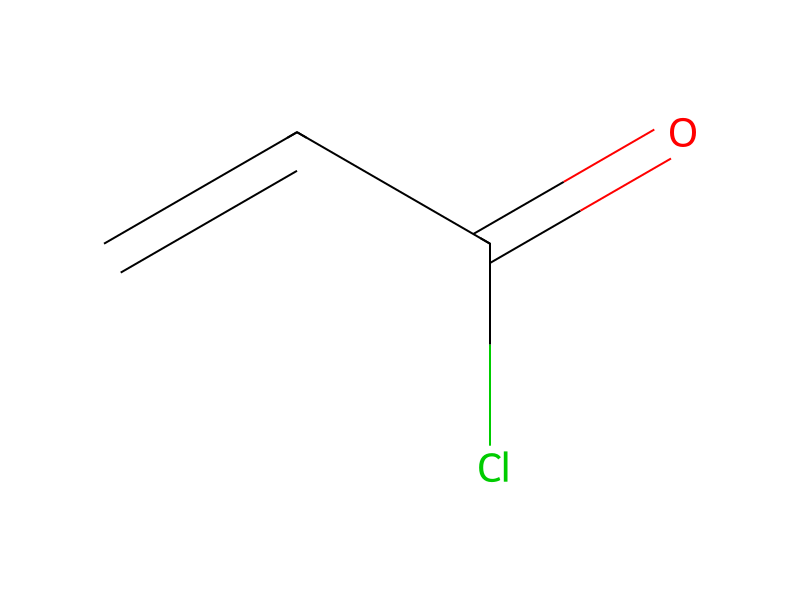
HCID 13140
새 노트새 반응견적 요청하기
인쇄 미리보기
기본 정보개요이름 및 식별자물성안전 및 규제화학 및 산업관련 반응화합물 노트
부분 구조 검색유사 구조 찾기

기본 정보

CAS
814-68-6
표준 SMILES
C=CC(=O)Cl
InChIKey
HFBMWMNUJJDEQZ-UHFFFAOYSA-N
분자식
C3H3ClO
평균 분자량
90.51 g/mol
단동위원소 질량
89.9872424

개요

Acrylyl chloride appears as a liquid. Boiling point 75 °C. Used to make plastics. Polymerization in a closed container can cause pressurization and explosive rupture. (EPA, 1998)

이름 및 식별자

우선 이름
Acryloyl chloride
IUPAC
prop-2-enoyl chloride
현지명
아크릴일클로라이드
영어명
Acryloyl chloride
분자식
C3H3ClO
분자량
90.51

이름 및 동의어

Acryloyl chloride814-68-6ACRYLYL CHLORIDE2-Propenoyl chloridePropenoyl chlorideAcrylic acid chlorideChlorid kyseliny akrylove8K23O56TG5NSC-93770DTXSID1061150RefChem:552883DTXCID0048218
이름 더 보기
아크릴일클로라이드아크릴오일클로라이드아크릴일염화물아크릴일클로라이드아크릴일 클로라이드2-프로펜일클로라이드oyLchloridkyselinyakryloveAcryloyl chloride, 97%, for synthesis, stabilized with p-Hydroxyanisolepropenoylchloride
212-399-0prop-2-enoyl chlorideacryloylchloridacryl chlorideC3H3ClOMFCD00000731AcryloylchlorideAcrylic acid chloride; Acrylyl chloride; NSC 93770; Propenoyl chloride

데이터베이스 식별자

CAS
814-68-6
PubChem CID
13140
DTXSID
DTXSID1061150
UNII
8K23O56TG5
EC Number
212-399-0
Nikkaji
J7.108K

물성

구조 계산 물성

XLogP
1.4
극성 표면적
17.1 Ų
수소 결합 공여자 수
0
수소 결합 수용자 수
1
회전 가능 결합 수
1
무거운 원자 수
5
형식 전하
0
복잡도
57.9

실험 및 물리화학적 성질

Chemical Classes · 2건

Toxic Gases & Vapors -> Acid Halides

Flammable agents - 3rd degree

SpringerMaterials PropertiesSchoenflies notation
Density · 3건

1.1136 at 68 °F (EPA, 1998) - Denser than water; will sink

1.1136 g/cu cm at 20 °C

1.189 @ 20°C

Color/Form · 2건

Liquid

Light yellow liquid

Solubility · 2건

Soluble in chlorinated solvents

Very soluble in chloroform

CorrosivityCorrosive to metals
Flash Point14 °C (57 °F) - closed cup
Boiling Point · 3건

167 °F at 760 mmHg (EPA, 1998)

75.5 °C

73 °C @760 [mm Hg]

Decomposition · 2건

Hazardous decomposition products formed under fire conditions: Carbon oxides, hydrogen chloride gas.

When heated to decomposition it emits toxic fumes of /chloride/.

안전 및 규제

안전 정보는 참고용이며, 공급업체의 물질안전보건자료(SDS), 관련 법규 및 전문가 평가를 대체하지 않습니다.

GHS 분류

GHS Classification · 6건

Danger

H225 (100%): Highly Flammable liquid and vapor [Danger Flammable liquids]

P210, P233, P234, P240, P241, P242, P243, P260, P264, P264+P265, P270, P271, P273, P280, P284, P301+P317, P301+P330+P331, P302+P352, P302+P361+P354, P303+P361+P353, P304+P340, P305+P354+P338, P316, P317, P320, P321, P330, P362+P364, P363, P370+P378, P390, P391, P403+P233, P403+P235, P405, P406, and P501 (click each P-code to see the statement)

Aggregated GHS information provided per 158 reports by companies from 7 notifications to the ECHA C&L Inventory. Each notification may be associated with multiple companies.

Danger

H225: Highly Flammable liquid and vapor [Danger Flammable liquids]

유해성 정보

Regulatory Information · 4건

Chemical: 2-Propenoyl chloride

REACH registered substance: Acryloyl chloride (EC: 212-399-0)

Acryloyl chloride: Does not have an individual approval but may be used under an appropriate group standard

The New Jersey Worker and Community Right to Know Act requires public and private employers to provide information about hazardous substances at their workplaces. (N.J.S.A. 34:5A-1 et. seq.)

Other Safety InformationIMAP assessments - 2-Propenoyl chloride: Human health tier I assessment
DOT LabelFlammable Liquid Corrosive
Fire HazardsWhen heated to decomposition, it emits toxic fumes of chlorides. Decomposes in water. (EPA, 1998)
Fire PotentialFlammable liquid.
Health HazardsExcerpt from ERG Guide 132 [Flammable Liquids - Corrosive]:
Hazards Summary · 1건

화학 및 산업

용도 및 제조

Uses · 2건

Used as a monomer and intermediate; [HSDB] Used to make plastics; [CAMEO]

Monomer, intermediate.

U.S. Production · 2건

Non-confidential 2012 Chemical Data Reporting (CDR) information on the production and use of chemicals manufactured or imported into the United States. Chemical: 2-Propenoyl chloride. National Production Volume: 94,387 lb/yr.

Non-confidential 2016 Chemical Data Reporting (CDR) information on the production and use of chemicals manufactured or imported into the United States. Chemical: Acrylyl chloride:

Methods of ManufacturingAcryloyl chloride is made by reaction of acrylic acid with phosphorous oxychloride, or benzoyl or thionyl chloride.
Formulations/PreparationsStabilized with 200 ppm phenothiazine and 100 ppm hydroquinone.
General Manufacturing Information · 6건

2-Propenoyl chloride: ACTIVE

... Reactions of the heptafluoroisopropyoxy anion prepared from hexafluoroacetone and potassium fluoride with acrylyl chloride and glycidyl bromide have led to the preparation of polymerizable acrylates and epoxides.

Vinyl isocyanate... is prepared by heating acryloyl chloride with sodium azide

Acrylic acid ... can be easily converted to ... acryloyl chloride, by reaction with phosphorous oxychloride, or benzoyl or thionyl chloride.

... Fluorocarbons have a much broader resistance to physical and chemical attack than acrylic polymers, but lack the advantages of acrylic polymers. It is an objective of the present invention to substantially increase the fluorocarbon content in acrylic resins, without interfering with the acrylate properties. Another object of this invention is to vary the fluorine content of fluroacrylic resins over wide ranges through the placement of perfluoroalkyl pendant groups of different lengths. These and other objects are achieved by reacting a fluoroaromatic diol and acryloyl chloride in a highly fluorinated solvent with an acid acceptor to form a fluorinated diacrylate ester monomer and purifying the monomer by forming a solution, adding decolorizing carbon to the solution and percolating the solution through activated alumina.

관련 반응

1,444건
반응 기록 만들기
HRID 3067 반응식
HRID 3067반응물로uspto-grants-1998_03
HRID 3069 반응식
HRID 3069반응물로uspto-grants-1998_03
HRID 3072 반응식
HRID 3072반응물로uspto-grants-1998_03
HRID 5492 반응식
HRID 5492반응물로uspto-grants-1993_09
HRID 5494 반응식
HRID 5494반응물로uspto-grants-1993_09
HRID 5496 반응식
HRID 5496반응물로uspto-grants-1993_09
HRID 5497 반응식
HRID 5497반응물로uspto-grants-1993_09
HRID 5499 반응식
HRID 5499반응물로uspto-grants-1993_09
1 / 181 페이지

화합물 노트

불러오는 중…

이 페이지에서기본 정보개요이름 및 식별자물성안전 및 규제화학 및 산업관련 반응화합물 노트
더보기
새 노트새 반응견적 요청하기
Melting Point
-90 °C
Vapor Density3.63 (Air = 1)
Polymerization · 1건

A 500 mL bottle of the acid chloride stabilized with 0.5% of phenothiazine was shipped to a hot climate without refrigeration, and was stored on arrival in a fume cupboard for 2 days at temperatures approaching 50 °C. The material polymerized, bursting the bottle and forming a solid foam.

물리화학적 성질

녹는점
76 °C · 76 °C(Solv: isopropyl ether (108-20-3))
끓는 점
72 · 72-76 °C (lit.)
밀도
1.114 g/mL · 1.114 g/mL at 25 °C (lit.)
증기 밀도
1 · >1 (vs air)
증기압
1.93 psi · 1.93 psi ( 20 °C)
굴절률
20 · n20/D 1.435(lit.)
인화점
61 °F · 61 °F
저장 조건
2 · 2-8°C
용해도
클로로포름, 메탄올(약간)에 용해됨
물리적 상태
기름
색상
무색~담황색
수용성
물과 섞일 수 있습니다.
BRN
635744 · 635744
안정성
안정적이지만 물과 격렬하게 반응합니다. 알코올, 산화제, 강염기와 호환되지 않습니다. 감광성. 가연성이 높습니다.
InChI
1S/C3H3ClO/c1-2-3(4)5/h2H,1H2
InChIKey
HFBMWMNUJJDEQZ-UHFFFAOYSA-N
SMILES
ClC(=O)C=C
NIST
2 · 2-Propenoyl chloride(814-68-6)
EPA
Acrylyl chloride (814-68-6)

화학적 성질

Acryloyl chloride is a highly flammable, polymerizable, and toxic (inhalation), light yellow liquid. A lacrimator.

Produces acrylic acid when contacts water; [HSDB] Reacts violently with water and light; A lachrymator; A corrosive substance that can cause injury to the skin, eyes, and respiratory tract; Inhalation may cause chemical pneumonitis and pulmonary edema; [MSDSonline]

Reactive GroupAcyl Halides, Sulfonyl Halides, and Chloroformates
Reactivity AlertsPolymerizable
Reactivity Profile · 1건

ACRYLYL CHLORIDE is incompatible with strong oxidizing agents, alcohols, amines, alkali. Polymerizes readily upon exposure to oxygen. May react vigorously or explosively if mixed with diisopropyl ether or other ethers in the presence of trace amounts of metal salts [J. Haz. Mat., 1981, 4, 291].

Air and Water ReactionsPolymerizes readily upon exposure to oxygen in the air. Reacts exothermically with water to give hydrochloric acid and acrylic acid.
Highly Hazardous SubstanceChemical: Acrylyl Chloride

안전 및 보호

Fire FightingExcerpt from ERG Guide 132 [Flammable Liquids - Corrosive]:
First Aid · 1건

Signs and Symptoms of Acrylyl Chloride Exposure: Acrylyl chloride may be very irritating to the skin, eyes, mucous membranes, and respiratory tract. Lacrimation (tearing) is common. Coughing and difficulty in breathing may be noted along with pulmonary edema in more severe exposures. Other signs and symptoms of acute exposure may include headache, dizziness, and weakness. Gastrointestinal effects may include nausea, vomiting, and diarrhea.

Fire Fighting Procedures · 3건

Suitable extinguishing media: Dry powder, dry sand

Advice for firefighters: Wear self-contained breathing apparatus for firefighting if necessary.

Use water spray to cool unopened containers.

Storage Conditions · 1건

Keep container tightly closed in a dry and well-ventilated place. Containers which are opened must be carefully resealed and kept upright to prevent leakage. Recommended storage temperature 2-8 °C. Light sensitive. Reacts violently with water.

Cleanup Methods · 2건

ACCIDENTAL RELEASE MEASURES: Personal precautions, protective equipment and emergency procedures: Wear respiratory protection. Avoid breathing vapors, mist or gas. Ensure adequate ventilation. Remove all sources of ignition. Evacuate personnel to safe areas. Beware of vapors accumulating to form explosive concentrations. Vapors can accumulate in low areas. Environmental precautions: Prevent further leakage or spillage if safe to do so. Do not let product enter drains. Methods and materials for containment and cleaning up: Contain spillage, and then collect with non-combustible absorbent material, (e.g. sand, earth, diatomaceous earth, vermiculite) and place in container for disposal according to local/national regulations.

For emergency situations, wear a positive pressure, pressure-demand, full facepiece self-contained breathing apparatus (SCBA) or pressure-demand supplied air respirator with escape SCBA and a fully-encapsulating, chemical resistant suit.

Nonfire Spill ResponseAvoid inhalation. (EPA, 1998)
Disposal Methods · 2건

SRP: Recycle any unused portion of the material for its approved use or return it to the manufacturer or supplier. Ultimate disposal of the chemical must consider: the material's impact on air quality; potential migration in air, soil or water; effects on animal, aquatic and plant life; and conformance with environmental and public health regulations. If it is possible or reasonable use an alternative chemical product with less inherent propensity for occupational harm/injury/toxicity or environmental contamination.

Product: Contact a licensed professional waste disposal service to dispose of this material. Offer surplus and non-recyclable solutions to a licensed disposal company. Burn in a chemical incinerator equipped with an afterburner and scrubber but exert extra care in igniting as this material is highly flammable. Contaminated packaging: Dispose of as unused product.

Preventive Measures · 5건

ACCIDENTAL RELEASE MEASURES: Personal precautions, protective equipment and emergency procedures: Wear respiratory protection. Avoid breathing vapors, mist or gas. Ensure adequate ventilation. Remove all sources of ignition. Evacuate personnel to safe areas. Beware of vapors accumulating to form explosive concentrations. Vapors can accumulate in low areas. Environmental precautions: Prevent further leakage or spillage if safe to do so. Do not let product enter drains.

Precautions for safe handling: Avoid contact with skin and eyes. Avoid inhalation of vapor or mist. Use explosion-proof equipment. Keep away from sources of ignition - No smoking. Take measures to prevent the build up of electrostatic charge.

Appropriate engineering controls: Avoid contact with skin, eyes and clothing. Wash hands before breaks and immediately after handling the product.

Gloves must be inspected prior to use. Use proper glove removal technique (without touching glove's outer surface) to avoid skin contact with this product. Dispose of contaminated gloves after use in accordance with applicable laws and good laboratory practices. Wash and dry hands.

SRP: The scientific literature for the use of contact lenses by industrial workers is inconsistent. The benefits or detrimental effects of wearing contact lenses depend not only upon the substance, but also on factors including the form of the substance, characteristics and duration of the exposure, the uses of other eye protection equipment, and the hygiene of the lenses. However, there may be individual substances whose irritating or corrosive properties are such that the wearing of contact lenses would be harmful to the eye. In those specific cases, contact lenses should not be worn. In any event, the usual eye protection equipment should be worn even when contact lenses are in place.

Isolation and EvacuationExcerpt from ERG Guide 132 [Flammable Liquids - Corrosive]:
Protective Action Criteria (PAC) · 3건

0.082 [mg/m3]

0.9 [mg/m3]

3.2 [mg/m3]

Personal Protective Equipment (PPE) · 5건

For emergency situations, wear a positive pressure, pressure-demand, full facepiece self-contained breathing apparatus (SCBA) or pressure- demand supplied air respirator with escape SCBA and a fully-encapsulating, chemical resistant suit. (EPA, 1998)

Eye/face protection: Tightly fitting safety goggles. Faceshield (8-inch minimum). Use equipment for eye protection tested and approved under appropriate government standards such as NIOSH (US) or EN 166 (EU).

Skin protection: Handle with gloves.

Body Protection: Complete suit protecting against chemicals. Flame retardant antistatic protective clothing. The type of protective equipment must be selected according to the concentration and amount of the dangerous substance at the specific workplace.

Respiratory protection: Where risk assessment shows air-purifying respirators are appropriate use a full-face respirator with multipurpose combination (US) or type ABEK (EN 14387) respirator cartridges as a backup to engineering controls. If the respirator is the sole means of protection, use a full-face supplied air respirator. Use respirators and components tested and approved under appropriate government standards such as NIOSH (US) or CEN (EU).

Acute Exposure Guideline Levels (AEGLs)The compound is currently at the Holding Status AEGLs which have been reviewed by the NAC/AEGL Committee and are on hold due to insufficient data to develop AEGL values.

독성 정보

Environmental Fate · 3건

TERRESTRIAL FATE: As a class, acyl halides react readily with water to yield the parent acid and hydrogen halide(1-2). As a result, adsorption, volatilization and biodegradation are not expected to be important fate processes in moist soil(SRC). Acrylyl chloride is expected to volatilize from dry soil surfaces(SRC) based upon an estimated vapor pressure of 115 mm Hg at 25 °C(SRC), determined from a fragment constant method(3).

AQUATIC FATE: As a class, acyl halides react readily with water to yield the parent acid and hydrogen halide(1-2). As a result, adsorption to suspended solids and sediment, bioconcentration, volatilization, and biodegradation are not expected to be important fate processes in aquatic systems(SRC).

ATMOSPHERIC FATE: According to a model of gas/particle partitioning of semivolatile organic compounds in the atmosphere(1), acrylyl chloride, which has an estimated vapor pressure of 115 mm Hg at 25 °C(SRC), determined from a fragment constant method(2), is expected to exist solely as a vapor in the ambient atmosphere. Vapor-phase acrylyl chloride is degraded in the atmosphere by reaction with photochemically-produced hydroxyl radicals and ozone(SRC); the half-lives for these reactions in air are estimated to be 1.7 and 6.6 days(SRC), calculated from respective rate constants of 9.2X10⁻¹² and 1.7X10⁻¹⁶ cu cm/molecule-sec at 25 °C(SRC), that were derived using a structure estimation method(2). Acrylyl chloride contains chromophores that absorb at wavelengths >290 nm(3) and, therefore, may be susceptible to direct photolysis by sunlight(SRC).

Adverse EffectsDermatotoxin - Skin burns.
Toxicity Summary · 1건

IDENTIFICATION AND USE: Acrylyl chloride is a liquid. It is used as a monomer and chemical intermediate. HUMAN STUDIES: Three university students were exposed to toxic vapors (acryloyl chloride 96% and methacrylic anhydride 94%) in a laboratory accident. They all gave a history of minimal exposure and presented with mild symptoms. One patient died on the same day. The other two cases were uneventful. ANIMAL STUDIES: Inhalation exposure to 100 ppm acrylyl chloride for 2 hr produced in rats lethargy and respiratory difficulty, during autopsy lung edema was noted.

Soil Adsorption/Mobility · 1건

As a class, acyl halides react readily with water to yield the parent acid and hydrogen halide(1-2). Analogous acetyl chloride and chloroacetyl chloride hydrolyze rapidly to yield acetic acid and hydrochloric acid(1), and chloroacetic acid and hydrochloric acid(2), respectively. Therefore, adsorption to soil and mobility are not expected to be important environmental fate processes(SRC).

Human Toxicity Excerpts · 1건

/CASE REPORTS/ Three university students were exposed to toxic vapors (acryloyl chloride 96% and methacrylic anhydride 94%) in a laboratory accident. They all gave a history of minimal exposure and presented with mild symptoms. One patient died on the same day. The other two cases were uneventful. This paper reports on these three cases, followed by a discussion on irritant gas intoxication. /Mixture/

Artificial Pollution SourcesAcrylyl chloride's production and use as a chemical intermediate(1) may result in its release to the environment through various waste streams(SRC).
Environmental Biodegradation · 1건

As a class, acyl halides react readily with water to yield the parent acid and hydrogen halide(1-2). Analogous acetyl chloride and chloroacetyl chloride hydrolyze rapidly to yield acetic acid and hydrochloric acid(1), and chloroacetic acid and hydrochloric acid(2), respectively. Therefore, biodegradation of acrylyl chloride is not expected to be an important environmental fate process(SRC).

Environmental Bioconcentration · 1건

As a class, acyl halides react readily with water to yield the parent acid and hydrogen halide(1-2). Analogous acetyl chloride and chloroacetyl chloride hydrolyze rapidly to yield acetic acid and hydrochloric acid(1), and chloroacetic acid and hydrochloric acid(2), respectively. Therefore, bioconcentration is not expected to be an important environmental fate process(SRC).

Volatilization from Water/Soil · 1건

As a class, acyl halides react readily with water to yield the parent acid and hydrogen halide(1-2). Analogous acetyl chloride and chloroacetyl chloride hydrolyze rapidly to yield acetic acid and hydrochloric acid(1), and chloroacetic acid and hydrochloric acid(2), respectively. Therefore, volatilization of acrylyl chloride from water or moist soil surfaces is not expected to be an important environmental fate process(SRC). Acrylyl chloride is expected to volatilize from dry soil surfaces(SRC) based upon an estimated vapor pressure of 115 mm Hg(SRC), determined from a fragment constant method(3).

Non-Human Toxicity Excerpts · 1건

/LABORATORY ANIMALS: Acute Exposure/ Acrylyl chloride /inhalation toxicity/ 100 ppm (D): 4M rats: 1 x 2-hr exposure: lethargy, respiratory difficulty, autopsy, lung edema 25 ppm (xylene): 4F rats: 1 x 4-hr exposure: eye irritation, respiratory difficulty, incoordination, 1 died: autopsy, lungs distended and edematous, (histol.) lung emphysema and edema 5 ppm (acetone): 4F rats: 5 x 5-hr exposures: eye irritation, respiratory difficulty, lethargy, low rectal temperature, weight loss, 3 rats died on 3rd day: autopsy (histol.) pneumonia 2-5 ppm (acetone): 4M 4F rats: 3 x 6-hr exposures: weight loss, low rectal temperature, 1 died: autopsy, lungs distended, (histol.) lung edema and inflammation 1 ppm (acetone): 4M4Frats: 15 x 6-hr exposures: no toxic signs: autopsy, organs normal.

Environmental Abiotic Degradation · 1건

The rate constant for the vapor-phase reaction of acrylyl chloride with photochemically-produced hydroxyl radicals has been estimated as 9.2X10⁻¹² cu cm/molecule-sec at 25 °C(SRC) using a structure estimation method(1). This corresponds to an atmospheric half-life of about 1.7 days at an atmospheric concentration of 5X10+5 hydroxyl radicals per cu cm(1). The rate constant for the vapor-phase reaction of acrylyl chloride with ozone has been estimated as 1.7X10⁻¹⁶ cu cm/molecule-sec at 25 °C(SRC), that was derived using a structure estimation method(1). This corresponds to an atmospheric half-life of about 6.6 days at an atmospheric concentration of 7X10+11 ozone molecules per cu cm(2). As a class, acyl halides react readily with water to yield the parent acid and hydrogen halide(3-4). Therefore, acrylyl chloride is expected to undergo rapid hydrolysis in the environment(SRC). Acrylyl chloride contains chromophores that absorb at wavelengths >290 nm(5) and, therefore, may be susceptible to direct photolysis by sunlight(SRC).

Probable Routes of Human Exposure · 2건

According to the 2012 TSCA Inventory Update Reporting data, 1 reporting facility estimated the number of persons reasonably likely to be exposed during the manufacturing, processing, or use of acrylyl chloride in the United States may be as low as <10 workers per plant; the data may be greatly underestimated due to confidential business information (CBI) or unknown values(1).

Occupational exposure to acrylyl chloride may occur through inhalation and dermal contact with this compound at workplaces where acrylyl chloride is produced or used. (SRC)

규제 정보

CERCLA Reportable Quantities · 1건

Releases of CERCLA hazardous substances are subject to the release reporting requirement of CERCLA section 103, codified at 40 CFR part 302, in addition to the requirements of 40 CFR part 355. Acrylyl chloride is an extremely hazardous substance (EHS) subject to reporting requirements when stored in amounts in excess of its threshold planning quantity (TPQ) of 100 lbs.

DHS Chemicals of Interest (COI) · 4건

Acrylyl chloride

1

10000

Flammable chemical that can be released at a facility.

안전 데이터

wgk
3
tsca
TSCA listed
rtecs
AT7350000
ridadr
UN 3383 6.1/PG 1
HS 번호
29161980
risk_code
11-14-26-34
hazard_code
F,T+
safety_code
16-26-28-36/37/39-45-7/9
포장분류
II
위험 등급
3
기존화학 물질
KE-29735
F 고인화성물질
8-10
Hazard Classifications
Acute Tox. 1 InhalationAcute Tox. 4 OralEye Dam. 1Flam. Liq. 2Met. Corr. 1Skin Corr. 1A
스토리지 클래스
3 - Flammable liquids
유해 물질 데이터
814-68-6(Hazardous Substances Data)
사고대비 물질 필터링
37

For more General Manufacturing Information (Complete) data for Acrylyl chloride (7 total), please visit the HSDB record page.

응용 분야 · 2건

용도Acryloyl chloride is used in the production of plastics. It plays an important role in the preparation of acrylate monomers and polymers. It also acts as a substrate for cross-metathesis. Further, it is utilized in organic synthesis for the introduction of acrylic groups into other compounds.

일반 설명A liquid. Boiling point 75°C. Used to make plastics. Polymerization in a closed container can cause pressurization and explosive rupture.

상·하류 제품 정보

상류 원료

염화구리(Ⅰ)아크릴산삼염화 인

하류 제품

N-이소프로필아크릴아마이드N-아크릴옥시석신이미드N-NONYL ACRYLATE1,4-Diacryloylpiperazine1,4-부탄디올 디아크릴레이트Atracurium besylate로릴 아크릴레이트Poziotinib (HM781-36B)CO-1686데실 아크릴산n-프로필 아크릴산프로파길아크릴레이트2-프로펜산(3-메톡시페닐)메틸에스테르1-(2,3-dihydro-1H-indol-1-yl)-2-Propen-1-oneIbrutinib D56-(4-시아노-비페닐-4'-일옥시)헥실아크릴레이트1-아다만틸아크릴레이트트리에틸렌글리콜디아크릴레이트5-메틸린돌-3-카르복실산메틸에스테르